Fund fees: what they consist of and how to measure their impact

In this article, we’ll explore how investment fund fees work, the difference between management and performance fees, why the High-Water Mark principle protects investors from paying twice for the same gains, and how to calculate actual returns after all costs.
Fund fees usually come in two parts: a management fee charged on assets, and a performance fee charged on profits. The first is deducted regardless of whether there was any return. The second only where there is profit, and it is around the definition of that profit that every unpleasant surprise appears.
The short answer to this article’s central question: over a long horizon, the impact of a fee is determined less by its rate than by how the base it is charged on is calculated. On an active account, the difference between two calculation methods can exceed the difference between two fee rates.
Below: both parts of the fee, the mechanics of the high water mark, costs that are not called fees, and how to compare two offers correctly.
The management fee
Charged on asset value and independent of results. It pays for infrastructure, and it exists in a losing year too.
Worth clarifying: which figure it is charged on. The balance at the start of the period, the average across it, or the balance at the end. On an account that moved significantly these produce different numbers, and the difference compounds year after year.
A second question: how mid period deposits are treated. A fee taken on the full amount for a whole year when the deposit arrived in December is not the same as a fee prorated by time.
The management fee looks minor next to the performance fee, but it has an unpleasant property: it is always charged, including on a depressed account, and over a long horizon its cumulative effect on capital is larger than intuition suggests.
The performance fee and the high water mark
Charged on profits. One question matters most here: is a high water mark applied.
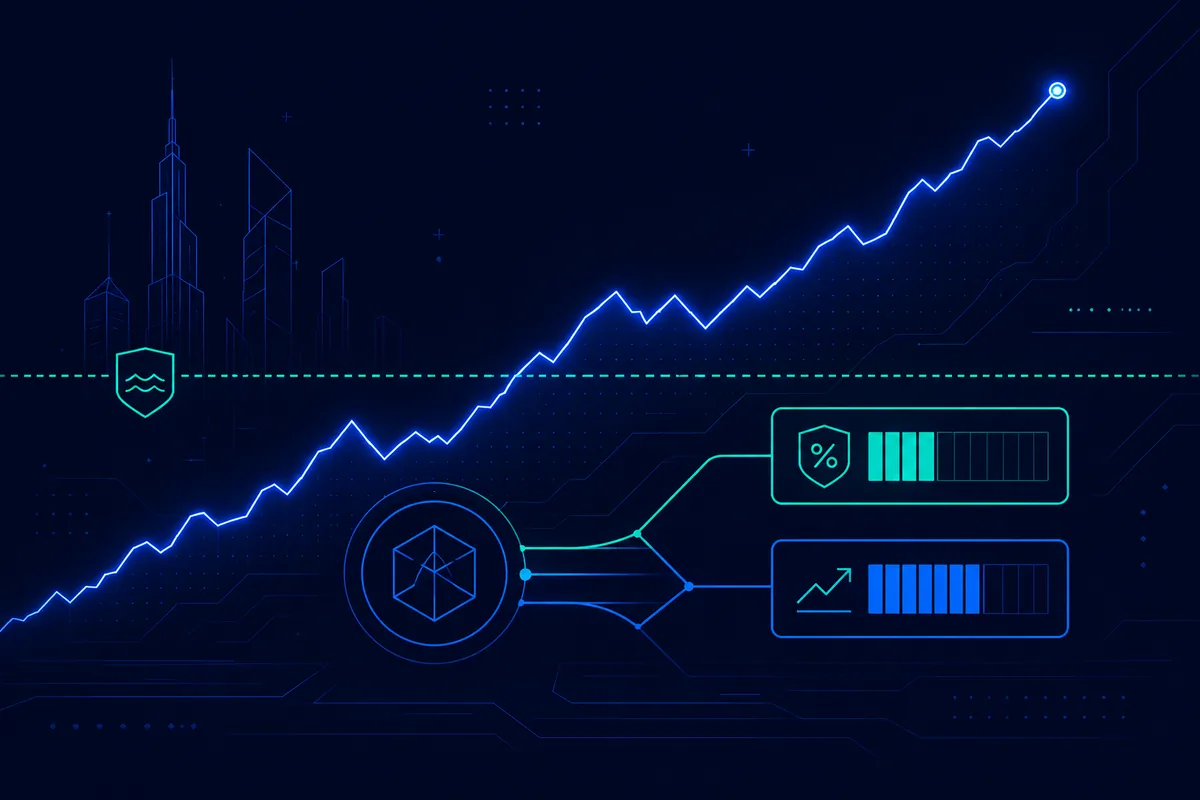
A high water mark means that after a drawdown, no performance fee is charged until the account’s previous peak is recovered. Without it, an investor pays twice for the same stretch of gains.
A worked example. The account gains twenty percent and the investor pays a performance fee. The account then falls twenty percent and rises twenty percent again. Without a high water mark the investor pays on the second rise as well, despite being roughly where they started.
The mechanism is especially visible on constructions with wide swings and full recoveries: across several cycles an investor pays for a result that, measured from the start, never appeared.

A second clarifying question: over what period is performance measured. Monthly, quarterly or annually. The shorter the period, the more often an investor pays for fluctuations rather than for outcomes. At identical annual returns, an account with high intra year volatility charged monthly gives up noticeably more than a smooth one, simply because positive months are billed and negative ones are not credited back.
A third question: how profit itself is defined. On closed trades or including open positions. A situation is possible where the fee is charged on closed profitable trades while a losing position sits open and outside the calculation.
Costs that are not called fees
Beyond the fund’s own fee, results are affected by costs that belong to no fund yet reduce the very same balance.
Exchange fees on every trade. This depends on strategy activity: a construction that trades frequently pays them many times over, and on high frequency approaches they can exceed all other costs combined.
Slippage, the gap between modelled and actual execution price. It never appears as a separate line in reporting, yet it is present in every trade and grows with position size.
Funding on perpetual contracts, a recurring payment between sides of the market. It does not appear in a trade report at all, and on positions held for weeks it becomes a visible expense, comparable to the management fee.
The cost of idle capital. If part of the funds must sit unused for readiness, the return on committed capital is lower than the return on the working portion.
The right question is therefore not “what is your fee” but “what result remains for the investor after all costs”. That is a single number, and it can be verified.
How to verify it yourself
Every deduction passes through the account and appears in operation history. That history can be exported and used to compute results including every charge, without relying on a supplied report.
We built IQ Metrics for this: the service connects through a read only key that can neither trade nor withdraw, and computes returns, drawdown and actual costs from the export. If the result in a report diverges from the result in operation history, that divergence is information in itself: most often it is methodology, and then it is worth establishing which one.
How to compare two offers
Comparing headline rates is useless, because identical percentages can sit on different bases.
Compare on four points at once:
The investor’s net result after all costs over an identical period.
Whether a high water mark applies.
How often the performance fee is accrued.
How profit is defined: closed trades only or including open positions.
An offer with a higher rate and a high water mark often proves cheaper over time than one with a low rate and none. This is especially visible on strategies with significant swings, where enough fall and recovery cycles accumulate over a few years.
What fee structure tells you
A useful side observation. The structure of compensation shows what the manager is incentivised to pursue.
A high management fee with a low performance fee means the main income comes from asset size rather than from results.
A performance fee with no high water mark creates an interest in amplitude: fluctuations are billed even when the net outcome is zero.
A performance fee with a high water mark and annual accrual comes closest to aligned interests, because what is paid for is the gain above the previous peak rather than the journey back to it.
This is not a selection criterion by itself, but a useful frame for the conversation.
In short
Fees consist of a management charge and a performance charge. The second requires clarifying three things: whether a high water mark applies, over what period performance is measured, and how profit is defined.
Beyond fund fees there are exchange costs, slippage, funding and the cost of idle capital, all reducing the same balance. The only question worth asking is what remains for the investor after everything, and that answer is verified from operation history.
Not an individual investment recommendation. Past performance does not guarantee future returns.
Frequently asked questions
What fees do investment funds charge?
Fund fees usually come in two parts: a management fee charged on assets regardless of returns, and a performance fee charged only on profits. Most unpleasant surprises appear around how that profit is defined.
What is a high-water mark?
A high water mark means no performance fee is charged after a drawdown until the account's previous peak is recovered. Without it, an investor pays twice for the same stretch of gains, including a rise that only returns the account to roughly where it started.
What hidden costs reduce fund returns?
Beyond the fund's own fee, results are reduced by exchange fees on every trade, slippage between modelled and actual execution price, funding on perpetual contracts and the cost of idle capital. None of them belongs to the fund, yet all reduce the same balance.
How do you compare the fees of two funds?
Comparing headline rates is useless because identical percentages can sit on different bases. Compare the net result after all costs over the same period, whether a high water mark applies, how often the performance fee is accrued and how profit is defined.