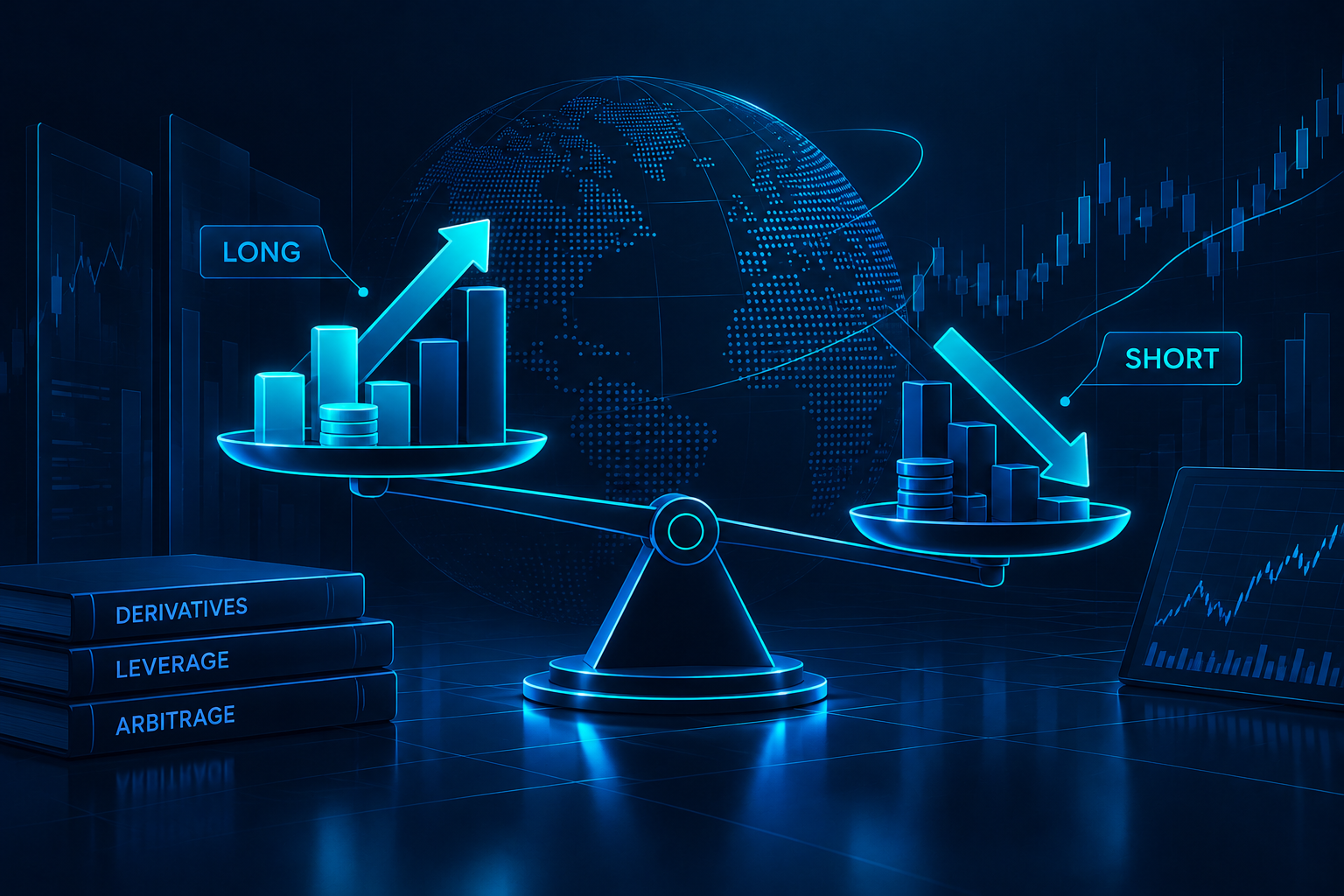
How algorithms make money in both rising and falling markets

In this article, we explain why market volatility is not a threat but an opportunity, how algorithmic strategies profit in both rising and falling markets, and how IQ Security Fund algorithms adapt to different market phases to protect capital and generate returns from price movements.
Why a market downturn is not always a problem
One of the most common questions crypto investors ask is:
“What happens if the market falls?”
This fear is understandable. Most people have experienced situations where:
- the market drops sharply,
- the portfolio goes into a deep drawdown,
- the only option is to wait and hope for a recovery.
But this logic applies only to the classic “buy and hold” approach.
In algorithmic trading, the situation is fundamentally different.
Professional algorithms do not depend on market direction. Their goal is to extract profit from price movement, not to guess whether the market will go up or down.
Long and short: the core principle of market neutrality
At the heart of most professional trading systems is the ability to operate in two directions:
- Long — earning from price increases
- Short — earning from price declines
In crypto markets, this is implemented through futures markets, where traders can:
- buy an asset if price growth is expected,
- sell an asset if a decline is expected.
For an algorithm, it makes no difference whether the market is rising or falling.
There is only movement, volatility, and statistical edge.
That is why algorithmic trading often delivers stable results during periods when the market looks “bad” for a traditional investor.
Why futures are not about risk, but about tools
For many people, the word “futures” is associated with high risk and speculation.
In practice, for funds and algorithms, futures are a management tool, not gambling.
Futures allow:
- opening short positions,
- hedging risks,
- reducing dependence on overall market direction,
- flexible exposure management.
It is important to understand:
risk is created not by the instrument itself, but by the lack of a system and control.
In algorithmic strategies, futures are used strictly within:
- predefined limits,
- mathematical models,
- automated risk management frameworks.
Adapting to market phases: why a strategy cannot be “always the same”
The market is never constant. It goes through different phases:
- sustained trends,
- sideways movement,
- sharp impulses,
- periods of stress and panic.
An algorithmic strategy must take this into account.
If a system trades the same way in every situation, it is a weak system.
Professional algorithms:
- reduce activity during dangerous phases,
- increase exposure when a statistical edge appears,
- can fully step aside and “wait” when the market offers no high-quality signals.
This adaptability is what distinguishes a fund-level approach from simple trading bots.
How this is implemented in IQ Security Fund strategies
IQ Security Fund uses a set of algorithmic strategies that:
- operate both long and short,
- adapt to current market volatility,
- strictly limit maximum drawdowns.
During crisis phases:
- position sizes are reduced,
- protective filters are activated,
- trading activity may be partially or fully scaled down if necessary.
The goal is not to “make money at any cost,” but to preserve capital and remain operational over the long term.
Example of algorithm behavior during a crisis
In simplified form, the logic may look like this:
- Sharp market reversal against an open position → the system reduces position size
- Market structure breakdown → trend signals are disabled
- Formation of a stable downward move → short strategies are activated
- Elevated uncertainty → partial or full exit from the market
All of this happens automatically — without emotions, panic, or manual decisions.
The key difference of the algorithmic approach
A manually trading investor is usually tied to a single scenario: market growth.
An algorithmic fund operates with a different mindset:
It doesn’t matter where the market goes. What matters is how it moves.
That is why algorithmic strategies:
- are less dependent on market cycles,
- handle crises more effectively,
- are suitable for investors who value structure and risk control.
Conclusion
A market decline is a risk only for those who do not know how to work with it.
Algorithmic trading:
- uses both rising and falling markets,
- adapts to different market phases,
- eliminates emotional decision-making,
- prioritizes capital protection over short-term profits.
If you are looking for an approach that does not rely on a single market scenario,
IQ Security Fund’s algorithmic strategies are designed exactly for that purpose.
Frequently asked questions
How can a trading algorithm make money when the market is falling?
It profits by taking short positions through futures markets, selling an asset when a decline is expected rather than only buying when growth is expected. Because the algorithm's goal is to extract profit from price movement rather than to predict direction, it makes no difference to the system whether the market is rising or falling, only that it is moving with enough volatility and statistical edge to trade.
Are futures too risky to use in a managed crypto strategy?
Not when they are used as a management tool rather than for speculation. In algorithmic strategies, futures are used within predefined limits and mathematical models to open short positions, hedge risk, and reduce dependence on overall market direction. The risk comes from a lack of system and control, not from the instrument itself.
How does an algorithmic strategy adjust its behavior across different market phases?
It changes its activity level depending on the phase rather than trading the same way at all times. Professional algorithms reduce activity during dangerous phases such as sharp impulses or panic, increase exposure when a statistical edge appears, and can fully step aside when the market offers no quality signals. A system that behaves identically in every situation is considered a weak system.
How do IQSF strategies respond during a market crisis?
They reduce position sizes, activate protective filters, and can partially or fully scale down trading activity when necessary. The strategies operate both long and short and adapt to current market volatility, with the goal of preserving capital and remaining operational long term rather than making money at any cost.