Long and short positions explained: how short selling works

In this article, we’ll explore how long and short positions work, how traders profit from rising and falling prices, what short selling and short squeezes are, why short positions carry potentially unlimited losses, and how combining long and short positions can help manage market risk.
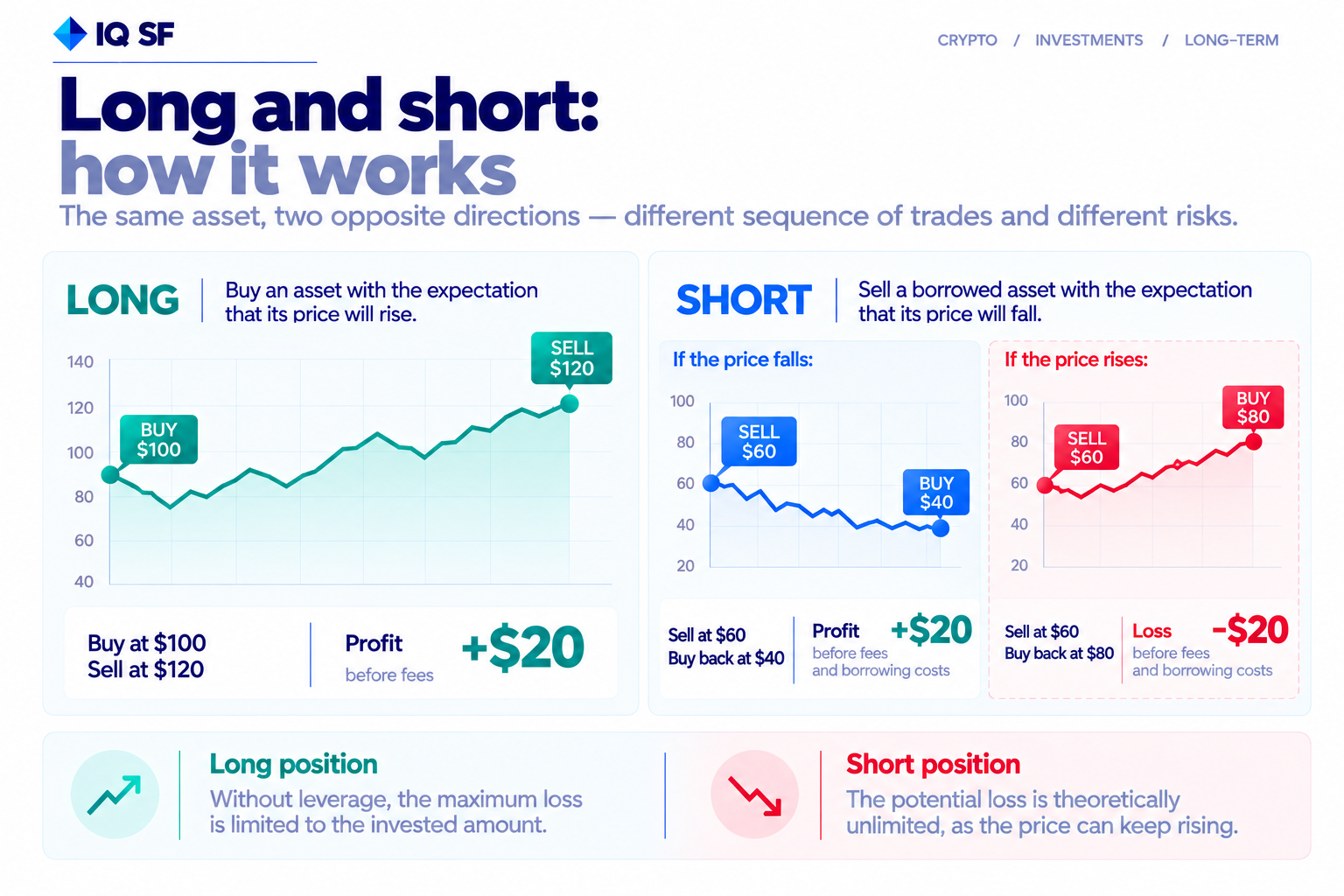
A long position is the purchase of an asset in the expectation that its price will rise: buy lower, sell higher. A short position is the sale of a borrowed asset in the expectation that its price will fall: you sell it now, buy it back later and return it, and if the price has dropped in the meantime, the difference is yours.
Direction is not the only difference: a long bought without borrowed money can lose at most the amount invested, a short can in theory lose without limit. A stock short costs a daily fee, while a perpetual futures short may pay or receive funding.
What is a long position and what is a short position
A long position gains when the price rises, a short position gains when it falls, and the result of both is the difference between the entry price and the exit price.
A long means buy first, sell later; a short reverses the order. Take a hypothetical case: an investor who expects Company A to fall borrows its shares at $60 and sells them. If the price drops to $40, the investor buys the shares back, returns them and keeps $20 per share before commissions and fees. If the price rises to $80 instead, the investor loses $20 per share.
How does short selling work
A classic short sale has three steps: the broker lends you shares, you sell them at the current price, and later you buy the same number of shares in the market and hand them back.
The borrowed shares come from the broker's own inventory, from the margin accounts of other clients or from another lender. The short seller pays interest on the loan and pays the lender any dividend distributed while the position is open.
The proceeds of the sale are not free cash. They stay in the account as collateral, and the broker requires the investor to add money of their own on top.
Shorting with futures and perpetual swaps
You can also go short without borrowing anything: sell a futures contract, an agreement settled at a price fixed when the trade is made.
The seller gains if the price of the underlying asset falls before the position is closed and loses if it rises. Profit and loss are settled in cash, and the exchange holds collateral called margin.
Most crypto shorts use perpetual futures, or perpetual swaps. They have no expiry date, and the funding rate keeps the contract price close to the coin price: on the BTCUSDT contract on Binance, one side pays the other every eight hours. When the contract trades well above the coin, longs pay shorts; when it trades well below, shorts pay longs; when the gap is small, the rate equals the base 0.01% per eight hours and longs pay.
By our calculation across all 7,715 funding payments on that contract from September 2019 to September 2026, longs were the paying side 85.8% of the time. Not always, though: on March 13, 2020, the rate hit its lower bound of -0.3% per eight hours, and shorts were the ones paying.
Risks of short selling
The core risk of a short position is asymmetry: a price cannot fall below zero, so the gain is capped at the sale amount, while the price, and therefore the loss, can keep rising.
A short can earn at most 100% of the sale amount, and only if the stock becomes worthless. If the price triples, the loss is 200% of the sale amount.
In a rising market, shorts get hurt more often. Bitcoin went from $4,261 on August 17, 2017 to $84,410 on September 24, 2026, almost a twentyfold rise. By our calculation on daily candles over the same period, a position with 3x leverage, no stop-loss and no added margin reached liquidation within a month in 7.1% of cases on the long side and in 15.0% on the short side, roughly twice as often.
Short squeezes and forced buy-ins
A short squeeze is a sharp price rise fuelled by short sellers themselves: to cap their losses or meet a margin call they buy the asset back, and their buying pushes the price even higher.
The best-known recent case is GameStop. According to the SEC staff report of October 2021, short interest in the stock reached 122.97% of the float in January 2021. The closing price went from just under $20 at the end of 2020 to $347.51 on January 27, 2021, and the next day it touched $483 during trading. The report concluded that a squeeze was not the main driver of the rally, but that in some periods short covering added to it. Melvin Capital, a fund with large short positions, lost 53% in January.
Volkswagen in October 2008 was an even sharper squeeze. On October 26, Porsche disclosed 42.6% of the ordinary shares plus cash-settled options on another 31.5%, and the state of Lower Saxony held about 20%, leaving a free float of 5.9% against short positions of about 13%. On October 28, the price passed 1,000 euros, up from 211 euros at the close on October 24, and Volkswagen briefly became the most valuable listed company in the world.
A short can also be closed by force without any squeeze: as the price rises, the broker issues a margin call, and if no money arrives, it buys the shares back at the market price. On crypto exchanges this is called liquidation and happens automatically; see our article on leverage and liquidation risk. Stocks add one more trigger: the lender can recall the shares, and if the broker finds no replacement, it closes the short on its own timing.
What it costs to hold a short
A stock short carries a borrow fee that accrues every day it stays open, while on perpetual futures the short side may either pay or receive the funding rate.
For stocks it is the borrow fee, an annual rate charged for every calendar day. For easy-to-borrow stocks it is low; for hard-to-borrow ones it can exceed 50% a year, and in May 2025 one US stock that had just soared carried a fee of 1,000% a year, close to 3% of the position's value per day. On top of that, the short seller pays the lender any dividends.
Long vs short: comparison table
Beyond direction, long and short positions differ in how much they can lose, what they cost to hold and what can close them by force.
Long position | Short position | |
Bet on | rising price | falling price |
First trade | buy | sell a borrowed asset or sell a contract |
Closing trade | sell | buy back and return the loan |
Maximum gain | unlimited | the sale amount, if the price falls to zero |
Maximum loss | the amount invested, without leverage | unlimited |
Holding cost | none when buying the asset itself without leverage; funding rate on a perpetual | borrow fee, dividends to the lender, funding rate |
Forced closing | only when bought with leverage | when collateral runs short; for stocks, also on a recall |
Why funds combine long and short positions
Holding long and short positions together makes the result less dependent on market direction: the loss on one side is partly or fully offset by the gain on the other.
The simplest case is a hedge: a bitcoin holder who fears a decline sells a futures contract on the same number of coins. If the price falls, the coins lose value while the short gains about the same amount, and vice versa, so the outcome depends on the gap between the contract and coin prices and on funding.
Pairs are more complex: a long in one asset and a short in a related one, betting on the ratio of their prices. How market-neutral strategies and arbitrage build on this is covered in our article on long-short and crypto arbitrage strategies.
The risk does not disappear. If the two legs sit in different accounts, a sharp rally can liquidate the short before the holder moves money from the profitable long.
This material is for information only and is not individual investment advice.
Frequently asked questions
What does it mean to go long or short?
Going long means buying an asset because you expect its price to rise. Going short means selling a borrowed asset because you expect its price to fall, then buying it back to return it.
How does a short seller make money?
The gain on a short is the sale price minus the buy-back price, less the borrow fee, any dividends paid to the lender and commissions. If the price rises instead, the same arithmetic produces a loss.
How much can you lose on a short position?
In theory there is no limit, because the price can rise several times over. In practice the broker closes the position when the collateral runs out, but after a sudden jump the loss can exceed the money deposited, and the investor owes the difference.
What is a short squeeze?
A short squeeze is a sharp price rise accelerated by short sellers rushing to buy back the asset. In January 2021, short interest in GameStop exceeded its float, and according to the SEC staff report, its close on January 27 was more than 1,600% above the close on January 11. The report found that the main driver of that rally was a wave of buying, with short covering only accelerating it on some days.
How long can you hold a short position?
A stock short has no end date: it stays open while margin is sufficient and the shares are not recalled, with the borrow fee accruing daily. A dated futures contract must be closed or rolled before expiry; a perpetual has no expiry but pays or receives funding.