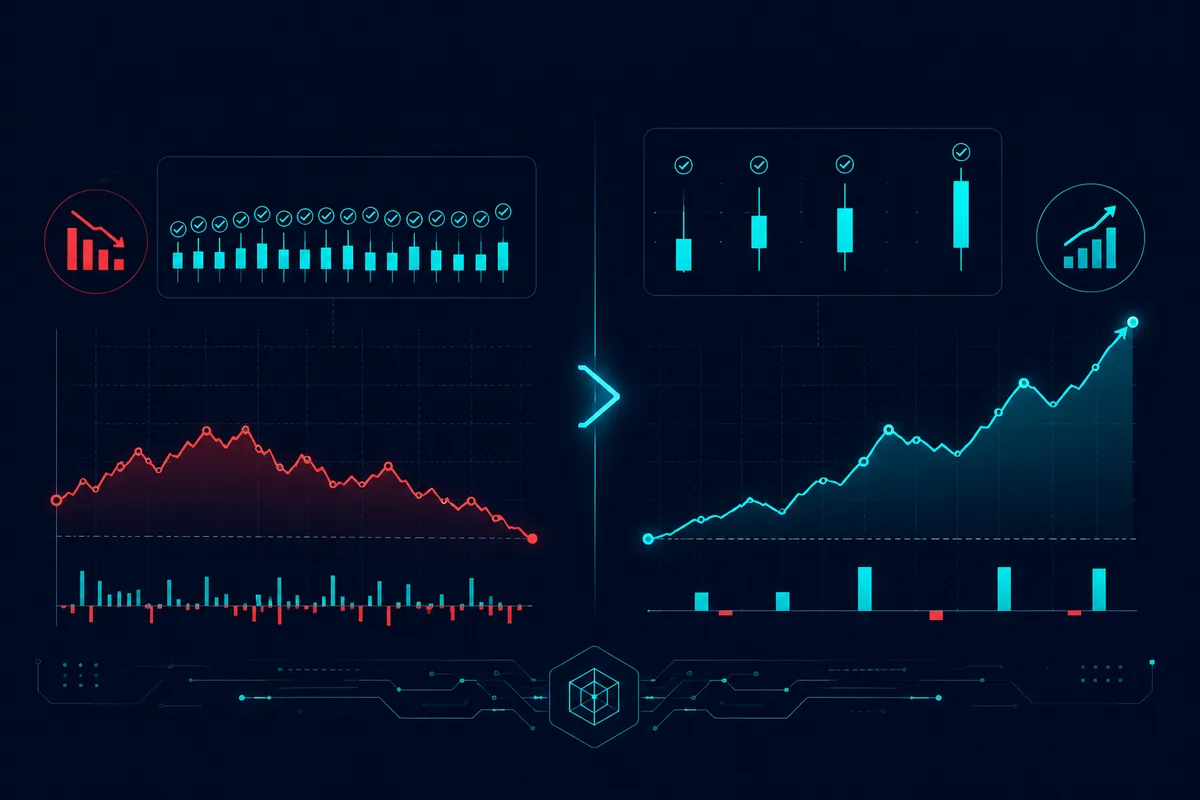
How funds manage losing streaks — and why they are inevitable
In this article, we explain why losing streaks are an inevitable component of any systematic strategy, how professional funds manage loss sequences, and why disciplined risk control matters more than attempting to eliminate drawdowns altogether.
In the investment world, losing streaks are often perceived as a sign of a flawed strategy or poor management. For retail investors, they frequently become a trigger for emotional decisions and premature exits.
In professional capital management, the perspective is fundamentally different: losing streaks are viewed as a statistically inevitable component of any systematic strategy.
Understanding the nature of loss streaks is one of the key factors behind a fund’s long-term resilience.
Losing streaks as statistical reality
Algorithmic strategies do not operate on guaranteed outcomes — they operate on probabilities and mathematical expectancy. Even strategies with positive expectancy inevitably experience periods when:
- the market does not provide favorable conditions,
- signals underperform their historical average,
- trade sequences unfold unfavorably.
This is not a failure of the algorithm, but a normal manifestation of randomness within a probabilistic framework.
Importantly, the absence of losing streaks over a long horizon is more of an anomaly than a strength.
Why attempts to “avoid losses” increase risk
Many retail strategies aim to minimize the number of losing trades. In practice, this often leads to:
- averaging against the market,
- increasing position size after losses,
- artificially smoothing returns.
Such approaches can create an illusion of stability, but at the cost of accumulating hidden risk. When an adverse scenario eventually materializes, that risk is realized abruptly — through sharp drawdowns or liquidity stress.
Professional funds do not attempt to eliminate losses as a category. They focus on limiting their impact.
How funds manage losing streaks
The core objective of risk management is not to predict when a losing streak will begin, but to ensure it never becomes critical to the capital base.
Within an institutional framework, this is achieved through:
- strict per-trade risk limits,
- caps on aggregate portfolio risk,
- correlation control across strategies,
- reduced trading activity during unfavorable market regimes.
As a result, losing streaks are treated as controlled scenarios rather than emergencies.
Market regimes and performance cycles
Most algorithms perform effectively only under specific market conditions. For example:
- momentum and impulse-based strategies thrive during directional moves and volatility expansions;
- their efficiency declines in range-bound or low-liquidity environments.
During such phases, the probability of sequences of small losses increases. This does not mean the strategy is “broken” — it means the market is temporarily not compensating the selected type of risk.
Professional funds account for this by adjusting activity levels rather than attempting to “trade through” unfavorable conditions.
Why losing streaks are psychologically difficult — but logically necessary
For investors, losing streaks often appear as a deterioration in management quality. In reality, they are a consequence of discipline:
- trades are closed according to predefined rules,
- risk is realized, not deferred,
- the strategy does not deviate from its model for short-term comfort.
Paradoxically, strategies that appear to avoid short-term losses are often the most fragile over the long run.
IQ Security Fund’s approach to loss streak management
At IQSF, losing streaks are treated as part of the expected return distribution — not as system failures.
In practice, this means:
- each trade carries a predefined risk limit;
- losses are capped and do not compound exponentially;
- strategy activity is reduced during unfavorable market phases;
- daily PnL is recorded continuously, allowing analysis not only of returns, but also of volatility structure and loss dynamics.
This approach enables the strategy to preserve both capital and structural integrity during periods when the market offers limited profit opportunities.
Why the absence of losing streaks is a warning sign
If a strategy exhibits:
- near-complete absence of losing periods,
- perfectly smoothed returns,
- stable profits regardless of market conditions,
it raises legitimate questions about the nature of the underlying risk.
Often, such profiles rely on mechanisms that defer losses into the future, increasing the likelihood of rare but destructive events.
Conclusion
Losing streaks are not a sign of strategic weakness — they are an unavoidable consequence of operating within probabilistic systems.
The quality of a fund is not defined by its ability to avoid loss streaks, but by:
- how controlled those streaks are,
- their depth and duration,
- whether the strategy’s mathematical expectancy remains intact,
- whether capital is preserved during adverse market phases.
This disciplined, systematic approach lies at the core of IQ Security Fund’s investment philosophy.
Frequently asked questions
Why do trading strategies go through losing streaks?
Losing streaks happen because algorithmic strategies operate on probabilities and mathematical expectancy rather than guaranteed outcomes. Even a strategy with positive expectancy will face periods when the market does not provide favorable conditions or signals underperform their historical average. This is a normal manifestation of randomness, not a sign that the algorithm has failed.
Why is a strategy with no losing periods a warning sign?
A strategy with almost no losing periods and perfectly smoothed returns raises legitimate questions about its hidden risk, since the absence of losing streaks over a long horizon is more of an anomaly than a strength. Such profiles often defer losses into the future, which raises the chance of a rare but destructive event. Professional funds do not try to eliminate losses; they focus on limiting their impact.
How do professional funds control losing streaks?
Professional funds limit the impact of losing streaks through strict per-trade risk limits, caps on aggregate portfolio risk, correlation control across strategies, and reduced trading activity during unfavorable market regimes. The goal is not to predict when a losing streak begins, but to ensure it never becomes critical to the capital base. This turns losing streaks into controlled scenarios rather than emergencies.
How does IQSF manage losing streaks?
At IQSF, losing streaks are treated as part of the expected return distribution rather than as system failures. Each trade carries a predefined risk limit, losses are capped instead of compounding, and strategy activity is reduced during unfavorable market phases. Daily PnL is recorded continuously, which allows analysis of volatility structure and loss dynamics, not only returns.