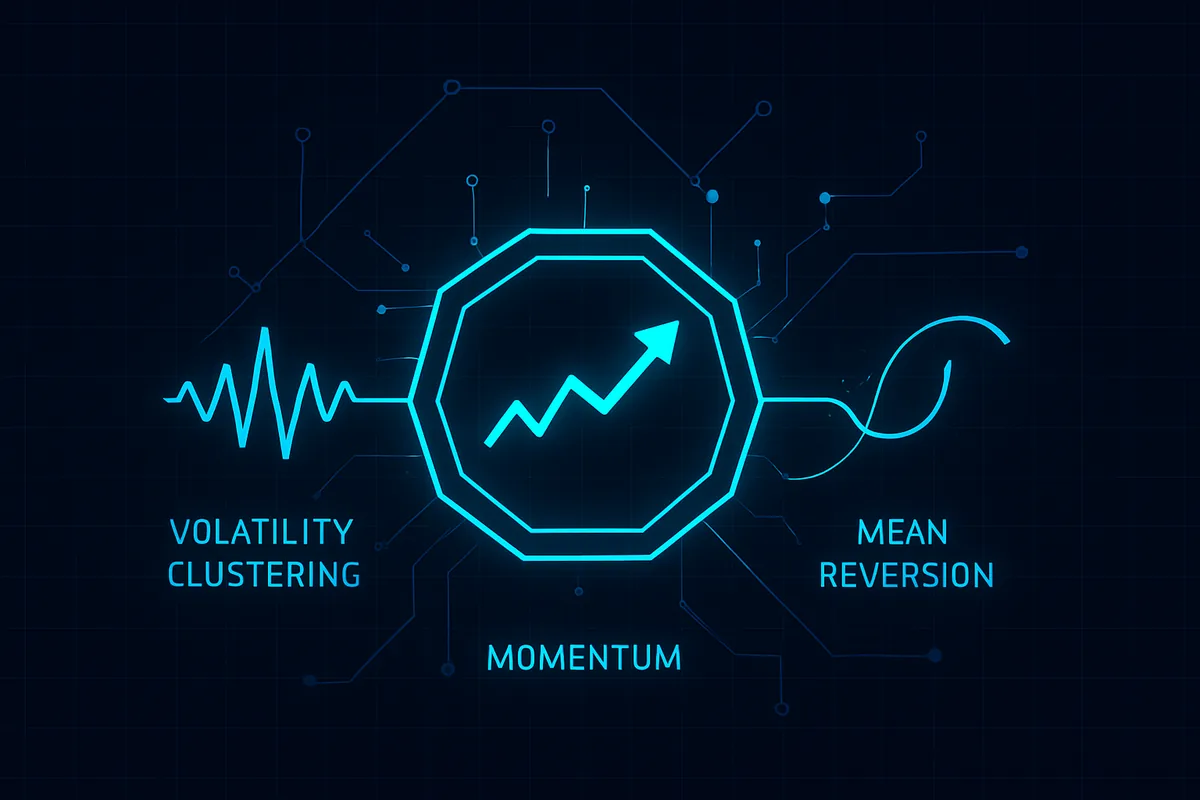
Key elements of IQSF algorithmic trading: momentum, volatility clustering, mean reversion. Their balance is the foundation of sustainable profitability
In this article, we break down how the three core market effects — momentum, volatility clustering, and mean reversion — form the foundation of sustainable profitability. You’ll learn why no single strategy can survive the crypto market, how IQSF algorithms adapt to shifting regimes, and how mathematical balance reduces risk while enhancing returns.
Why algorithmic trading has become the standard
The cryptocurrency market is too fast and too unpredictable for manual decision-making.
Prices can rise or fall by tens of percent within minutes, and human reaction is always delayed.
Algorithmic trading solves these problems by:
- automating decision-making,
- removing emotional bias,
- analyzing massive datasets,
- reacting to market conditions within milliseconds.
But algorithmic profitability is not magic — it is built on mathematical models.
Three fundamental components:
- Momentum (trend effect)
- Volatility clustering
- Mean reversion
Their balance is the key to sustainable returns and reduced risk.
Momentum: When Movement Continues Movement
Momentum strategies assume that when an asset starts trending, it is likely to continue.
In crypto this is especially relevant: impulses often arise from news, liquidations, and capital inflows.
Why it works:
- markets are inefficient,
- traders react too late,
- trends are fueled by liquidations and market orders.
Pros of momentum:
- high return potential
- captures strong directional moves
- quickly exploits market inefficiencies
Cons:
- large drawdowns during reversals
- requires filters and stop-losses
In IQSF algorithms, momentum trading is one of the core components responsible for capturing trends during periods of strong directional movement.
Volatility clustering: volatility is not chaos — it is structured chaos
In crypto, volatility is almost never evenly distributed.
It appears in clusters — periods of sharp spikes followed by calm conditions.
This phenomenon is called volatility clustering.
Why traders must account for clusters:
- strategies behave differently in low vs. high volatility
- risk changes dynamically
- position sizing must be adaptive
How algorithms use volatility clusters:
- increase leverage during low-volatility regimes
- reduce exposure when explosive moves begin
- select optimal strategy types depending on market mode
Simple example:
When Bitcoin is range-bound, mean reversion performs well.
When momentum surges — momentum strategies dominate.
The challenge is knowing when to use what.
Mean reversion: markets prefer equilibrium
Mean reversion strategies assume that after sharp deviations, price tends to return to its average.
Why it works:
- liquidity flows back in
- arbitrage smooths out imbalances
- panic-driven moves are usually short-lived
Pros:
- stable returns
- low drawdowns with proper risk design
- particularly effective in calm markets
Cons:
- frequent stop-outs during strong trends
- requires strict risk limits
Mean reversion is the foundation of stable, “smooth” profitability when markets are not aggressively trending.
Core idea: The balance of strategies, not the search for a ‘perfect algorithm’
The most common mistake among beginners is trying to build a “universal strategy.”
But the market is never constant.
Strategies must adapt to:
- trends
- reversals
- low volatility
- high volatility
This is why professional funds use a portfolio of algorithms, not a single “ideal” one.
Combination:
| Market State | Optimal Approach |
| Strong trend | Momentum |
| Explosive volatility | Volatility filters |
| Sideways range | Mean reversion |
How IQ Security Fund achieves this
IQSF algorithms are built on a combination of methods:
- Trend and impulse detection (momentum)
- Volatility filtering with dynamic risk adjustment
- Mean reversion methods for quiet market regimes
This approach provides:
- profit during trending phases
- profit during sideways markets
- controlled risk during chaotic periods
Our objective is not to “catch the absolute top,”
but to extract profit across different market phases with predefined risk and stable returns.
Advantages of an algorithmic model over manual trading
A manual trader cannot:
- use multiple models simultaneously,
- assess volatility in real time,
- react with microsecond latency,
- remain emotionally neutral.
An algorithm can.
As a result:
- lower drawdowns
- more stable profit distribution
- minimal emotional influence
Conclusion: stability matters more than peak performance
Short-term booms can be achieved with any aggressive strategy.
But sustainable profitability comes from:
- model diversification
- volatility control
- adaptive risk
- mathematics, not emotions
IQ Security Fund provides access to an automated trading system that:
- operates 24/7
- balances multiple algorithms
- reduces risk by adapting to market regimes
- delivers stable annual returns of 80–120%
Join us — and earn profits based on mathematics, not emotions.
Frequently asked questions
What is momentum trading and why does it work in crypto markets?
Momentum trading assumes that once an asset starts trending, it is likely to keep moving in that direction. It works because crypto markets are inefficient, traders often react late to news, and trends are fueled by liquidations and market orders, though the approach also carries large drawdowns during reversals and needs filters and stop-losses to manage that risk.
What is volatility clustering in crypto trading?
Volatility clustering means that volatility does not spread evenly over time but appears in clusters, periods of sharp spikes followed by calmer conditions. Because strategies behave differently in low and high volatility, algorithms adjust by increasing leverage during calm regimes and reducing exposure when explosive moves begin, choosing the strategy type that fits the current market mode.
What is mean reversion and when does it work best?
Mean reversion assumes that after a sharp deviation, price tends to return toward its average, and it works because liquidity flows back in, arbitrage smooths out imbalances, and panic-driven moves are usually short-lived. It performs particularly well in calm, range-bound markets, while strong trends cause frequent stop-outs and require strict risk limits.
Why do professional funds combine several trading strategies instead of using one?
Because the market is never constant, moving between trends, reversals, low volatility, and high volatility, and no single strategy performs well in every regime. IQSF combines momentum for trending phases, volatility filtering for chaotic periods, and mean reversion for quiet, range-bound markets, aiming to extract profit across different conditions with predefined risk rather than chasing one perfect approach.