Why high returns are not the main indicator of a good strategy
In this article, we explore why high returns alone do not define a strong investment strategy, how risk and drawdowns shape true performance, and why professional funds prioritize stability and risk-adjusted returns. We also highlight how the IQ Security Fund approach delivers resilient capital growth even in challenging market environments.
In the investment world, especially in cryptocurrencies, attention is most often drawn to eye-catching numbers: +200%, +300% per year, “outperforming the market several times over.”
At first glance, such results look impressive. However, for professional investors and funds, high returns alone are not a measure of strategy quality. What matters far more is how those returns were achieved and at what cost in terms of risk.
Return and drawdown: two sides of the same result
Return reflects the final financial outcome over a given period.
Drawdown (maximum drawdown) shows how deeply capital declined during the process of achieving that return.
A strategy may deliver a strong final result while:
- experiencing deep declines,
- spending long periods in losses,
- requiring a high level of psychological resilience from the investor.
In professional capital management, drawdown is no less important than return, because it defines the risk of capital loss and the resilience of a strategy under stressful market conditions.
Stability matters more than one-off success
A single period of high returns is often the result of:
- a favorable market regime,
- concentrated risk,
- a short-term alignment of factors.
Such results are difficult to replicate and even harder to scale.
A high-quality strategy, by contrast, demonstrates:
- consistent performance,
- controlled return volatility,
- the ability to operate across different market phases.
It is stability over time—not a one-time record—that signals a mature investment approach.
Why +300% in a year is a red flag
Returns of +200–300% over a short period almost always imply excessive risk-taking. Behind such figures, one often finds:
- deep drawdowns (50–70% or more),
- strong dependence on a single market scenario,
- lack of robust risk management.
For funds and institutional investors, this risk profile is unacceptable. The goal of professional management is not to maximize returns at any cost, but to ensure controlled capital growth with a predictable level of risk.
What funds actually look at: risk-adjusted returns
In professional investing, the key benchmark is risk-adjusted return—returns evaluated in relation to the risk taken.
One of the primary metrics is the Sharpe Ratio, which measures how much excess return a strategy generates per unit of risk.
As a general reference:
- Sharpe > 1 — good
- Sharpe > 2 — excellent
- Sharpe > 3 — rare for real-world (non-theoretical) strategies
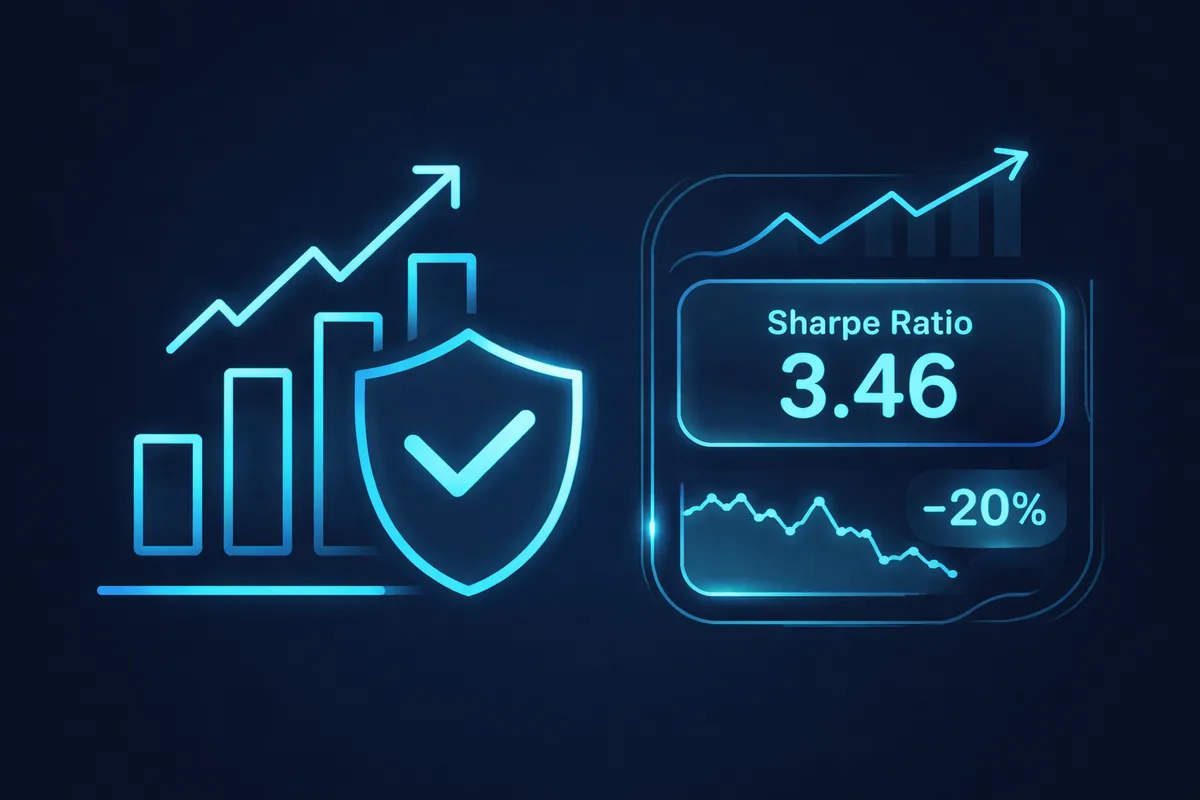
The IQ Security Fund strategy has a Sharpe Ratio of 3.46, indicating high algorithmic efficiency combined with controlled volatility.
Equally important is maximum drawdown.
For IQSF, the maximum recorded drawdown is −19.98%, a moderate level for the crypto market and a clear reflection of capital protection being prioritized even under unfavorable market conditions.
IQSF Philosophy: capital protection first
The IQ Security Fund approach is based on the principle that long-term results are achieved through discipline, not aggression.
IQSF strategies:
- are built on algorithmic models incorporating momentum, volatility clustering, and mean reversion,
- adapt to different market regimes,
- employ strict risk management and exposure limits,
- focus on resilience rather than short-term records.
High Sharpe ratios and limited drawdowns are a consequence of this philosophy—not an end in themselves.
Conclusion
High returns without considering risk provide an incomplete picture.
The true quality of a strategy is revealed by how it behaves across different market conditions, how well losses are controlled, and how stable results are over time.
For investors focused on long-term capital management, these factors are what truly matter.
Frequently asked questions
Why isn't a high past return enough to judge whether a strategy is good?
Because return only shows the final outcome, while drawdown shows how deeply capital fell along the way, and a strategy can post a strong result while still enduring deep declines and long loss periods. A single high-return period is often the product of a favorable market regime or concentrated risk rather than a repeatable, scalable edge.
Why is a return of 200 to 300 percent in a year considered a warning sign?
Because returns that high over a short period almost always imply excessive risk-taking. Behind such figures there is typically a deep drawdown of 50 to 70 percent or more, strong dependence on a single market scenario, and a lack of robust risk management.
What is the Sharpe ratio and why do professional funds rely on it?
The Sharpe ratio measures how much excess return a strategy generates per unit of risk taken, giving a risk-adjusted picture instead of a raw return figure. As a general reference, a Sharpe ratio above 1 is considered good, above 2 excellent, and above 3 is rare for real-world strategies.
How are IQSF strategies built to keep drawdowns limited?
IQSF works on the principle that long-term results come from discipline, not aggression. Its strategies are built on algorithmic models that use momentum, volatility clustering and mean reversion, adapt to different market regimes, apply strict risk management and exposure limits, and aim for resilience rather than short-term records. A high Sharpe ratio and limited drawdowns are a consequence of this approach, not a goal in themselves.