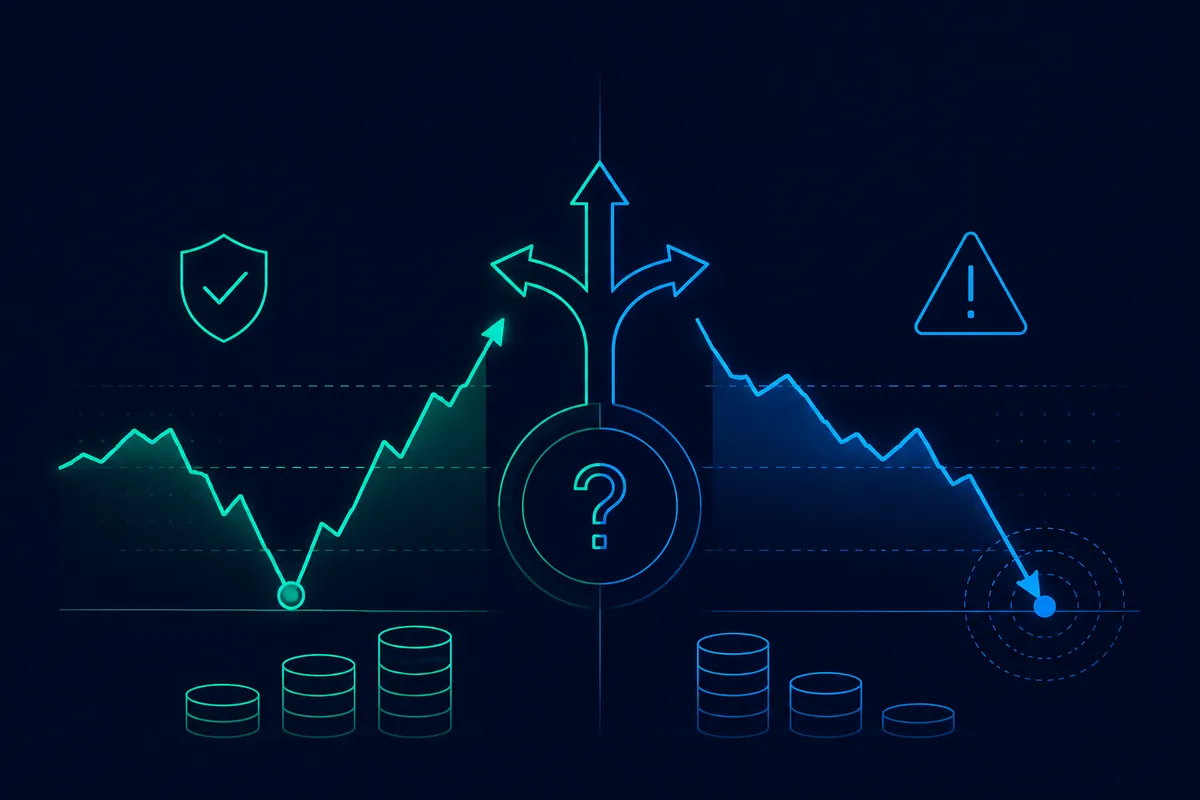
Why the absence of trades is also an investment decision

In this article, we explore why staying out of the market can be a deliberate investment decision, how systematic strategies avoid unfavorable market regimes, and how IQ Security Fund’s risk-driven approach helps preserve capital and long-term performance.
In the investment community, there is often an expectation that a strategy should be constantly active. A lack of trades is perceived as a missed opportunity or as insufficient system efficiency. However, in professional capital management a different principle applies: the decision not to trade at a given moment is a deliberate investment decision, directly linked to risk management and the preservation of a strategy’s expected value.
For systematic and algorithmic strategies, the ability to stay out of the market is no less important than executing a correct entry.
The market does not always create conditions for profit
Financial markets constantly change their state. Periods of high volatility and directional moves are replaced by phases of sideways markets, reduced liquidity, or heightened uncertainty.
An algorithmic strategy generates profits only in those market regimes where its statistical edge exists. When the market moves outside these conditions, trading ceases to be a source of returns and instead increases risk.
In such periods, the absence of trades does not represent passivity, but a conscious refusal to participate in an environment with negative expected value.
When trading reduces rather than improves results
There are market situations in which even model-correct signals do not lead to sustainable profitability. These situations include periods of:
- low or compressed volatility,
- chaotic price movement without clear structure,
- unstable liquidity,
- a high proportion of false impulses.
Under such conditions, active trading typically leads to higher transaction costs and an increased probability of loss streaks. A systematic approach implies reducing activity or completely refraining from trading until the market environment normalizes.
The role of trading filters in systematic strategies
Professional algorithmic strategies do not react to the market mechanically. They employ a set of trading filters that determine whether market participation is permissible.
These filters take into account:
- the level and structure of volatility,
- liquidity conditions,
- the current market regime,
- correlations between instruments,
- the degree of uncertainty and anomalies.
If the market does not meet predefined criteria, the strategy deliberately stays out of the market, preserving capital and reducing the likelihood of adverse scenarios.
Activity is not the same as effectiveness
Trade frequency is often perceived as a sign of a “working” strategy. In practice, effectiveness is determined not by the number of operations, but by their quality and alignment with market conditions.
Excessive activity:
- increases commission costs,
- amplifies the impact of slippage,
- raises the probability of psychological and statistical errors.
Systematic trading focuses on selectivity rather than constant market presence.
The IQ Security Fund approach
At IQ Security Fund, trading strategies operate within a strict risk-management architecture. Algorithms are not required to be constantly in the market and do not seek activity at any cost.
As uncertainty increases or market structure deteriorates, strategy activity is reduced. In unfavorable regimes, trading may be completely suspended. During such periods, the priority is capital protection and preserving the strategy’s potential for future market phases, rather than attempting to extract short-term returns.
Psychology and the maturity of the investment approach
The absence of trades often causes discomfort, especially when the market is moving. However, for a professional investor this is a sign of system maturity.
A strategy capable of temporarily staying out of the market typically demonstrates more stable long-term results. It avoids trading under unfavorable conditions and remains ready to operate when the market once again begins to “pay” for risk.
An investment decision is not only about market entry
The absence of trades is not a mistake or inaction. It is the result of:
- filtering market conditions,
- disciplined risk management,
- an understanding of the probabilistic nature of trading.
The quality of a systematic strategy is defined not by constant activity, but by its ability to make balanced decisions—including the decision to remain out of the market temporarily.
This approach forms the foundation of the investment philosophy of IQ Security Fund.
Frequently asked questions
Why would a trading strategy deliberately choose not to trade?
A strategy stays out of the market when conditions fall outside the regimes where it has a real statistical edge, since trading there would raise risk instead of generating returns. This applies especially during low or compressed volatility, chaotic price movement, unstable liquidity, or a high share of false impulses. In professional capital management, this counts as a deliberate decision, not passivity or a missed opportunity.
What are trading filters and what do they check before a strategy trades?
Trading filters are the criteria a systematic strategy checks before deciding whether market participation is allowed: volatility level and structure, liquidity conditions, the current market regime, correlations between instruments, and the degree of uncertainty or anomalies. If the market fails these criteria, the strategy stays out to preserve capital and reduce adverse scenarios. This makes participation selective, not constant.
Does more trading activity mean a strategy is more effective?
No, effectiveness is determined by the quality of trades and how well they match market conditions, not by how often a strategy trades. Excessive activity increases commission costs, amplifies the impact of slippage, and raises the probability of psychological and statistical errors. Systematic trading favors selectivity over constant market presence for exactly this reason.
How does IQ Security Fund handle periods when it is better not to trade?
At IQ Security Fund, algorithms are not required to stay constantly active and do not pursue trading activity at any cost. As uncertainty increases or market structure deteriorates, strategy activity is reduced and can be suspended completely during unfavorable regimes. During such periods, the priority shifts to protecting capital and preserving the strategy's potential for future market phases rather than chasing short-term returns.