Portfolio diversification: five myths that cost money

In this article, we’ll explore why diversification is not about the number of assets in a portfolio, how correlations can break down in a crisis, and why real portfolio protection depends on independent sources of return, position sizing, and disciplined risk management.
When the “impossible” happened to everyone at once
In the autumn of 1998, one of the most respected hedge funds in the world ceased to exist within a matter of weeks. It was called Long-Term Capital Management.
Its team included two future Nobel Prize winners in economics, a former vice chairman of the Federal Reserve, and some of the best quantitative analysts on Wall Street. Their models described the market with a level of precision that many envied.
The fund held many positions that, from a statistical point of view, appeared weakly connected to one another: different countries, different instruments, different bonds. According to their mathematics, the risk was spread so thinly that a catastrophe was considered an event that could happen once in several thousand years.
Then Russia defaulted, and panic swept through global markets. Investors around the world rushed to sell anything that carried even the slightest amount of risk.
And then an unpleasant truth became clear. Positions that had moved independently in calm periods suddenly started falling together, synchronously, as if they were one single asset. The “unrelated” bets turned out to be connected by one common force: fear.
The same thing happened again ten years later, only on a much larger scale. In 2008, investors who held twenty “different” stocks and believed they were protected discovered that their portfolio was falling almost exactly as much as the index.
Not because the stocks were chosen badly, but because in a crisis twenty names had turned into one single bet.
If some of the smartest people on the planet, with some of the best models, were wrong about the most important thing, the issue is not intelligence. The issue is that several persistent myths have grown around diversification*.
Let us break them down one by one: what is myth, and what is fact.

Myth: Twenty stocks are safer than ten, and fifty are safer than twenty. The more baskets you have, the lower the chance of dropping all the eggs at once.
Fact: safety is measured not by the number of positions, but by the correlation* between them.
Correlation is a measure of how much assets move together. A value close to zero means they move independently. A value close to one means they move almost as one: up together, down together.
Twenty stocks from the same market, traded on the same exchange and reacting to the same news about interest rates, inflation, and the economy, are not twenty different bets.
They are one bet in twenty wrappers.
Their correlation with one another is already high in normal conditions and becomes almost complete in a crisis. You can hold Apple, an oil company, and a supermarket chain and think that the risk is spread across sectors. But when the market falls by forty percent, all three can fall together because they share the same driver: overall market sentiment.
There is also an honest academic caveat here. Classic studies showed that adding stocks reduces portfolio volatility, but only up to around thirty or forty securities. After that, the effect almost disappears: the thirty-first stock changes almost nothing.
And even that mathematics removes only the specific risk of an individual company, not the risk of the whole market.

Myth: During a storm, a basket of different assets is exactly what saves you. Something falls, something compensates, and the portfolio holds up.
Fact: correlation between assets is not constant, and it changes in the worst possible direction at the worst possible moment.
In calm periods, different stocks live their own lives. One company reports strong results and rises. Another disappoints and falls.
But in a panic, a different logic takes over. Investors stop looking at details and start selling everything in order to move into cash. Prices fall together, regardless of asset quality, and correlation jumps toward one.
The protection disappears exactly when investors expect it to work.
Let us put this into numbers, without charts or tables. Imagine a portfolio split into two equal halves. In calm conditions, their correlation is close to zero, so they move independently.
If one half falls by ten percent, the other half, on average, stays flat, and the whole portfolio loses about five percent. Volatility is reduced, just as promised.
Now compress the same structure into a crisis, where correlation has moved close to one. Both halves fall together by the same ten percent, and the portfolio loses the full ten percent.
The same structure that softened the blow by half in calm conditions does not soften anything in panic. Diversification has not “weakened”. It has simply stopped existing at the exact moment when investors expected it to work.
Myth: Technology, energy, and consumer goods are three independent sectors, so a portfolio made of them is protected from the failure of any one sector
Fact: in a systemic risk-off* environment, everything is sold at the same time, and sector boundaries disappear.
In 2008, correlation between stocks from different sectors rose to roughly 0.85. This means that technology, energy, and consumer goods were falling almost as one single unit.
In the spring of 2020, the equity market lost around a third of its value within a few weeks, and a portfolio of twenty “diversified” stocks fell almost exactly as much because correlation between them surged again to similar levels.
Different sectors are still the same risk: the risk of the overall equity market.
They share a common driver, and in a systemic crisis that driver outweighs all industry differences. In a rising market, any basket of similar assets can look brilliant.
The true face of a portfolio is revealed only in March 2020 or in 2022, when it becomes clear how many truly independent supports it actually has.
Myth: The classic “stocks plus bonds” combination always works. Stocks fall, bonds rise, and one offsets the other.
Fact: there are periods when both fall at the same time.
In 2022, even the familiar combination of stocks and bonds broke down: both asset classes declined simultaneously, something that had not happened for decades.
The reason was the same as everywhere else: that time, they had a common driver, rising interest rates caused by inflation. When the driver is the same, the negative correlation that everyone counted on disappears.
This does not mean that bonds are useless or that the same situation will repeat tomorrow. We are not making forecasts here.
It only means that the historical relationship “stocks down, bonds up” is not a law of nature. It is an observation that stops working in certain regimes.
Any protection you consider automatic should be tested with one question: what do these two assets have in common, and could that common factor one day pull them in the same direction?
Myth: Diversification means collecting as many different assets, classes, and names as possible. The longer the list, the better.
Fact: real diversification is about uncorrelated sources of return, not the length of the list.
Ten ETFs with different names, countries, and industries, all earning from the same rise in the equity market, are one risk with ten labels.
Real protection is built differently, and it rests on three things.
First: uncorrelated sources of income.
This does not mean different names. It means different mechanisms of earning returns.
A strategy that captures persistent trends, including downward trends, rather than betting only on growth. An approach that keeps part of the portfolio in cash in order to act when others are panicking.
When sources of return have a different nature, their correlation remains low even in a crisis because they are driven by different forces.
Second: position sizing.
Even a good set of assets will not help if too much capital is concentrated in one idea and its failure breaks the whole portfolio.
No single position and no single source of risk should be so large that one bad scenario knocks the portfolio out of the game.
Survival matters more than squeezing out the maximum return in a good year, because a deep drawdown* is mathematically harder to recover from than it seems: a portfolio that falls by half must then grow by one hundred percent just to return to its starting point.
Third: honest readiness for a scenario where everything falls together.
A mature approach does not pretend that a crisis is impossible. It calculates in advance how the portfolio may behave when correlations move toward one.
This is exactly what matters when several strategies with different natures are combined. If they are truly weakly connected to one another, their combined result becomes smoother than each individual strategy on its own, and the failure of one does not mean the failure of the whole.
This is the logic of a systematic, multi-strategy approach that we use in the fund’s work. It is not a promise that drawdowns will not happen. No one can avoid them completely. It is an attempt to make sure they do not all arrive at the same time and through the same door.
Short conclusion for the investor
Diversification is not the number of rows in your spreadsheet.
It is how the portfolio behaves on the day when it hurts the most.
Twenty stocks from the same market reduce the risk of a single company, but they do not remove the risk of the overall market. And that is exactly the risk that determines the fate of a portfolio in a crisis.
Real protection is measured not by the number of names, but by low correlation between sources of return, disciplined position sizing, and an honest calculation of a scenario in which everything falls at once.
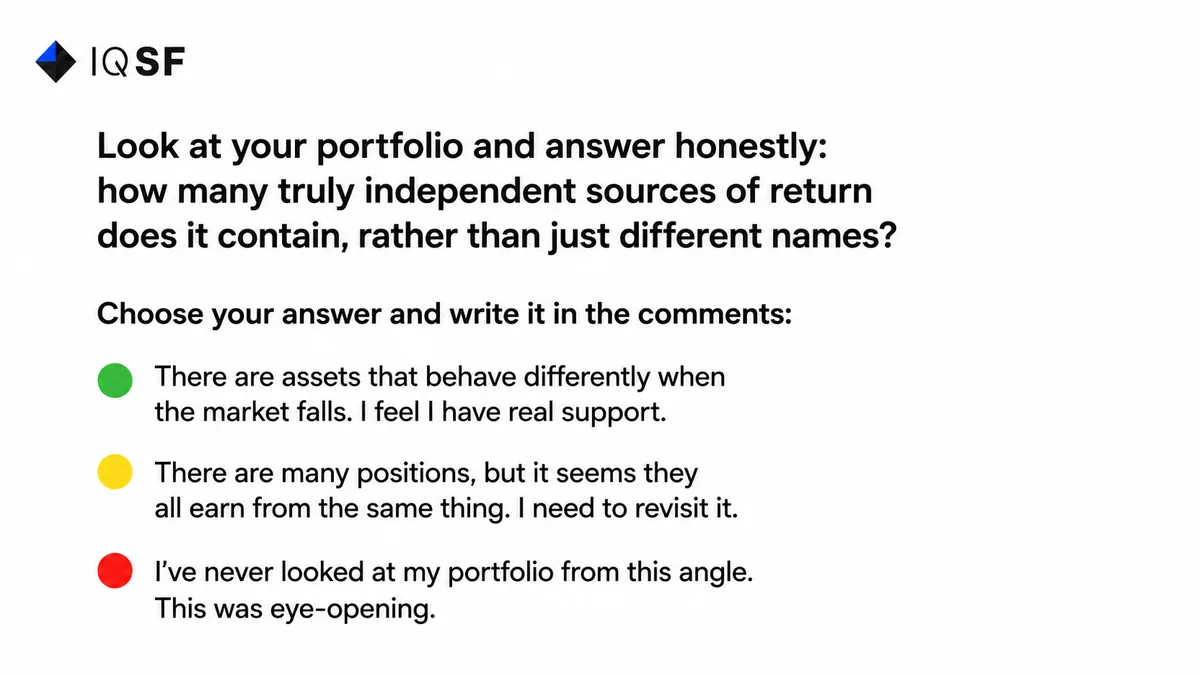
Test your portfolio not during growth, but against an imagined decline.
If there is not a single support inside it that behaves differently from the rest, it is not a diversified portfolio. It is one bet in a beautiful wrapper.
Glossary
Diversification* is the allocation of capital across different assets in order to reduce overall portfolio risk. The key nuance: it only works when the assets are weakly connected to one another, not when they simply have different names.
Correlation* is a measure of how much two assets move together. Around zero: they move independently of each other. Around one: they move synchronously, like one asset. In a crisis, correlation between most risky assets tends to move toward one.
Risk-off* is a market regime in which investors collectively move away from risk, sell risky assets, and shift into cash or defensive instruments. In these periods, almost everything gets sold, and correlations rise sharply.
Systemic, or market, risk is the risk connected to a decline of the entire market. It cannot be removed by adding more stocks from the same market because it affects all of them at once.
Unsystematic, or specific, risk is the risk connected to a particular company: its earnings, management, or individual problems. This is the kind of risk that can be reduced by adding different securities to a portfolio.
Drawdown* is a decline in portfolio value from its previous peak. The deeper the drawdown, the harder it is to recover: a 50% fall requires a subsequent 100% gain just to return to the starting point.
Frequently asked questions
Does adding more stocks to a portfolio reduce risk?
Adding more stocks helps only up to a point. Classic studies show that adding stocks reduces portfolio volatility up to about thirty or forty securities, after which the effect almost disappears. Even that reduction removes only the specific risk of individual companies, not the risk of the overall market, so twenty stocks from the same market can still fall together in a crisis.
Why does diversification fail during a market crash?
Diversification fails in a crash because correlation between assets moves toward one exactly when a crisis hits. A portfolio split into two uncorrelated halves might lose about five percent if one half falls ten percent in calm times, but in a crisis both halves can fall the same ten percent together. This happened to Long-Term Capital Management in 1998, when unrelated positions fell at once after Russia's default.
Can stocks and bonds fall at the same time?
Yes, this happened in 2022, when both asset classes declined simultaneously for the first time in decades. The shared cause was rising interest rates driven by inflation, which affected stocks and bonds through the same channel. This does not mean the classic stock-bond relationship is broken forever: it is an observation, not a law of nature.
What actually makes a portfolio diversified?
Real diversification comes from uncorrelated sources of return rather than the number of assets held. It also requires position sizing so that no single idea is large enough to break the whole portfolio if it fails, since a 50% drawdown needs a 100% gain just to recover. The third element is an honest assessment of how the portfolio would behave if everything fell together at once.