Bitcoin dominance: what it tells investors about the market

In this article, we’ll explore why bitcoin volatility is not a temporary anomaly but a structural feature of the crypto market, how BTC dominance reflects investor sentiment, and why digital assets require a systematic approach to risk, position sizing, and capital management.
On May 22, 2010, programmer Laszlo Hanyecz paid 10,000 bitcoins for two pizzas. At the time, that was worth around $41. Today, the same amount of coins is worth hundreds of millions of dollars.
This story has long become a meme in the crypto market, but behind the joke lies a serious fact: bitcoin has gone from an asset with no established price to an asset with a trillion-dollar market capitalization in less than a decade and a half. Throughout this journey, volatility was not a side effect – it was a constant companion.
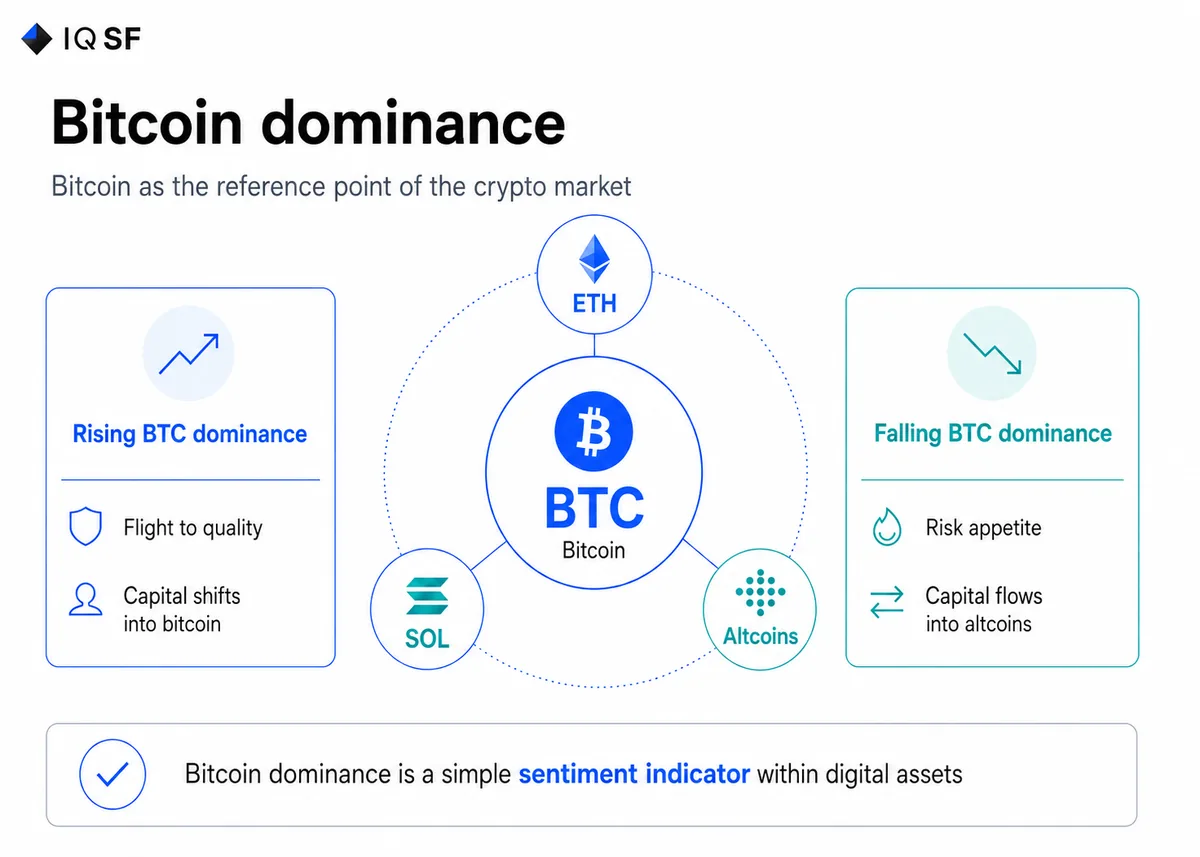
Bitcoin remains the reference point for the entire crypto market. Bitcoin dominance, meaning its share of the total cryptocurrency market capitalization, is one of the simplest indicators of market sentiment. Rising dominance usually means a flight to quality within digital assets, while falling dominance often signals a stronger appetite for risk in altcoins.
Bitcoin volatility as a structural feature, not an anomaly
Bitcoin volatility is significantly higher than the volatility of traditional assets. This is not a temporary flaw of a young market, but a structural feature of the cryptocurrency market as a whole.
Market volatility in digital assets is shaped by several factors at once:
- lower liquidity depth compared with traditional markets;
- 24/7 trading without breaks, unlike exchanges with fixed trading hours;
- a high share of emotional decisions by retail investors in total trading volume.
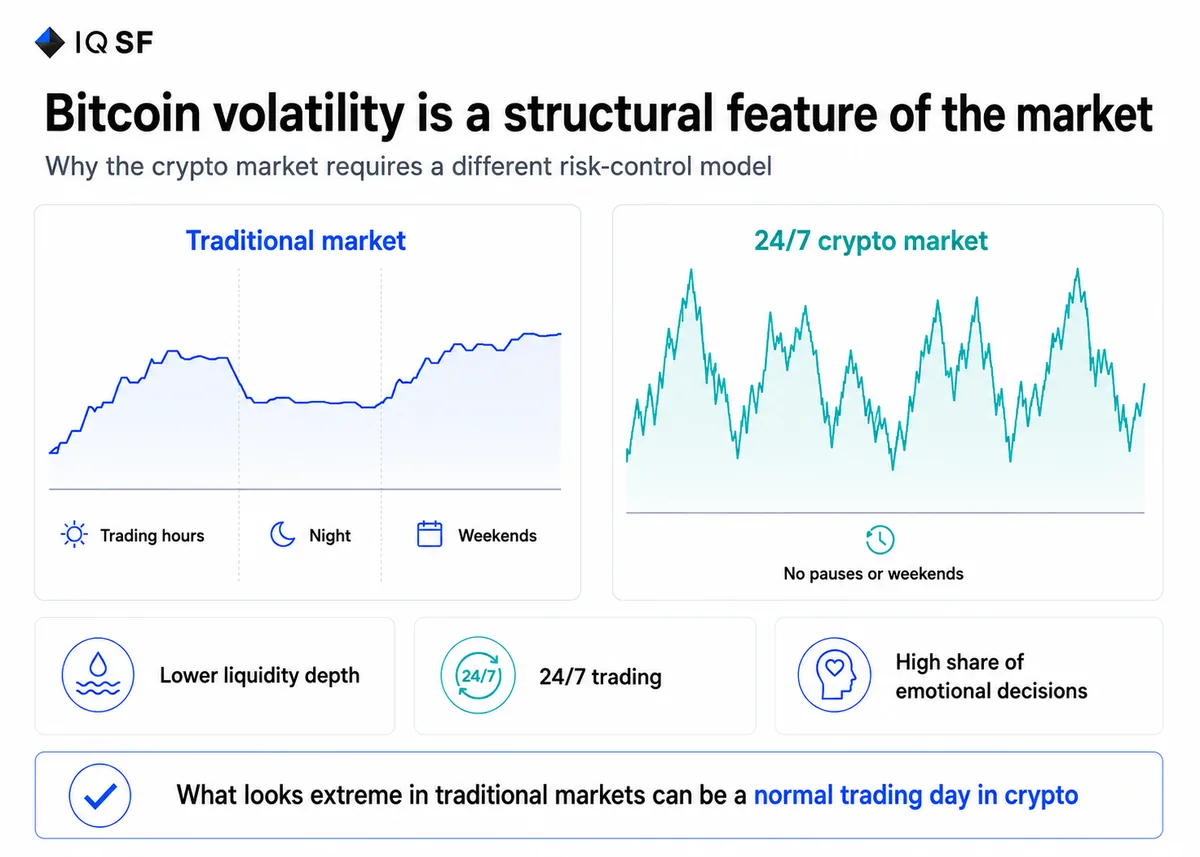
A traditional exchange closes at night and on weekends, giving market participants time to “cool down” after a major news event.
The crypto market works like a 24/7 exchange desk with no weekends. If news breaks at three in the morning Moscow time, the market reacts immediately, without a pause for reflection.
This is why crypto investing requires a different approach to risk than investing in traditional assets. What may look like an extreme move in the stock market can be an ordinary trading day in bitcoin.
Bitcoin halving and crypto market cyclicality
Bitcoin halving, the regular reduction of the mining reward by half, has historically been one of the factors influencing the long-term dynamics of cryptocurrency market capitalization.
At the same time, the mechanical effect of halving on price is often overestimated in popular narratives more often than it is underestimated.
Crypto winter, meaning a prolonged bear cycle in the cryptocurrency market, tests which projects and market participants are built on a sustainable model – and which ones are built only on the expectation of endless growth.
Ethereum, the second-largest cryptocurrency by market capitalization, is also important for the market not only as an asset, but as infrastructure. A significant part of digital finance and decentralized applications is built on its network, which makes Ethereum’s behavior a separate indicator within the broader dynamics of the crypto market.
Digital gold and the digital portfolio
The idea of bitcoin as digital gold is based on several arguments:
- limited issuance with a fixed maximum supply;
- decentralized structure without a single issuer;
- growing institutional recognition as an asset class.
In practice, however, bitcoin’s correlation with traditional risk assets during periods of crisis is often higher than this analogy suggests.
For an investor building a digital portfolio, it is important not to confuse the digital gold narrative with the real behavior of the asset during periods of market stress.
Crypto assets in general, including investments in bitcoin, should not be viewed as a separate isolated asset class. They should be considered as part of a broader portfolio, taking into account correlations that change depending on the market cycle.
How an institutional approach works with this volatility
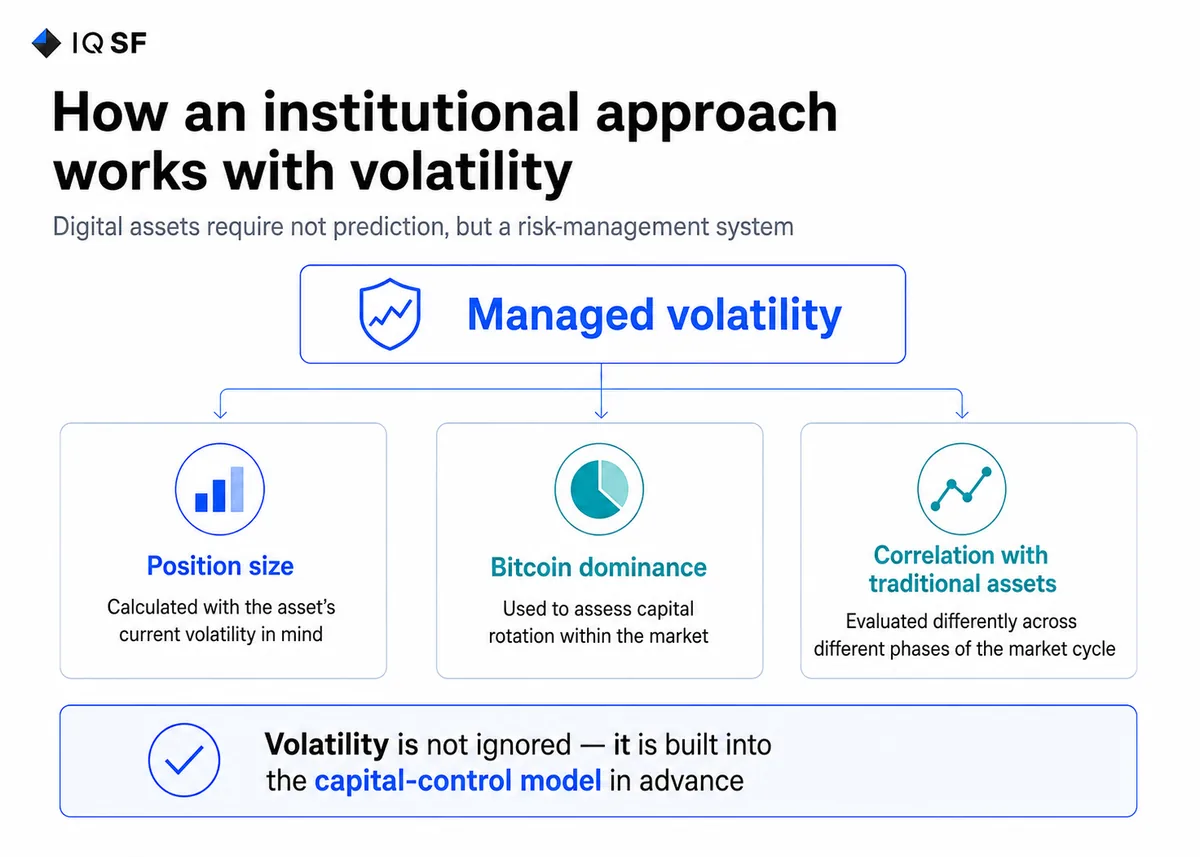
For professional management, bitcoin volatility – and crypto market volatility in general – is not a reason to avoid digital assets. It is a parameter that must be included in the risk model in advance.
There are three key elements of such a model:
- Position size, calculated in advance based on the current volatility of the asset.
- Bitcoin dominance as an indicator, used to assess capital rotation within the market rather than being ignored.
- Correlation with traditional assets, considered separately across different phases of the market cycle instead of being treated as a constant value.
IQSF works with digital assets through the lens of controlled risk.
Bitcoin volatility and the volatility of other digital assets are not ignored and are not used as an argument for excessive leverage. Instead, they are built into the capital control model.
This is not investment advice. It is an explanation of the structural features of the cryptocurrency market that determine its volatility.
Frequently asked questions
What is bitcoin dominance?
Bitcoin dominance is bitcoin's share of the total cryptocurrency market capitalization. A rising share typically signals a flight to quality within digital assets, while a falling share points to stronger risk appetite for altcoins. Professional management uses this indicator to track capital rotation within the market rather than treating it as background noise.
Why is bitcoin more volatile than traditional assets?
Bitcoin's volatility is a structural feature of the crypto market, not a temporary flaw. Liquidity depth is lower than in traditional markets, trading runs 24/7 without breaks, and a large share of trading volume comes from emotional retail decisions. Because the market never closes, news gets priced in immediately, without the pause a traditional exchange provides after hours.
Is bitcoin really digital gold?
Not entirely: bitcoin is called digital gold mainly because of its limited issuance, decentralized structure, and growing institutional recognition as an asset class. In practice, its correlation with traditional risk assets tends to rise during periods of crisis, higher than the digital gold comparison suggests. Because of this, it is best treated as part of a broader portfolio rather than a separate, isolated asset class.
How do professional investors manage bitcoin's volatility?
Professional investors build bitcoin's volatility into their risk model in advance rather than avoiding digital assets because of it. Position size is calculated from current volatility, bitcoin dominance is tracked as a rotation indicator, and correlation with traditional assets is assessed separately across market cycle phases. IQSF applies this approach, building volatility into its capital control model rather than treating it as a reason for excessive leverage.