Long-short and crypto arbitrage: quantitative trading strategies without directional risk

In this article, we’ll explore how long-short strategies and crypto arbitrage work without relying on market direction, why quantitative trading focuses on relative movements and inefficiencies, and how IQSF combines uncorrelated strategies to build a more systematic approach to digital asset management.
In 1949, sociologist Alfred Winslow Jones created a structure that later became known as the hedge fund.
The idea was simple: hold some securities with the expectation that they would rise, while simultaneously selling others short with the expectation that they would fall. The goal was to make the result less dependent on the direction of the overall market.
Jones was also the first to introduce a performance fee of 20% of profits. This model still exists in the industry today.
The mechanism he created almost 80 years ago is now known as long and short positions, or long-short. It remains the foundation of many quantitative strategies, including crypto arbitrage.
Long and short positions and market-neutral strategy
Long-short means opening a long position in one asset and a short position in another, usually related, asset at the same time.
A market-neutral strategy aims to generate results that do not depend on whether the overall market rises or falls. Profit comes from the relative movement of two assets against each other, not from the absolute movement of each asset.
It is similar to a seesaw with the support point exactly in the middle: if one side rises, the other falls symmetrically, and the overall level of the system stays almost unchanged regardless of the direction of a single movement.
Pairs trading is a specific case of this type of strategy.
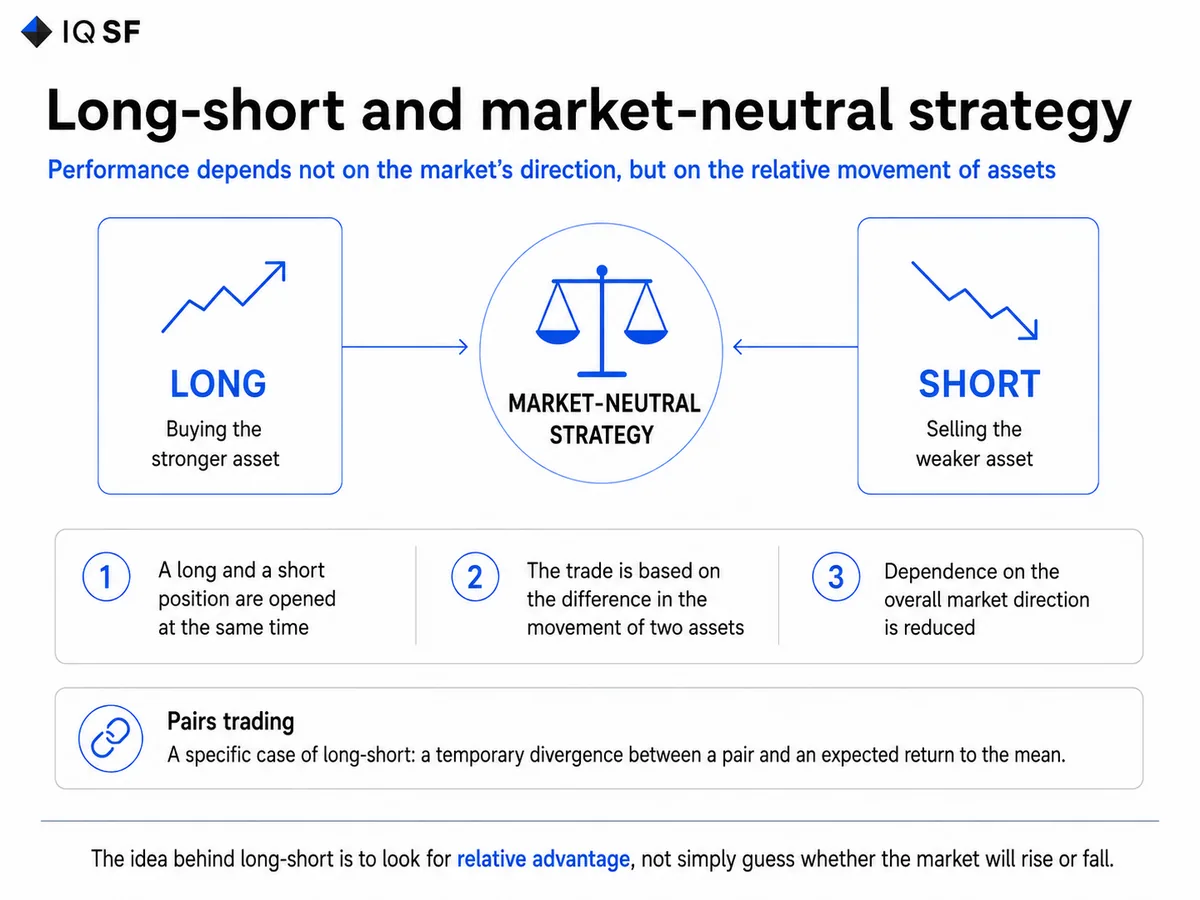
In pairs trading, two assets have historically moved in sync, and the trading strategy is based on the expectation that their relationship will return to its historical average after a temporary divergence.
This is a direct application of the principle of mean reversion: a price or ratio moves away from its average value, and the strategy is built around the expectation that it will return to that average.
Crypto arbitrage: earning from inefficiency, not direction
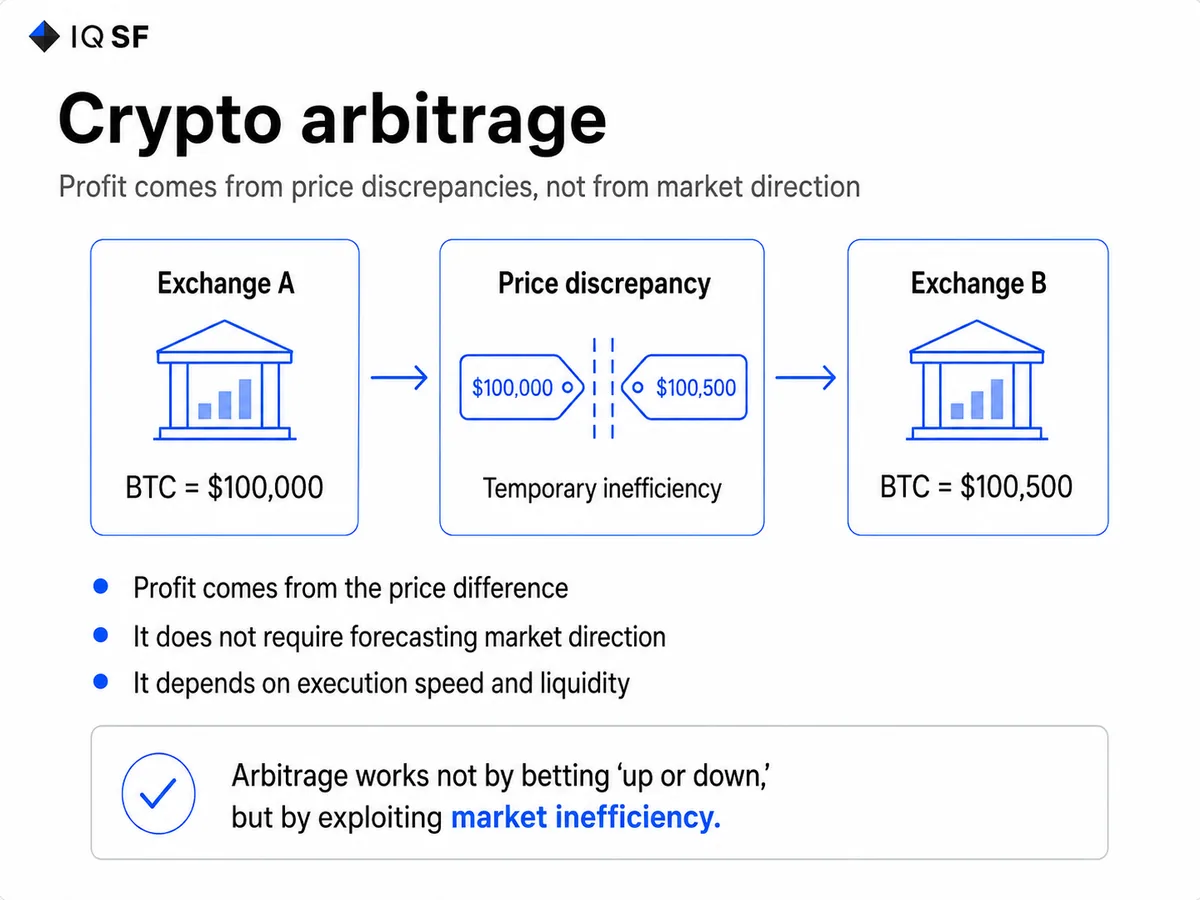
Crypto arbitrage uses price discrepancies of the same asset across different exchanges or instruments.
Crypto arbitrage exists because the cryptocurrency market is fragmented across many venues with different levels of liquidity. The price of the same asset does not always adjust instantly everywhere.
The key difference between crypto arbitrage and a directional trading strategy:
- it does not depend on whether Bitcoin is rising or Ethereum is falling;
- it can remain resilient across different market cycles, including crypto winter;
- profit comes from technical inefficiency, not from a forecast.
Trend following and systematic strategy
Trend following, or trend strategies, work according to the opposite logic: not against the market direction, but together with it.
Such a strategy enters a position after a sustained movement is confirmed and follows the trend until it reverses.
Unlike a market-neutral long-short strategy, trend strategies consciously accept directional risk and compensate for it through disciplined entry and exit rules.
A systematic strategy, whether it is a trend strategy, a mean reversion strategy, or arbitrage, differs from discretionary trading in one key way: the rules for entry and exit are defined in advance and do not change under the influence of emotions at the moment of execution.
Algorithmic strategies formalize these rules into code. This removes the human factor from the moment of decision-making, although it does not remove it from the strategy development stage.
In the cryptocurrency market, this approach is often implemented through algorithmic crypto trading, where entry, exit, and risk management rules are formalized in advance and executed automatically.
Quantitative strategy and strategy portfolios
A quantitative strategy is built on statistical testing of a hypothesis before it is allowed to work with real capital.
Quantitative trading, or quant trading, is the opposite of intuitive trading in this sense. Decisions are made based on a tested model, not on a feeling in the moment.
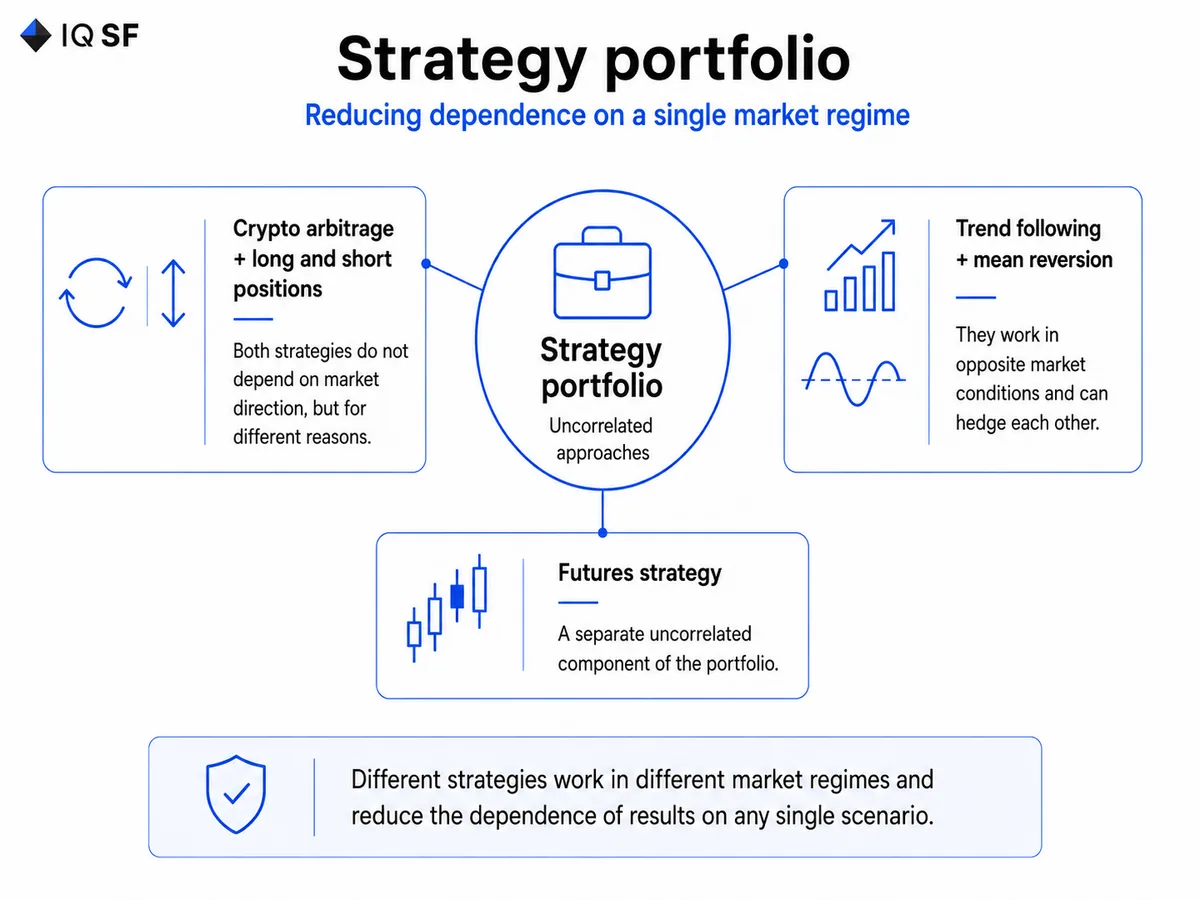
Strategy portfolios that combine several uncorrelated approaches at the same time reduce the dependence of the overall result on the current market regime.
Examples of combinations within one portfolio:
- crypto arbitrage + long and short positions. Both strategies do not depend on market direction, but for different reasons;
- trend strategies + mean reversion. They work in opposite market conditions and can hedge each other;
- a futures strategy as a separate uncorrelated portfolio component.
In this context, alpha strategies are the ability of each individual component of a strategy portfolio to generate results that cannot be explained simply by following the market.
Strategy management in practice
Strategy management means constantly checking whether real results match the expectations of the model, rather than relying on a one-time historical backtest.
IQSF builds its portfolio from these types of uncorrelated quantitative strategies, including long and short positions and crypto arbitrage, so that the result depends on the system rather than on a directional bet on the market.
In this sense, algorithmic crypto trading is not an attempt to guess the movement of Bitcoin or Ethereum. It is systematic work with different sources of market inefficiency.
This is not investment advice. It is an explanation of the logic behind quantitative trading strategies.
At IQSF, we discuss algorithmic strategies, risk management, and approaches to building strategy portfolios without promises of easy returns and without attempts to guess the market.
More materials are published in our Telegram channel.
Frequently asked questions
What is a long-short trading strategy?
A long-short strategy means opening a long position in one asset and a short position in another, usually related, asset at the same time. It aims to be market-neutral, so profit comes from the relative movement between the two assets rather than from the overall market direction. The mechanism dates back to 1949, when Alfred Winslow Jones created the structure that later became known as the hedge fund.
How does crypto arbitrage generate profit?
Crypto arbitrage profits from price discrepancies of the same asset across different exchanges, which exist because the crypto market is fragmented across venues with different liquidity levels. It does not depend on whether bitcoin is rising or ethereum is falling, and it can stay resilient across market cycles, including crypto winter. The profit comes from technical inefficiency, not from forecasting price direction.
What is a quantitative trading strategy?
A quantitative strategy is built on statistical testing of a hypothesis before it trades with real capital, so decisions rely on a tested model rather than a feeling in the moment. Entry and exit rules are defined in advance and formalized into code, which removes the human factor from the moment of execution. Quant strategies include trend following, mean reversion, and arbitrage.
Why combine several uncorrelated strategies in one portfolio?
Combining uncorrelated strategies reduces how much the result depends on the current market regime, since each component earns for a different reason. Crypto arbitrage and long-short positions are both independent of market direction, but for different reasons, while trend strategies and mean reversion work in opposite market conditions and can hedge each other. IQSF builds its portfolio from such strategies so the result depends on the system, not one bet.