Managed account: how capital and asset management works in cryptocurrency

In this article, we’ll explore how managed accounts work in cryptocurrency, why this model gives investors more direct control over their assets than a traditional fund structure, and how IQSF uses personal accounts to combine transparency, professional strategy execution, and digital asset risk management.
Before modern funds appeared, wealthy European families often hired a personal manager to manage their money on their own accounts, instead of mixing their capital with other clients’ money in a common pool.
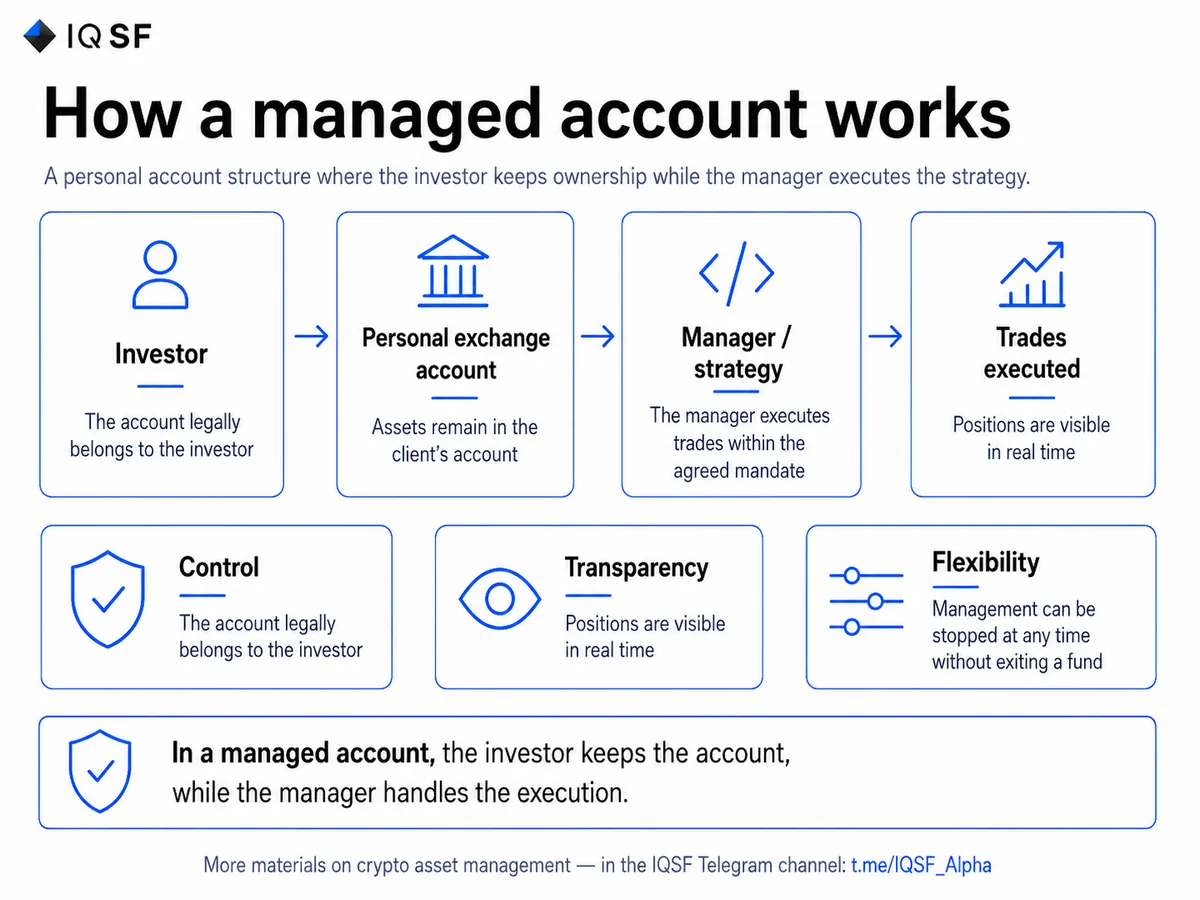
A managed account is, in many ways, the digital version of the same idea. The investor keeps legal ownership of the assets on their own account, while delegating capital management to a professional manager.
Managed accounts, in the plural, refer to several such accounts managed under one strategy at the same time.
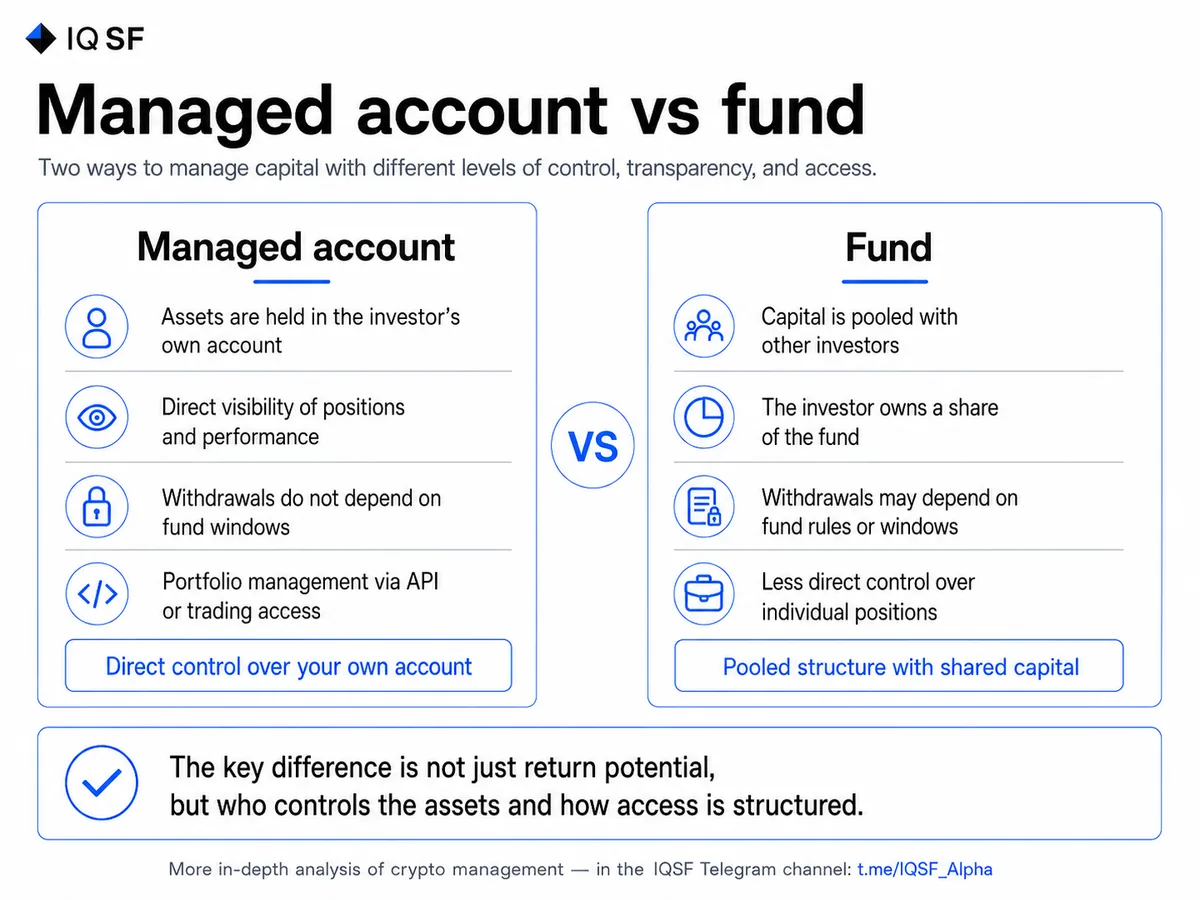
This is fundamentally different from a traditional fund, where assets are combined into a single pool.
How a managed account differs from a fund
In a managed account structure, asset management takes place on an account that formally belongs to the investor, not to a common fund.
The key differences from a traditional fund structure are:
- the investor can see their real positions at any time, not just their share in a common pool;
- withdrawals do not depend on the fund’s schedule, such as quarterly redemption windows or similar restrictions;
- the manager works with several independent accounts instead of one consolidated portfolio.
It is similar to the difference between a personal safe in your own hotel room and a shared vault in the basement of the hotel.
Both may be serviced by the hotel staff, but access, control, and responsibility are distributed differently.
This format gives the investor more transparency in real time. At the same time, it requires the management company to have infrastructure capable of executing decisions across multiple accounts simultaneously, while preserving the identity of the strategy on each individual account regardless of the size of a specific client’s capital.
Capital management and wealth management
Capital management in the context of a managed account is broader than simply executing trades.
It is closer to managing the client’s overall wealth: from position sizing on a specific account to the total portfolio risk if the client uses several strategies or several managed accounts at the same time.
Portfolio management in this model means that decisions are not made in isolation for each individual trade. They are made with the current structure of the entire client portfolio in mind, including alternative assets outside cryptocurrency, if the investor has them.
Cryptocurrency management on a personal account
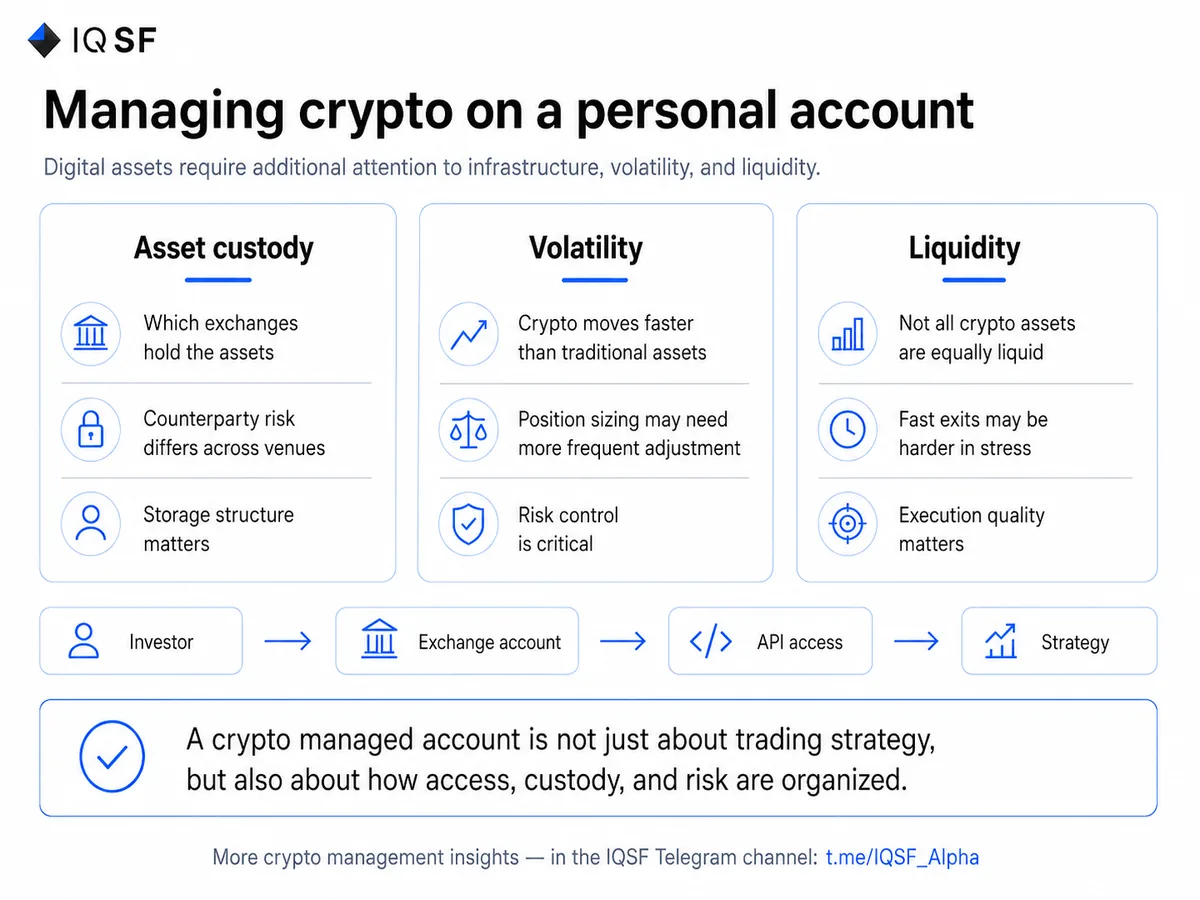
Managing cryptocurrency through a personal account adds specific factors compared with traditional assets.
A crypto portfolio requires attention to several additional elements:
- Custody
Which specific exchanges hold the assets, and what counterparty risk each of them carries. - Volatility
Crypto volatility is higher than in traditional alternative assets, which means position size must be recalculated more frequently. - Liquidity
Not all crypto assets are equally liquid at the moment when a fast exit is needed.
A crypto fund and a personal crypto managed account solve the same basic task: institutional management of digital assets.
But they solve it through different legal and operational structures.
How to choose between a personal account and a fund
A managed account is suitable for an investor who values direct legal control over assets and wants the ability to see and, if necessary, stop management specifically on their own account at any time.
A fund structure is more suitable for those who prefer a single pool with shared costs and do not need personal control over every position.
In practice, the choice often comes down to several questions:
- Is direct access to your own assets important at any time, not only during a withdrawal window?
- Is the investor ready for the operational complexity of a separate account instead of a simple fund share?
- Does the portfolio need to be customized around the client’s specific alternative assets?
IQSF offers capital management through personal accounts because this model gives the client direct control over their own assets while preserving a unified professional cryptocurrency management strategy on each separate account.
This is not investment advice. It is an explanation of how a managed account differs from a traditional fund and which capital management model may fit different investor priorities.
Learn more
Choosing between a managed account and a fund starts not with returns, but with understanding who controls the assets, how account access is structured, and how results are verified.
In the Telegram channel, we discuss capital management, risk management, and investment models in digital assets.
Frequently asked questions
What is a managed account in cryptocurrency?
A managed account lets an investor keep legal ownership of assets on their own account while delegating capital management to a professional manager, similar to how wealthy European families once hired a personal manager instead of pooling money with other clients. This differs from a traditional fund, where assets from multiple investors are combined into one pool. IQSF offers capital management through this personal account model.
How does a managed account differ from a traditional fund?
In a managed account the investor sees real positions at any time rather than just a share in a common pool, and withdrawals do not depend on the fund's schedule, such as quarterly redemption windows. The manager works with several independent accounts instead of one consolidated portfolio, like a personal safe in your own hotel room versus a shared vault in the basement. Access, control, and responsibility are distributed differently.
What extra factors matter when managing cryptocurrency compared with traditional assets?
Managing cryptocurrency on a personal account requires attention to custody, meaning which exchanges hold the assets and what counterparty risk each carries, and to volatility, since crypto volatility is higher than in traditional alternative assets and position size must be recalculated more frequently. Liquidity is another factor, because not all crypto assets are equally liquid at the moment a fast exit is needed.
Who should choose a managed account instead of a fund?
A managed account suits an investor who values direct legal control over assets and wants to see, and if necessary stop, management on their own account at any time. A fund structure suits those who prefer a single pool with shared costs and do not need personal control over every position. The choice often depends on whether direct access to assets matters outside withdrawal windows.