Where to invest crypto in 2026 besides simply holding bitcoin

In this article, we explore why simply holding Bitcoin is no longer the only option for crypto investors. We’ll examine diversification, staking, algorithmic strategies, and managed solutions, while discussing how to build a portfolio designed to perform not only during bull markets but also through periods of market decline.
Why “buy and hold bitcoin” is not enough
“Buy Bitcoin and hold it” remains the most popular strategy in crypto. And to be fair, it has often worked. Over long periods, simply holding Bitcoin has outperformed most active traders.
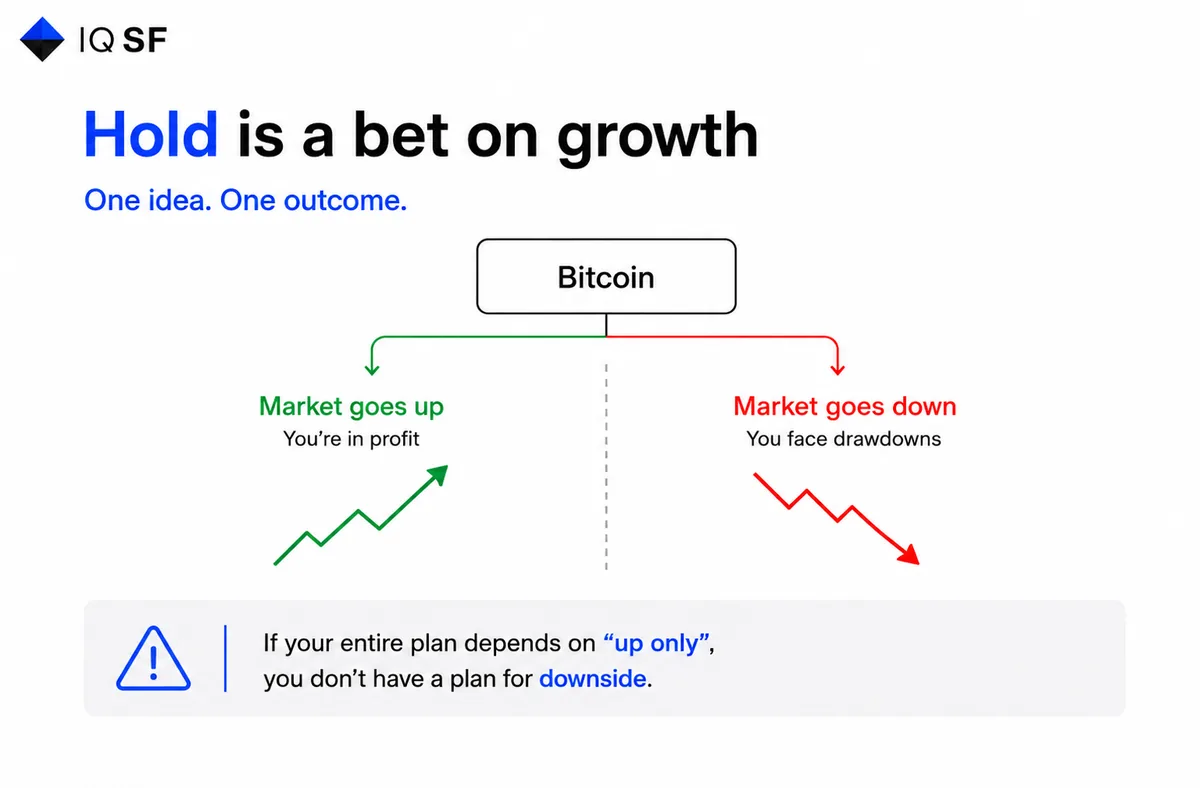
However, there is one major blind spot that investors rarely discuss: you only make money when the market rises. When the market falls 70%, you are fully exposed to that decline.
In 2026, crypto investors have more options than simply “hold” or “sell.” Today, building a portfolio means thinking beyond a single asset and preparing for different market conditions.
Why pure holding is not really a strategy
When you hold Bitcoin, you are essentially making one bet: that the price will continue to rise. This approach works very well during bull markets but can be extremely painful during prolonged downturns.
In 2022, Bitcoin holders experienced drawdowns exceeding 70%. Many investors could not tolerate the pressure and sold near the bottom. The problem was not Bitcoin itself. The problem was having no plan for what to do when the market moved against them.
There is also a psychological trap. In hindsight, holding always looks brilliant. Years later, it is easy to say, “I would have simply held Bitcoin and become wealthy.”
Reality is different. Nobody knows in advance when to buy, when to add capital, or when to reduce exposure. The success story is usually assembled after the outcome is already known.
Option 1: diversification across crypto assets
Instead of holding only Bitcoin, investors can build a diversified portfolio consisting of Bitcoin, Ethereum, large-cap altcoins, and stablecoins.
The idea is straightforward. Different assets do not always move in exactly the same way. As a result, a diversified portfolio typically experiences smoother fluctuations than a single asset.
Diversification is not a magic shield against market-wide crashes. During periods of panic, many crypto assets still decline together. However, diversification reduces dependence on the performance of any one coin and creates a more balanced portfolio structure.
Option 2: staking and yield-producing assets
Part of a crypto portfolio can be allocated to assets that generate income on their own. Examples include staking, yield-bearing products, and established DeFi protocols.
These instruments provide returns beyond simple price appreciation. Over time, that additional yield can become a meaningful contributor to overall portfolio performance.
At the same time, investors should remember a basic principle: higher yield always comes with higher risk. The larger the promised return, the more carefully the underlying source of that return should be examined.
If a platform offers unusually high yields without a clear explanation of how those yields are generated, that should be treated as a warning sign rather than an opportunity.
Option 3: algorithmic trading strategies
Algorithmic strategies operate very differently from buy-and-hold investing.
Instead of relying on a single prediction about market direction, these systems follow predefined rules. They can lock in profits, limit losses, adapt to changing market conditions, and in some cases profit from falling markets.
This addresses one of the biggest weaknesses of passive holding: the inability to respond when the market enters a prolonged decline.
The challenge is that the quality of algorithmic strategies varies significantly. Without a verified track record, it is difficult to distinguish a robust system from a marketing presentation.
That is why the most important question is not, “What is the return?” but rather, “Can you show a transparent and verifiable trading history?”
Option 4: professional asset management
Some investors simply do not want to spend hours analyzing charts, monitoring positions, and making portfolio decisions. In that case, capital can be allocated to a professional fund, managed account, or systematic investment program. The advantages are obvious: less stress, less time commitment, and access to professional risk management. However, this introduces another critical factor: trust. Before allocating capital, investors should understand where assets are held, who controls withdrawals, whether performance reporting is transparent, and how risks are managed.
Building a modern crypto portfolio
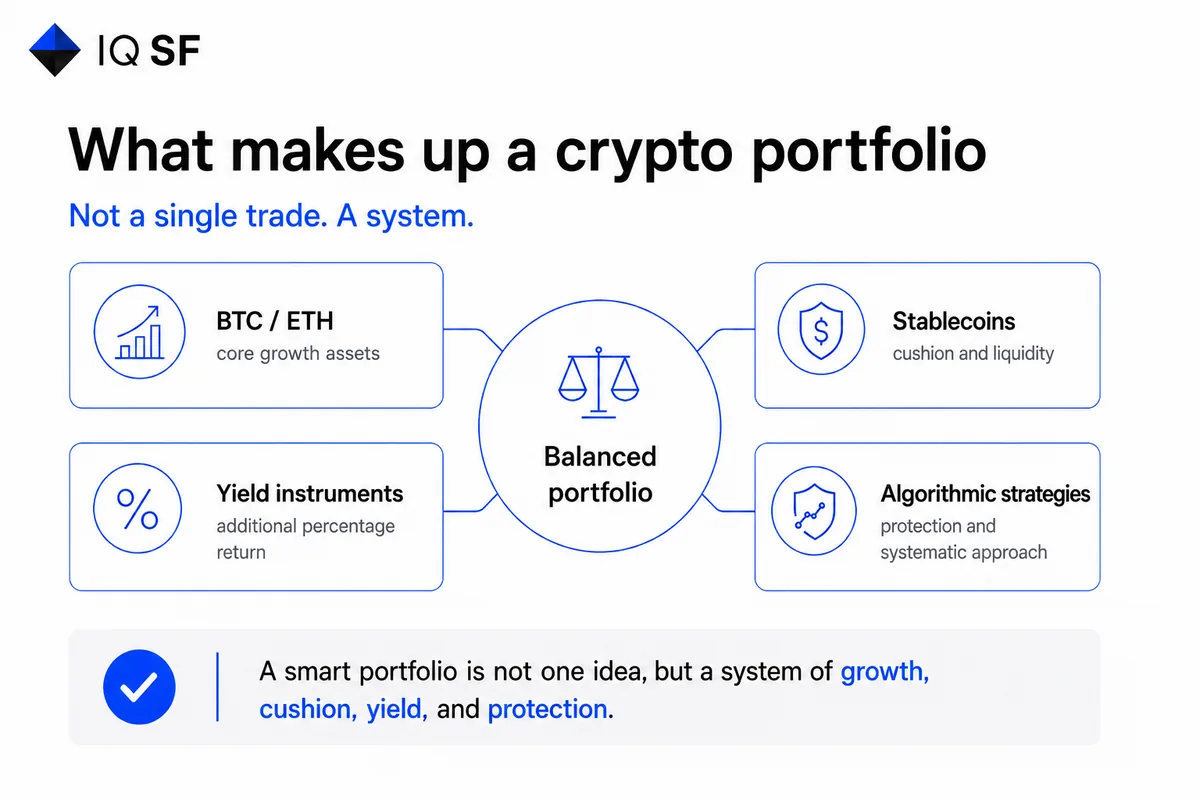
A sensible crypto portfolio in 2026 is not based on a single idea.
Instead, it combines several layers:
- Core holdings in major assets
- Stablecoin reserves
- Yield-generating positions
- Capital-protection strategies
The exact allocation depends on individual risk tolerance. However, the principle is more important than the percentages.
The goal is not to rely entirely on a single bet that the market will rise. The goal is to build a portfolio that can function in different market environments.
What this might look like in practice
Consider an investor who does not want to trade every day and is uncomfortable with extreme volatility.
A practical portfolio could include a significant allocation to Bitcoin and Ethereum, a meaningful stablecoin reserve, a smaller allocation to yield-generating products, and a portion dedicated to risk-managed strategies.
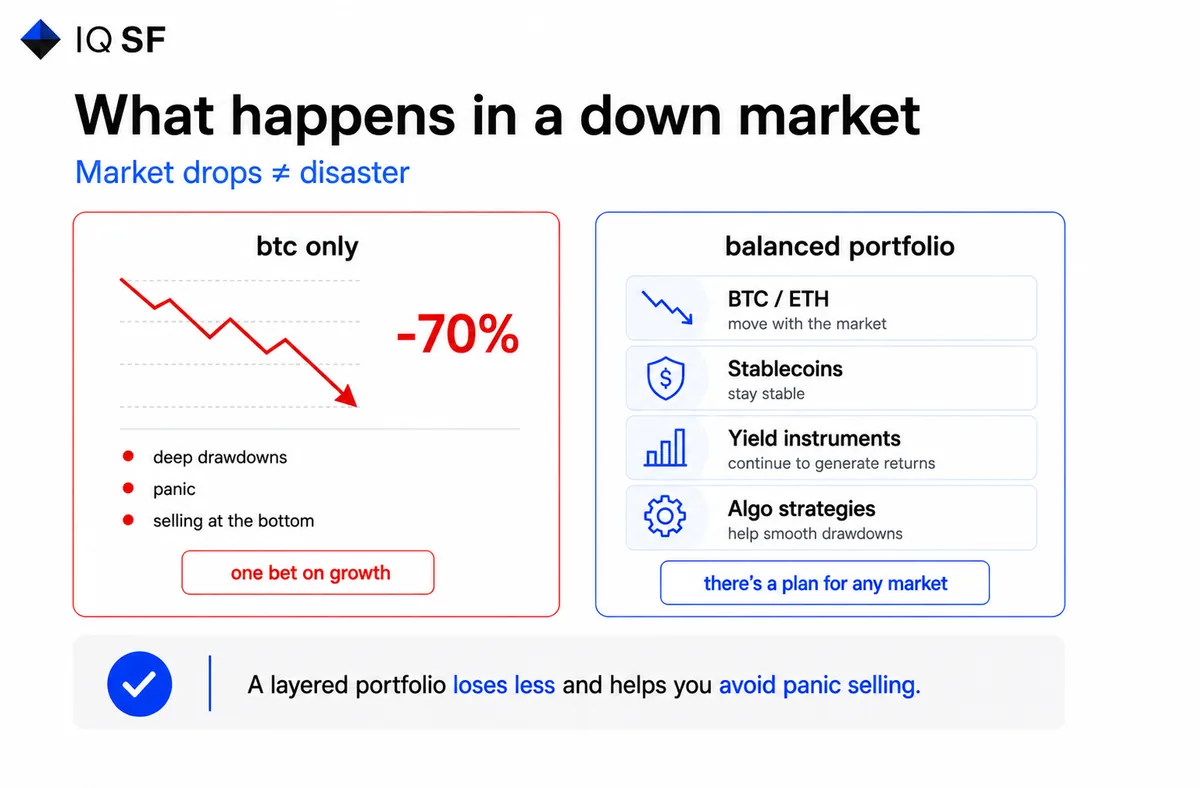
What happens if the market declines?
The core crypto holdings will likely fall. That is unavoidable.
However, stablecoins preserve purchasing power and create opportunities to buy assets at lower prices. Yield-generating positions continue producing income. Risk-managed strategies may help reduce overall portfolio volatility.
The result is often a smoother experience than pure buy-and-hold investing. More importantly, investors are less likely to panic and sell at the worst possible moment.
The numbers will vary from one person to another. What matters is the structure. Each layer serves a different purpose, and together they prepare the portfolio for different market scenarios.
Three mistakes that can ruin everything
Chasing the highest yield
Returns and risk always move together.
Promises of extraordinary returns without a clear economic source often end badly. In many cases, investors lose not only their profits but their entire capital.
Investing money you cannot afford to lose
Crypto markets experience deep drawdowns.
Invest only the portion of capital whose temporary loss would not significantly affect your financial life.
Abandoning a strategy during a drawdown
Many investors do not lose money because markets fall. They lose money because they abandon their plan at the worst possible moment. A properly structured portfolio helps reduce emotional pressure and makes it easier to stay disciplined during difficult periods.
How to earn from crypto without trading
Not everyone wants to become an active trader. Fortunately, crypto offers several passive approaches.
Staking
Staking allows investors to earn rewards for helping secure blockchain networks.
In practice, it provides a yield on assets without requiring active trading. Returns are typically moderate but can become meaningful over long periods.
Yield-producing crypto products
Some crypto products offer higher returns than staking.
However, they also introduce additional risks related to the platform itself. The same principle applies: if the source of yield is unclear, caution is warranted.
Algorithmic strategies and managed solutions
Algorithmic systems replace emotions with predefined rules.
For many investors, this provides a way to participate in crypto markets without spending hours in front of trading screens.
Crypto diversification explained simply
Diversification sounds complicated.
The concept itself is simple: do not put everything into one asset.
If your entire portfolio depends on a single coin, your outcome depends entirely on the success of that coin.
A diversified portfolio spreads risk across growth assets, stable reserves, income-generating positions, and protective strategies.
An important caveat is that many crypto assets remain highly correlated with Bitcoin. True diversification is therefore not about owning ten different coins.
It is about combining different types of instruments that play different roles within a portfolio.
Growth assets, stable reserves, yield-generating positions, and risk-managed strategies behave differently. That difference is what helps reduce overall portfolio risk.
How much should You invest?
There is no universal answer.
A practical rule is to invest only the amount of capital you can comfortably tolerate losing.
For most people, crypto should represent a portion of overall savings rather than the entirety of their wealth.
Starting gradually often makes sense. It reduces risk and allows investors to experience market volatility before committing larger amounts of capital.
More importantly, it helps investors discover their real risk tolerance rather than the risk tolerance they imagine they have during a bull market.
Key takeaway
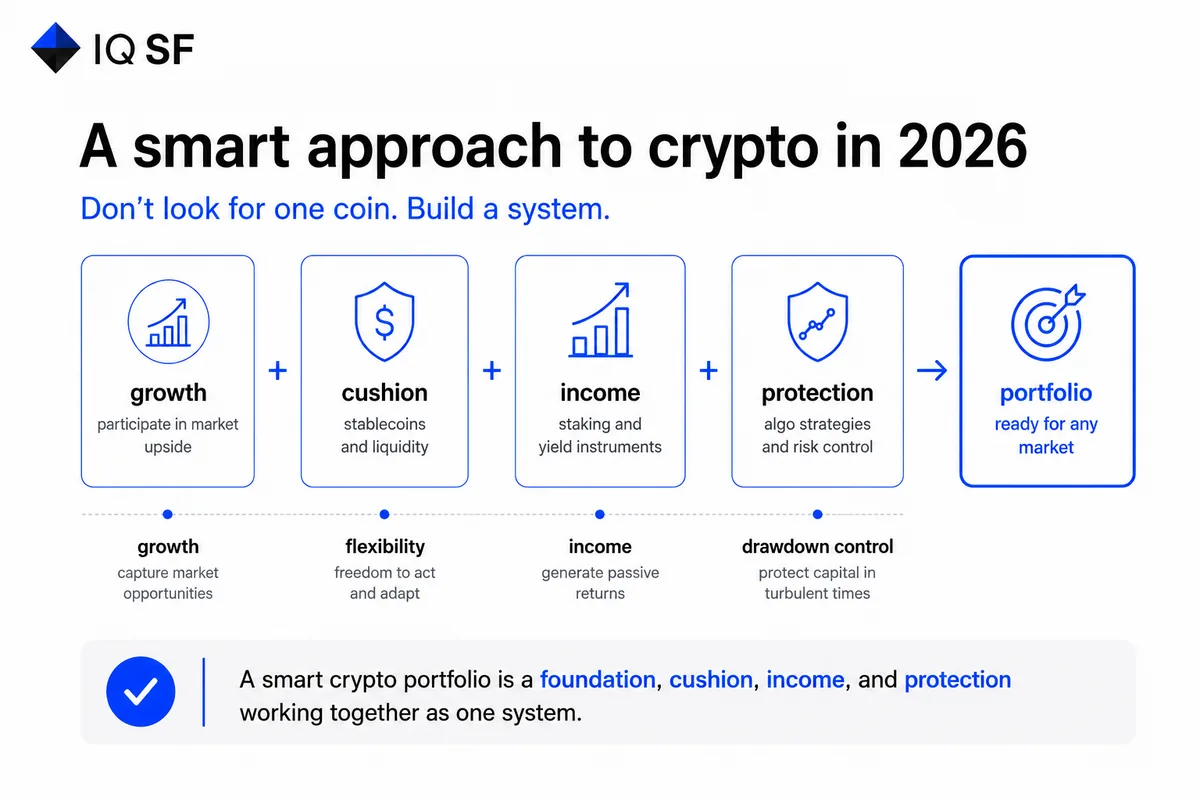
A smart crypto strategy in 2026 is not about finding one magical coin.
It is about building a portfolio that can function across different market conditions.
Holding Bitcoin can remain the foundation. But adding stability, income generation, diversification, and risk management creates a far more resilient approach.
When structured properly, a falling market stops being a catastrophe and becomes simply another scenario for which the portfolio is prepared.
At IQ Security Fund, we manage crypto capital according to this principle: rules instead of predictions, capital protection during downturns, and transparent performance history.
Frequently asked questions
Why isn't simply holding Bitcoin enough as a complete investment strategy?
Holding Bitcoin only pays off while the market is rising, and in 2022 Bitcoin holders saw drawdowns exceeding 70 percent with no plan for what to do when the market moved against them. The problem is not Bitcoin itself but having no response to a prolonged decline, since holding only looks brilliant in hindsight. A portfolio built around a single bet on price appreciation has no answer for a falling market.
What are the main ways to build a crypto portfolio beyond just holding Bitcoin?
Four options are usually combined: diversifying across Bitcoin, Ethereum, large cap altcoins and stablecoins, allocating part of the portfolio to staking or yield producing assets, using algorithmic strategies with predefined rules instead of one directional bet, and allocating capital to professional management for investors who do not want to monitor positions themselves. A sensible portfolio typically layers several of these together.
What should you check before trusting a high yield staking or DeFi product?
Higher yield always comes with higher risk, so the size of a promised return should be matched by how carefully its source can be examined. A platform offering unusually high yields without a clear explanation of how they are generated should be treated as a warning sign rather than an opportunity. The same caution applies broadly to yield producing crypto products, since they add risks tied to the platform itself on top of ordinary market risk.
What mistakes can ruin a crypto investment portfolio?
Three mistakes stand out: chasing extraordinary yields without a clear economic source, which can cost investors their entire capital, investing money whose loss would significantly affect your financial life, and abandoning a strategy during a drawdown at exactly the worst moment. Many investors lose money not because markets fall but because they abandon their plan under pressure. A properly structured portfolio reduces that pressure.