Bitcoin price prediction: what really drives the price

In this article, we’ll explore what drives Bitcoin’s price, why forecasts from banks and analysts often miss the mark, how BTC price expectations shifted throughout 2026, and why understanding historical drawdowns and potential scenarios matters more than predicting an exact price.
A bitcoin price prediction is an analyst's estimate of a future price, built on assumptions about interest rates, flows into spot bitcoin ETFs and the issuance of new coins. No single number deserves blind trust: at the start of 2026, published calls for the year ranged from $10,000 to $250,000, a 25-fold spread, and Citi alone named four different 12-month targets between December 2025 and October 2026.
IQ Security Fund does not publish price forecasts. Below are dated facts as of October 2026 and our own calculation of bitcoin's drawdowns since 2017.
What drives the price of bitcoin
Bitcoin's price is driven by demand: new supply is fixed in code until roughly 2140, while demand shifts with interest rates, ETF flows, government decisions and market shocks.
Interest rates and spot bitcoin ETF flows
The higher the Fed's rate, the more expensive dollar money becomes and the less of it flows into risk assets, so bitcoin reacts to rate expectations on the day new data comes out.
On September 16, 2026, the Federal Reserve raised its target range by a quarter point to 3.75%-4%, its first hike since 2023. On October 5, after a weak September jobs report cooled expectations of another hike, bitcoin climbed back above $86,000.
The second force arrived in January 2024, when spot bitcoin ETFs began trading in the US. According to SoSoValue data compiled by The Block, cumulative net inflows since launch reached $57.6 billion as of September 26, 2026. In 2026, flows and price moved together: by July 13, investors had pulled $5.8 billion from the funds year to date; by September 26, the year's balance had turned positive at $0.9 billion.
Halving, regulation and market shocks
The halving cuts the issuance of new bitcoin in half every 210,000 blocks, roughly every four years, but the whole market knows the date in advance, so it can't be used as a clock for the price.
The last halving took place in April 2024, cutting the block reward from 6.25 to 3.125 BTC; the next one is expected in 2028. On March 9, 2026, the 20 millionth bitcoin out of 21 million was mined. After the 2016, 2020 and 2024 halvings, a new all-time high came roughly 18 months later, followed by declines of 83.2%, 76.6% and, in the current cycle, 53% as of June 30, 2026 (our calculation on daily closes). Three coincidences in a row are an observation, not a law.
Policy decisions and shocks act faster. According to CoinDesk, on October 10, 2025, after the US announced 100% tariffs on Chinese goods, $19 billion of leveraged positions were forcibly closed within 24 hours, a market record. On September 15, 2026, the US Senate failed to advance the CLARITY Act, a market structure bill for digital assets, in a 49-50 vote; bitcoin fell 4.2% in a day to $75,850.
Bitcoin price prediction 2026: why forecasts differ so much
Bitcoin forecasts for 2026 differ several-fold because authors weigh the same forces differently and then move their targets after the price.
At the start of the year, the extremes were Mike McGlone of Bloomberg Intelligence, who repeated in March 2026 that bitcoin could sink toward $10,000, and Tom Lee of Fundstrat, who in January set a $200,000-$250,000 target for 2026. Bank targets sat in between and kept moving too, according to CoinDesk and Yahoo Finance:
• Standard Chartered, end of 2026: $300,000, cut to $150,000 in December 2025 and to $100,000 in February 2026.
• Bernstein: $150,000 by end-2026 in January; on August 26, around $125,000 by year-end and $150,000 by mid-2027.
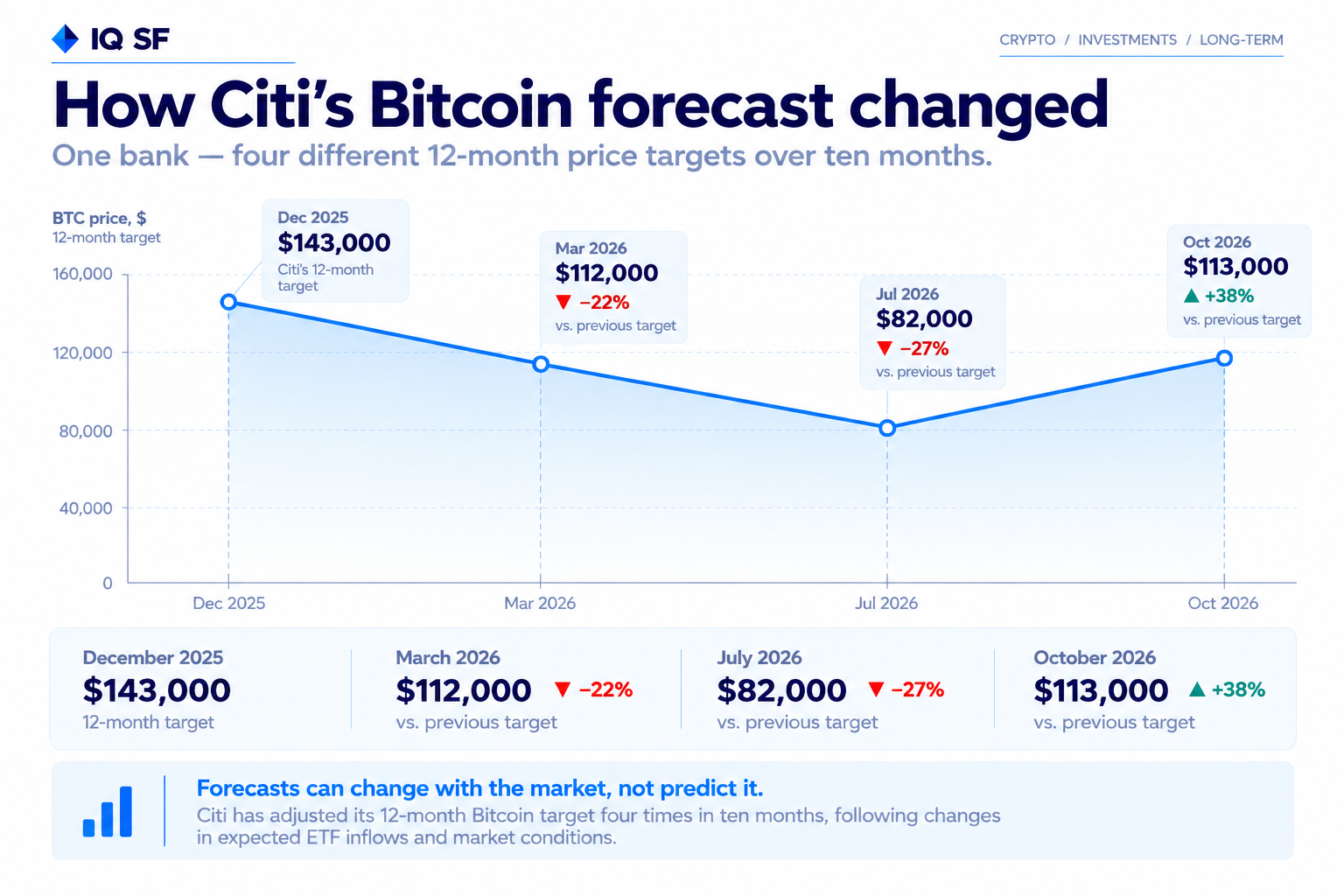
• Citi, 12-month target: $143,000 in December 2025, $112,000 in March, $82,000 on July 1 and $113,000 on October 1, 2026.
Citi cut its target to $82,000 the day after the lowest close of the year, with bitcoin near $58,650, and raised it to $113,000 with bitcoin near $86,000. Its key assumption moved along with the target: expected net ETF inflows over the next 12 months went from $10 billion to zero in July, then up to $5 billion in October. The forecast followed the price instead of leading it.
Bitcoin price predictions that failed
Famous bitcoin calls have missed by a factor of 1.2 to 34, and both individual pundits and banks got it wrong.
Who and when | Prediction | What happened |
John McAfee, November 2017 | $1,000,000 by end of 2020 | $29,002 on Dec 31, 2020 |
PlanB, stock-to-flow model, 2019-2021 | $100,000 by end of 2021 | $46,306 on Dec 31, 2021 |
Standard Chartered, July 2023 | $50,000 by end of 2023 | about $42,265 |
Standard Chartered, through July 2025 | $200,000 by end of 2025, cut to $100,000 on Dec 9 | $87,703 |
Tom Lee, Fundstrat, 2025 | $200,000-$250,000 by end of 2025 | $87,703 |
Year-end prices are based on data from CoinMarketCap and Yahoo Finance. The mistakes share a pattern: one force is treated as the only one (scarcity for McAfee, halvings for stock-to-flow), and the price path is drawn as a straight line.
Bitcoin drawdowns: what nine years of data show
A prediction names a price on a date, while history shows the path to it: by our calculation, bitcoin closed more than 20% below its all-time high on 72.2% of days since 2017.
We took daily closes of BTCUSDT on Binance from August 17, 2017 to September 24, 2026:
• there were ten declines deeper than 20% from the all-time high, and nine of them ended with a return to it; the median was 117 days from peak to recovery and 40 days from the bottom;
• declines of 20-35% recovered in 12-238 days, those of 50% or more in 189-1,074 days: -83.2% and 1,074 days in 2018-2020, -76.6% and 847 days in 2021-2024;
• on 39.2% of days the price closed at less than half of its high, and a new high came on just 106 days, 3.2% of the series;
• the current decline: a high of $124,659 on October 6, 2025 and a bottom of $58,625 on June 30, 2026 (-53%); as of September 24, 2026, the price was $84,410, 32% below the high, and needed a 48% gain to get back to it.
Recovery math is asymmetric: after -20% you need +25%, after -53% +113%, after -83.2% +495%. So a "$125,000 by year-end" call with bitcoin at $84,410 means another 48% rise in just over three months, which is why converting any target into a percentage move is a useful habit. The math is explained in our article on why a 50% drawdown needs a 100% gain.
Can you trust bitcoin price predictions? Use scenarios, not targets
You can trust a bitcoin prediction as a set of assumptions, not as a number: what matters is what has to happen for the target, over what horizon, and how the author has missed before.
Four questions to ask of any forecast:
1. What does it rest on? Citi's target moved with its ETF flow assumption, so the flows are what to watch, not the number.
2. Are there scenarios? In December 2025, Citi gave three 12-month scenarios: $78,500, $143,000 and $189,000. Even a range says nothing about the path: in June 2026, bitcoin closed at $58,625, below the bear case.
3. What is the horizon? "By year-end" and "in 12 months" are different forecasts, and a 2030 target can't be checked today at all.
4. What is the author's record and interest? By Yahoo Finance's count, Standard Chartered missed three year-end calls in a row. The head of a fund or of a company that holds coins benefits from a higher price: that doesn't make the forecast wrong, but it explains the tone.
The same approach works for your own money without anyone's target: decide in advance what you would do if the price were half as high a year from now, and how long you could wait if a recovery took 847 or 1,074 days, as in the last two cycles. Why a plan beats a forecast is covered in our article on discipline versus forecasting.
This material is for information only and is not individual investment advice.
Frequently asked questions
What will bitcoin be worth at the end of 2026?
Nobody knows. As of early October 2026, the year-end targets from Standard Chartered and Bernstein stand at $100,000 and about $125,000, while at the start of the year forecasts ranged from $10,000 to $250,000. On October 5, 2026, bitcoin traded around $86,000.
What is the bitcoin price prediction for 2030?
Long-term forecasts diverge even more. In January 2026, ARK Invest's 2030 scenarios ran from $300,000 to $1.5 million, and in December 2025 Standard Chartered pushed its $500,000 target from 2028 to 2030. Numbers like these can only be checked in 2030.
Does the halving affect the bitcoin price?
The halving cuts new supply in half, and after the 2016, 2020 and 2024 halvings the price set a new high about 18 months later and then fell 53-83%. But the date is known in advance, so three coincidences don't promise a fourth.
Why are bitcoin price predictions so often wrong?
Several forces move the price at once, and any of them can outweigh the rest: Fed policy, ETF flows, government decisions, surprise events. On top of that, authors revise targets after the market moves: between December 2025 and October 2026, Citi named $143,000, $112,000, $82,000 and $113,000.