Leverage and liquidation risk: capital control in crypto margin trading
In this article, we’ll explore how leverage increases liquidation risk in crypto margin trading, why position sizing matters more than intuition, and how systematic capital control helps reduce the risk of forced position closures.
In March 2021, Archegos, the family office managed by Bill Hwang, collapsed within just a few days.
Through derivative instruments and relationships with several banks at the same time, Archegos built hidden leverage that was several times larger than its own capital. When one of the securities in the portfolio fell sharply, the banks simultaneously demanded additional collateral. When there was not enough money to meet those margin calls, a chain reaction of forced position liquidations began.
The final losses of the counterparty banks exceeded $10 billion, and the family office itself ceased to exist within just a few trading sessions.
The Archegos story is not specifically about crypto, and not even only about the stock market. It is about a universal mechanism: leverage accelerates both profit and the path toward forced position closure.
What liquidation risk is and why it is more dangerous than a regular drawdown
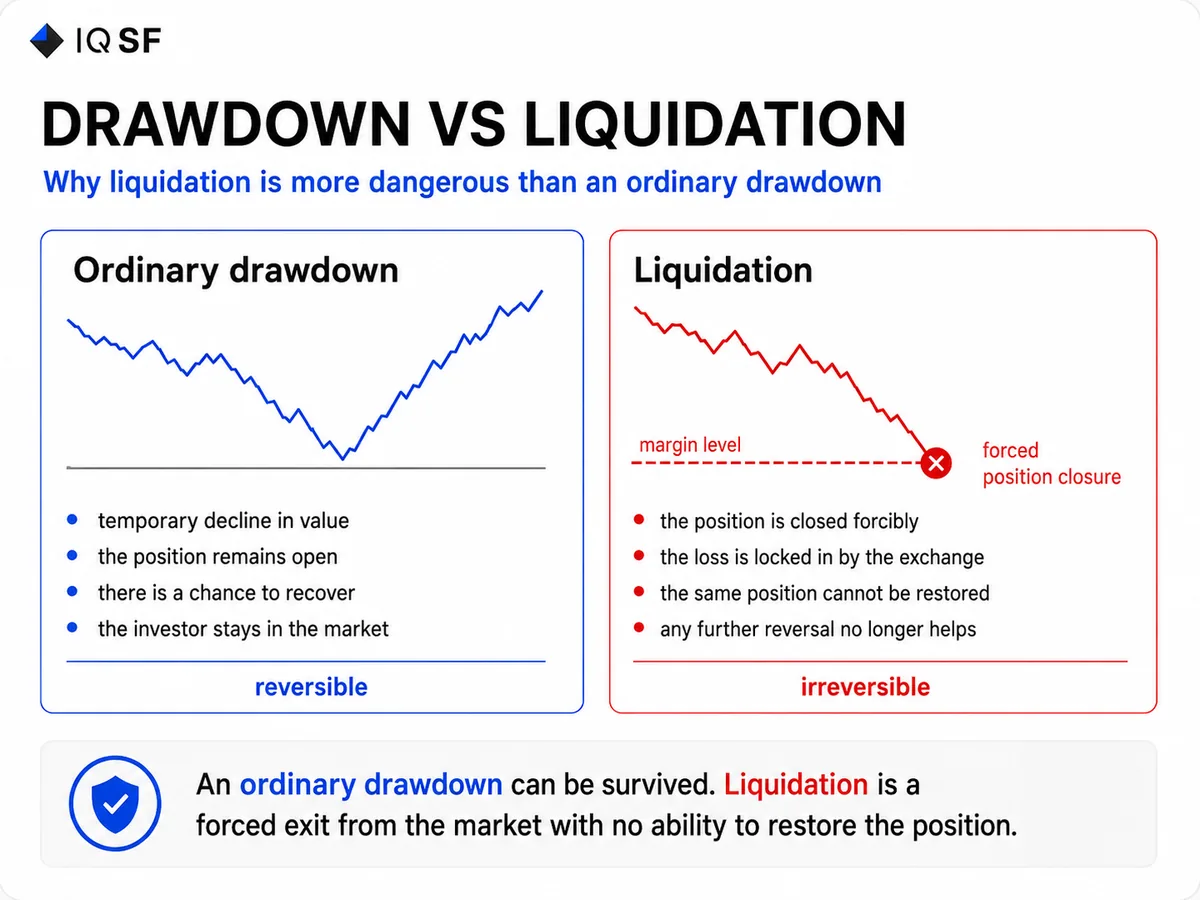
Liquidation risk is different from a normal market drawdown because it is irreversible.
A regular portfolio drawdown is a temporary decline in value that can be survived if the position size and capital allow the investor to remain in the market.
Liquidation is the forced closure of a position by the exchange when the margin threshold is reached. After that, the exact same position can no longer be restored, regardless of where the market goes one minute later.
Exchange-level risk increases liquidation risk in several ways:
- the specific margin calculation rules of a particular trading venue;
- the depth of liquidity at the moment of expiration or forced closure;
- the speed of execution of the closing order, which determines the actual liquidation price.
Crypto risk is higher in this sense than the risk of many traditional assets because crypto prices can move sharply over very short periods of time.
Position size as the first line of defense
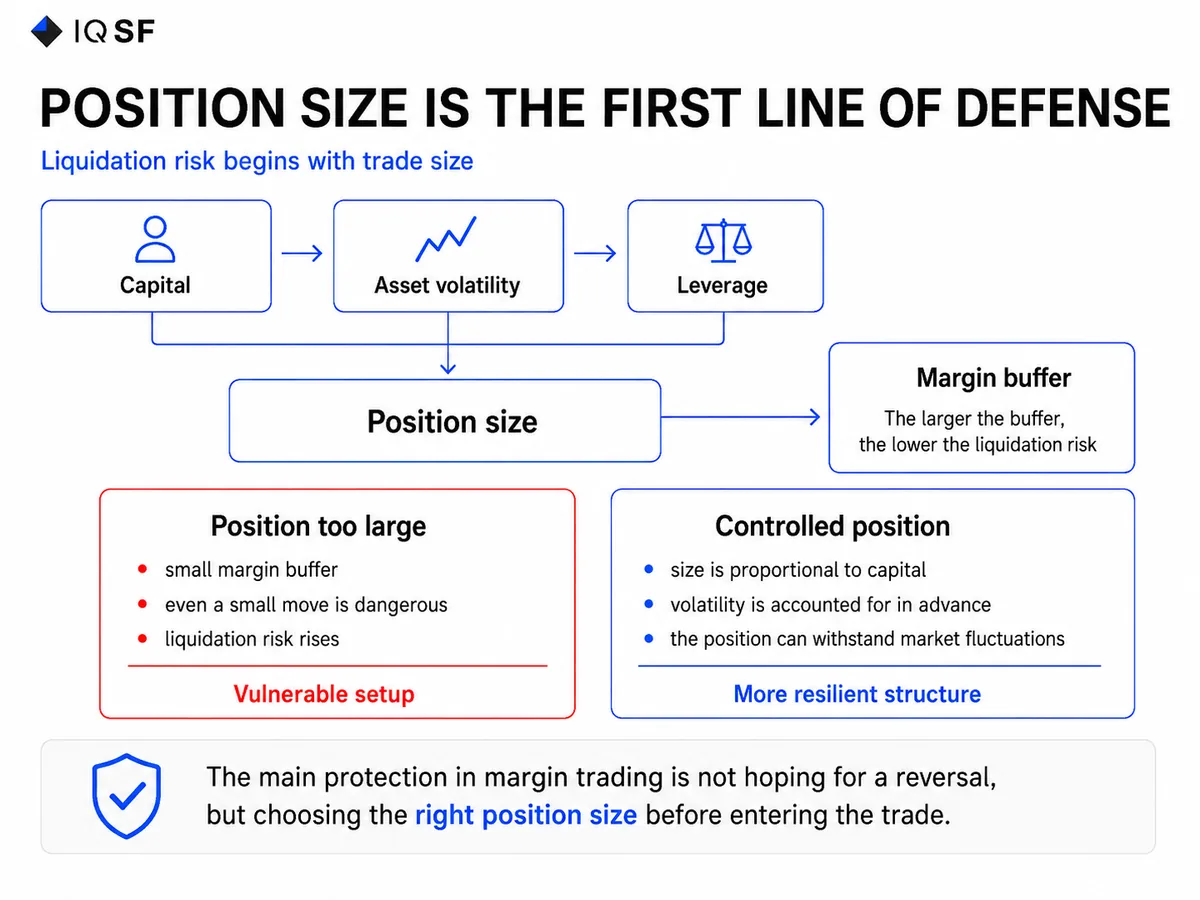
Before talking about stop-losses and hedging, it is worth recognizing one thing: the main capital control tool is position size.
Determining position size relative to capital and asset volatility — known in English as position sizing — addresses liquidation risk long before the market even approaches the margin threshold.
It is similar to the difference between borrowing money to buy one lottery ticket and borrowing money to buy one hundred. In the second case, the potential win is higher, but the debt that remains if you lose also increases proportionally — and it must be repaid regardless of the outcome.
Credit risk in margin trading is often underestimated. Borrowed funds from an exchange are still credit, and counterparty risk represented by the exchange must be considered alongside the market risk of the position itself.
Portfolio risk is not determined by one individual trade. It is determined by the combined leverage across all open positions at the same time. It is this total portfolio risk that defines the real vulnerability to liquidation risk in the market as a whole.
Capital protection: a system, not intuition
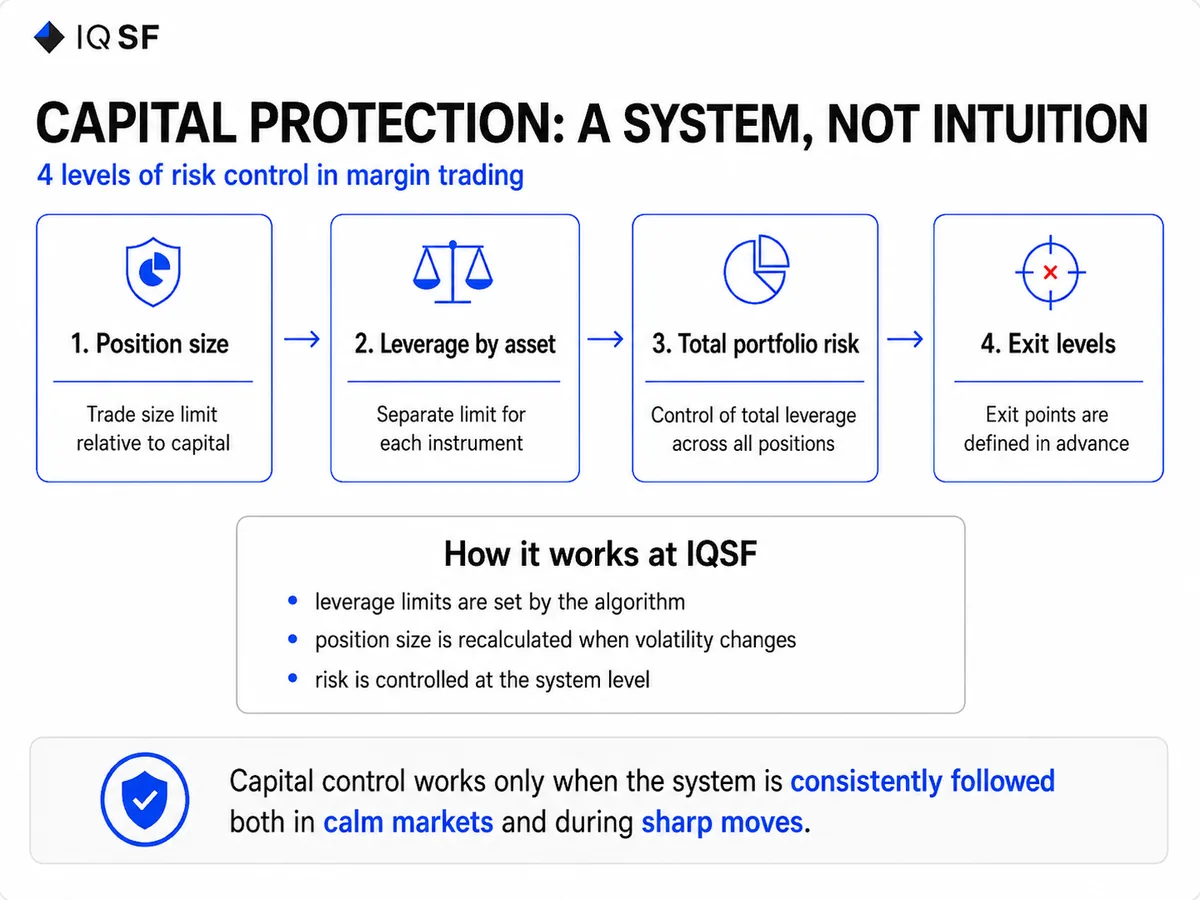
Capital protection is not reduced to a single rule. It is built as a multi-layer system:
- Position size – limiting the volume of each individual trade relative to capital.
- Asset-level leverage – a separate limit for each instrument based on its volatility.
- Total portfolio risk – a limit on the combined leverage across all open positions at once.
- Exit levels – pre-defined points for closing positions during adverse market moves, rather than decisions made in a moment of panic.
Investment risk in margin trading is manageable only to the extent that this system is followed consistently — not selectively during calm periods.
Capital control must work the same way in a quiet market and during a sharp move, because it is sharp moves that test the strength of the system in practice, not in theory.
How this works in institutional management
At IQSF, capital control is built as an algorithmic system of limits.
Position size and leverage are calculated in advance based on the volatility of the asset, rather than being determined manually in the moment of an emotional decision.
This approach does not eliminate liquidation risk completely, but it turns it from an unpredictable event into a managed and pre-calculated probability.
The key principles of this approach are:
- leverage limits are defined by the algorithm, not by a trader in the moment;
- position size is recalculated when asset volatility changes;
- total portfolio risk is controlled at the system level, not at the level of a single trade.
This is not investment advice. It is an explanation of the mechanics of risk in margin trading — mechanics that every investor should understand before opening a leveraged position.
Frequently asked questions
What happened to Archegos and why does it matter for crypto trading?
Archegos, a family office managed by Bill Hwang, collapsed within a few days in March 2021 after building hidden leverage several times larger than its own capital through derivatives and several banks. When one security fell sharply, banks demanded collateral at the same time, and forced liquidations followed. Counterparty banks' losses exceeded $10 billion, showing how leverage accelerates both profit and forced closure.
Why is liquidation more dangerous than a normal drawdown?
Liquidation is more dangerous than a normal drawdown because it is irreversible: a drawdown is temporary and can be survived if position size and capital allow staying in the market, while liquidation is a forced closure by the exchange once the margin threshold is reached. The same position cannot be restored afterward. Crypto is especially exposed because prices can move sharply over very short periods.
What is position sizing and why does it matter for liquidation risk?
Position sizing means setting position size relative to capital and asset volatility, and it is the main tool of capital control since it addresses liquidation risk long before the market nears the margin threshold. It works like borrowing for one lottery ticket versus one hundred: the win is higher in the second case, but so is the debt owed regardless of outcome. Portfolio risk ultimately comes from combined leverage across all open positions.
What layers make up a systematic approach to capital protection in margin trading?
A systematic approach to capital protection has four layers: position size limiting each trade relative to capital, asset-level leverage set for each instrument based on its volatility, a limit on total portfolio risk across all open positions at once, and pre-defined exit levels rather than decisions made in panic. This system needs to work the same way in calm markets and during sharp moves, since sharp moves are what actually test it.