Crypto arbitrage trading: real returns and where the catch is
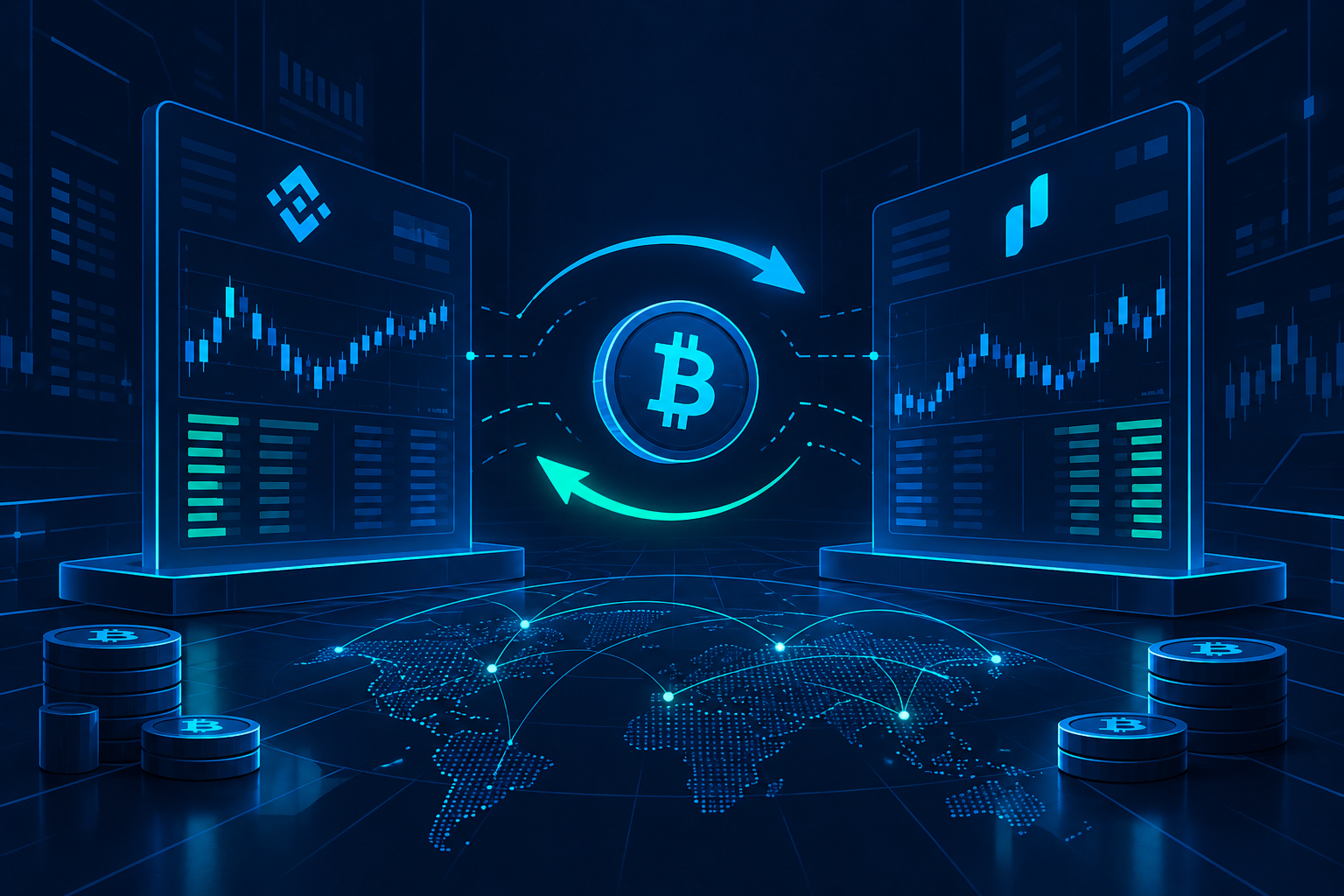
In this article, we’ll explore how crypto arbitrage really works, how much traders can earn from price and funding rate differences, why fees often consume potential profits, and what risks are hidden behind a seemingly market-neutral strategy.
Crypto arbitrage trading means buying a coin where it is cheaper and simultaneously selling it where it costs more: the profit comes from a price or funding rate gap, not from the market going up. On major exchanges that gap is almost always smaller than the fees: from June 28 to September 24, 2026, bitcoin prices on Binance, Bybit and Bitget diverged by more than the cost of two trades (0.2%) in one minute out of 128,160, and over the same period funding rate arbitrage between Binance and Bybit earned 0.43% of the position before fees and 0.22% after.
How crypto arbitrage trading works
Crypto arbitrage profits from differences in prices or payments on the same asset in different places, and it comes in five common forms.
• Cross-exchange. Buy bitcoin where it is cheaper and sell it at once where it is dearer, with cash and coins already on both exchanges, or the gap closes before a transfer arrives.
• Spot plus perpetual (cash and carry). Buy the coin and short a perpetual of the same size to collect funding.
• Cross-exchange funding rate arbitrage. Short the perpetual where funding is higher and go long where it is lower.
• Triangular. A chain of swaps on one exchange when cross rates briefly fail to line up.
• P2P. Buying USDT for rubles from one person and selling it to another at a higher price.
Its place in a market-neutral portfolio next to long short is covered in Long-short and crypto arbitrage.
Cross-exchange arbitrage: an example with Binance, Bybit and Bitget prices
On bitcoin and ether, cross-exchange arbitrage leaves a retail trader almost no gap after fees: over 89 days from June 28 to September 24, 2026 the gap covered the cost of two trades in exactly one minute.
We compared one-minute BTC/USDT and ETH/USDT spot prices on the three exchanges via their public APIs. At the base spot fee of 0.1% per trade, a round of buying on one exchange and selling on another costs 0.2%, while the median bitcoin gap between the dearest and the cheapest exchange was 0.0069%, 29 times smaller.
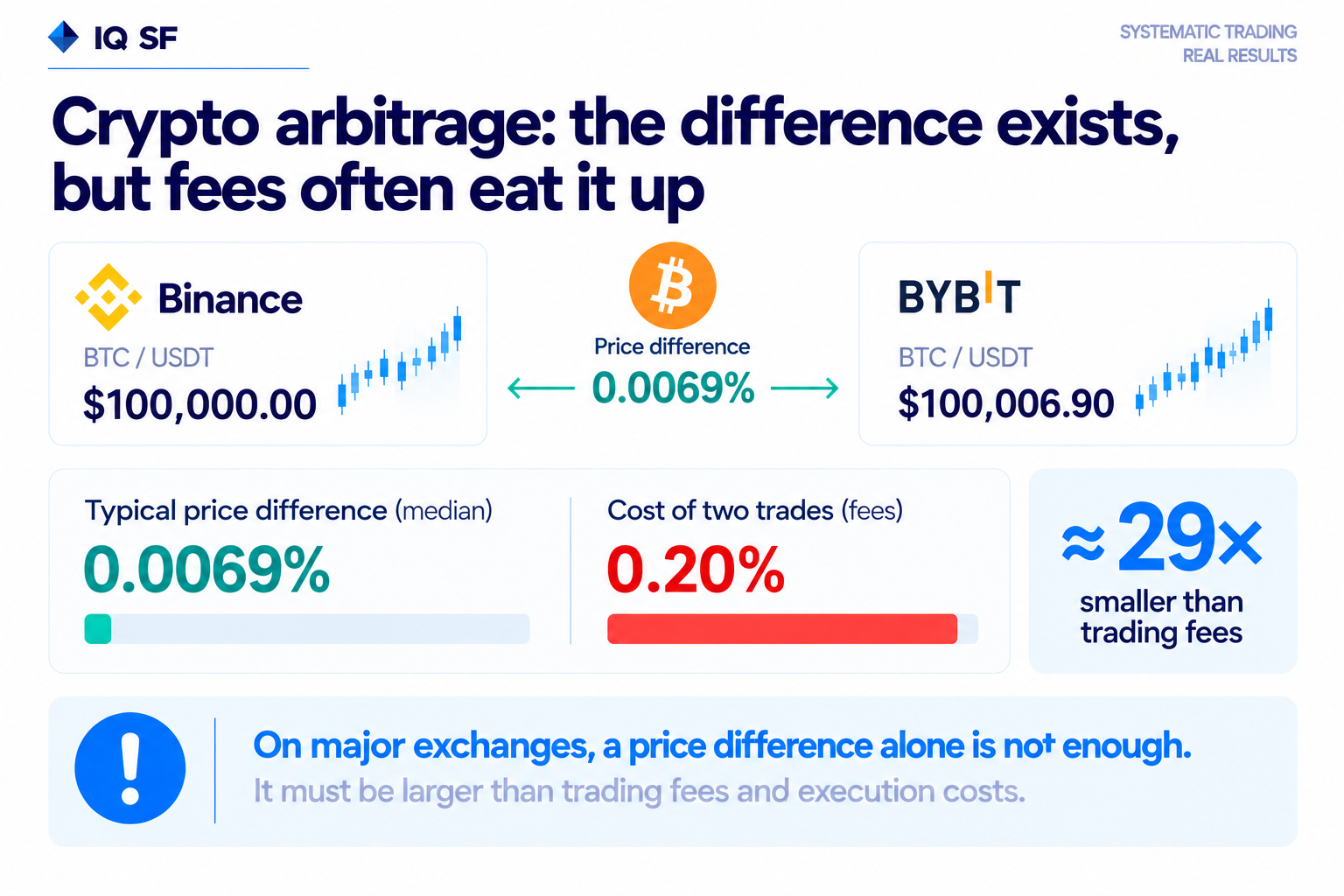
Minute data errs both ways: last-trade prices inflate gaps compared with the order book, while gaps that open and close within a minute never reach the sample, so their number is understated. On executable order book prices on September 28, the median bitcoin gap between Binance and Bybit was also in thousandths of a percent.
How much do fees eat into crypto arbitrage?
In arbitrage the fee matters more than the signal: gross profit per trade is measured in thousandths and hundredths of a percent, the fee in tenths.
On the trade journal of the Basket 50 strategy (2,900 fills over 691 days), the same trades would have made +30% at a 0.1% fee, typical of intermediaries in the CIS, and +126% at 0.04%, a VIP tier on Binance futures, by our calculation. This shows only sensitivity to fees: as of 27.09.2026 the dashboard gives Basket 50 a maximum drawdown of -28.59% and a longest drawdown period of 234 days, and past performance does not guarantee future results.
An arbitrageur has no edge beyond the price gap itself, so gaps on liquid coins go to players with minimal fees and automated execution.
Funding rate arbitrage: Binance vs Bybit vs Bitget
The funding rate is a payment between buyers and sellers of a perpetual futures contract every 8 hours; in 2026 the difference in these payments across Binance, Bybit and Bitget was worth fractions of a percent per quarter.
When the rate is positive, longs pay shorts, but the amount varies several-fold: over seven years since September 2019, a BTCUSDT long on Binance paid from 4.16% of the position (2022) to 30.61% (2021) per full year. Here is what is left of those payments by our calculation at base taker fees, as a percentage of the position:
BTC setup | Before fees | After fees |
Short on Binance, long on Bybit, 89 days | 0.43% | 0.22% |
Spot plus short on Binance, 89 days | 1.64% | 1.34% |
Spot plus short on Binance, 12 months from 25.09.2025 | 3.39% | 3.09% |
Is crypto arbitrage risk-free? Where the catch is
Arbitrage looks risk-free only in a spreadsheet: each leg lives on its own exchange, money does not move between exchanges by itself, and an exchange can halt withdrawals.
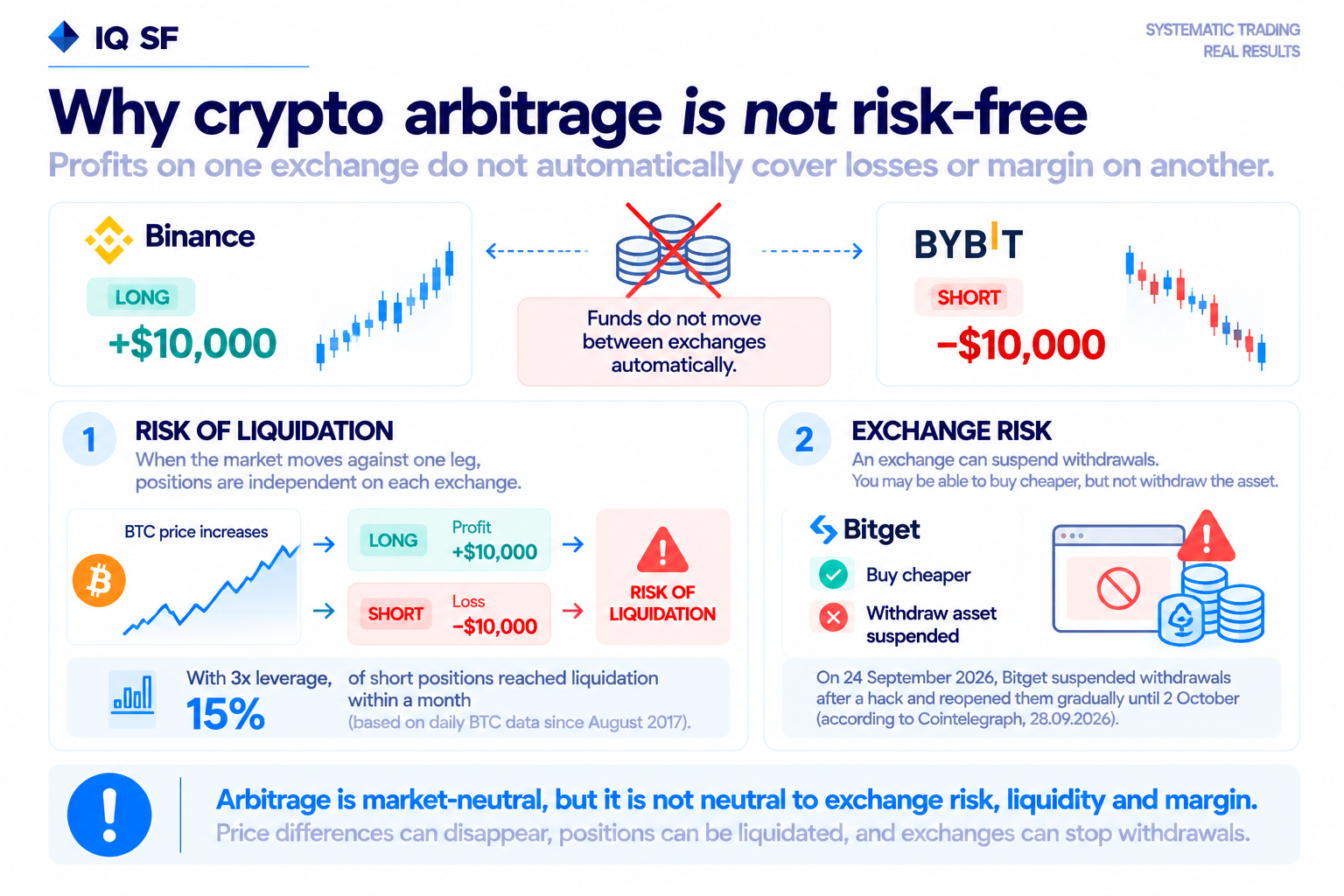
One leg gets liquidated. When bitcoin rises, the short on one exchange loses, and the long's profit elsewhere will not top up its margin by itself. By our calculation on daily BTC candles since August 2017, a 3x short opened on any day without a margin top-up hit liquidation within a month in 15% of cases. How to calculate that threshold: Leverage and liquidation risk.
The exchange halts withdrawals. On September 24, 2026, Bitget suspended withdrawals after a hack and is reopening them in stages through October 2 (Cointelegraph, 28.09.2026). In our September 28 snapshot of best prices for every USDT pair, in 85% of gaps above fees the cheapest price was on Bitget, where only bitcoin withdrawals were open at the time. You could buy cheaper there but not take the coin out: that is where scanners' big gaps come from.
Crypto arbitrage reviews and scams: the red flags
A review with a screenshot of profits does not prove that arbitrage works; a fake scheme shows signs you can see before handing over money.
• A fixed income per "round" or per day is promised. Price gaps and funding rates change every day, and even calm strategies have drawdowns. Quantum Alpha, the calmest strategy by volatility on the IQSF strategy dashboard, as of 28.09.2026 shows a CAGR of 19.03%, a maximum drawdown of -3.94% and a longest drawdown period of 298 days. Past performance does not guarantee future results.
• Money has to be sent to the organizer: a wallet, "platform" or "pool". That is how a Ponzi scheme works.
• The only evidence is screenshots and chats. Strategy statistics are verified with trade exports from the exchange through a read-only key, which is what the IQ Metrics service does.
P2P arbitrage in Russia is a separate case: strangers' money lands on your card, and if some of it belongs to a fraud victim, the card can end up in the Bank of Russia database. Under Law No. 161-FZ the bank may then suspend the client's card and online banking, and must do so when police data on unlawful actions is in the database. Since July 5, 2025, Article 187 of the Russian Criminal Code punishes handing your card or access to it to another person for gain for unlawful transactions, and making such transactions on someone else's instructions, with up to three years in prison.
Federal Law No. 282-FZ of 4 August 2026 "On Digital Currencies and Digital Rights" has been in force since 1 September 2026: crypto is defined as property and cannot be used for payments inside Russia. The law treats systematic buying and selling of crypto in one's own name off-exchange, two or more deals a month totaling over 3.5 million rubles, as exchange-office activity reserved for organizations on the Bank of Russia register (Article 18), though until 30 June 2027 residents may do so without being on the register (Article 55, Part 28). The rules for admission to the register take effect on 5 October 2026. From 1 July 2027 residents may buy and sell crypto for money in Russian banks, cash or other property in Russia only through or with organizations on the register; until then the law sets no such requirement.
Crypto arbitrage courses: what paid "routes" really sell
A crypto arbitrage course can be checked with one calculation: how much money the promised "route" carries before the gap closes, and how many students have to share that amount.
A "route" (Russian courses call it a "bundle") is a trade path: where to buy, where to sell, which bank or network to use. A market route lives until others find it and carries little: on September 28 the order book let no more than $9,100 through a gap above fees between Binance and Bybit, so a hundred buyers would close it with their first trades. A working route pays more when run on one's own money, so selling routes means the author earns from sales.
Honest arbitrage training starts with costs: fees, order book depth, funding rates, the liquidation threshold, exchange risk. Another red flag is an "operator" or "processing" job: the student is asked to receive transfers on their own card and send crypto on a curator's instructions. Russia's Interior Ministry lists employment at a crypto exchange office among eight schemes used to recruit money mules ("Moi Finansy" portal, August 2025).
This material is for information only and is not individual investment advice.
Frequently asked questions
Is crypto arbitrage still profitable in 2026?
It can be, but on liquid coins at major exchanges income is fractions of a percent per trade and single-digit percentages a year. Over the 12 months from 25.09.2025, spot plus short perpetual on bitcoin at Binance returned 3.09% of the position after fees.
What is an arbitrage "route" or "bundle"?
A trade path: where to buy a coin, where to sell it and how to move the money. A working route carries a limited amount and disappears once many people use it, so a paid route feeds the seller more than the buyer.
Why is P2P crypto arbitrage risky?
Strangers' money passes through your card; if some of it comes from fraud victims, the bank may suspend your card and online banking under Russia's Law No. 161-FZ. From 1 July 2027, crypto deals for money in Russian banks, cash or other property in Russia will be possible only through or with organizations on the Bank of Russia register.