Discretionary asset management and hedge funds: active, passive, and delegated capital management
In this article, we’ll explore the difference between active, passive, and delegated capital management, how hedge funds and discretionary management structures work, and why investors should understand who makes decisions, within what risk limits, and how results are verified.
In 1976, John Bogle launched the first retail index fund and was met with a wave of ridicule. Competitors called the idea “Bogle’s folly” and almost “un-American” because the fund openly admitted a simple truth: almost no one can consistently beat the market, so investors should simply follow it with minimal costs.
Half a century later, passive management has become a multi-trillion-dollar industry. This story shows an important point: the debate between active and passive management is not new and not abstract. It has a real fifty-year history, and real numbers are at stake.
Discretionary asset management: who controls what
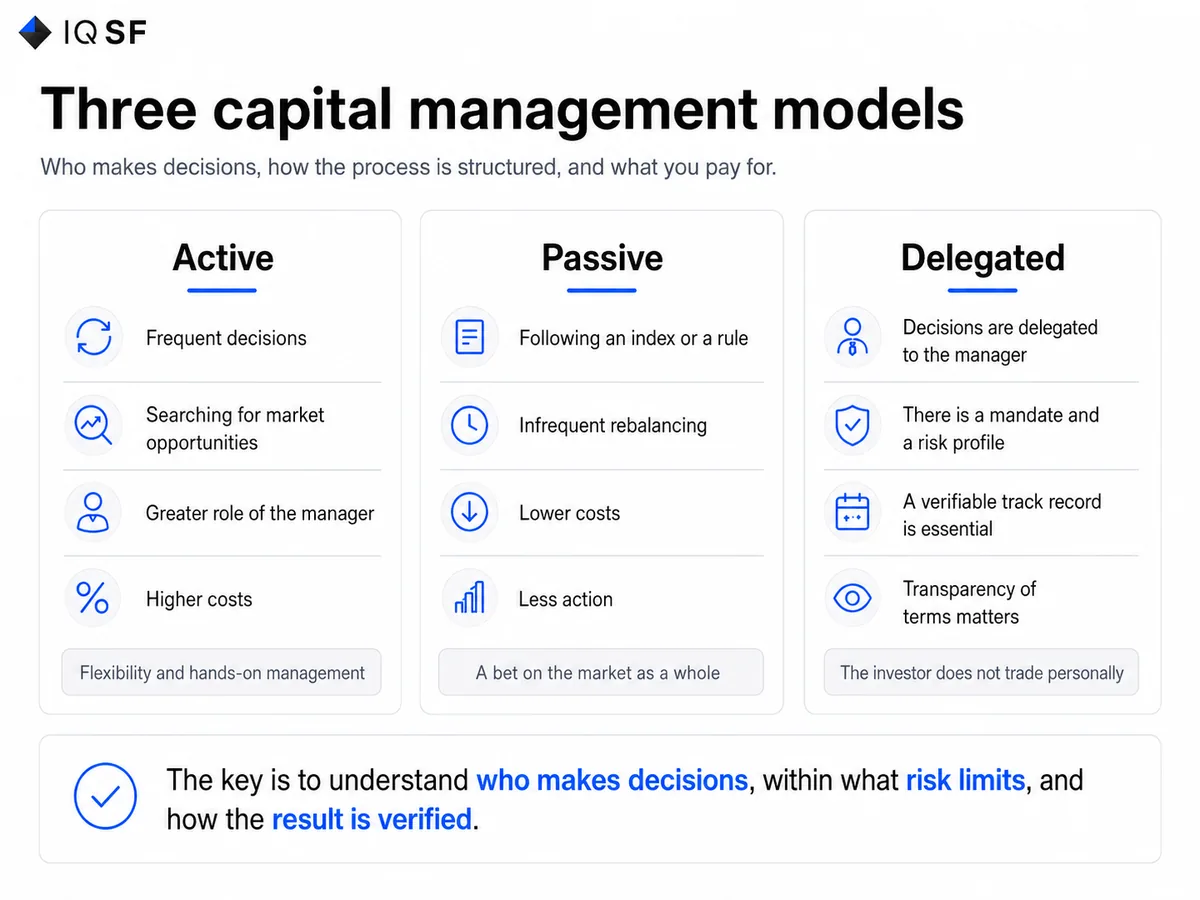
In its classic form, discretionary asset management means that an investor delegates capital to an investment manager, who makes decisions within a pre-agreed mandate.
This is a form of delegated management: the investor does not trade independently, but also does not fully step away from the process. The mandate defines what the manager is allowed to manage and within which risk limits.
A hedge fund, as a form of capital organization, usually gives the investment manager a broader mandate:
- use of borrowed funds beyond standard retail limits;
- short positions and derivatives that may not be available in traditional discretionary management through an exchange account;
- alternative strategies such as arbitrage and market-neutral approaches, which require a more flexible mandate.
This is why a hedge fund is usually associated with a more active trading model than a conservative discretionary account.
Active management versus passive management
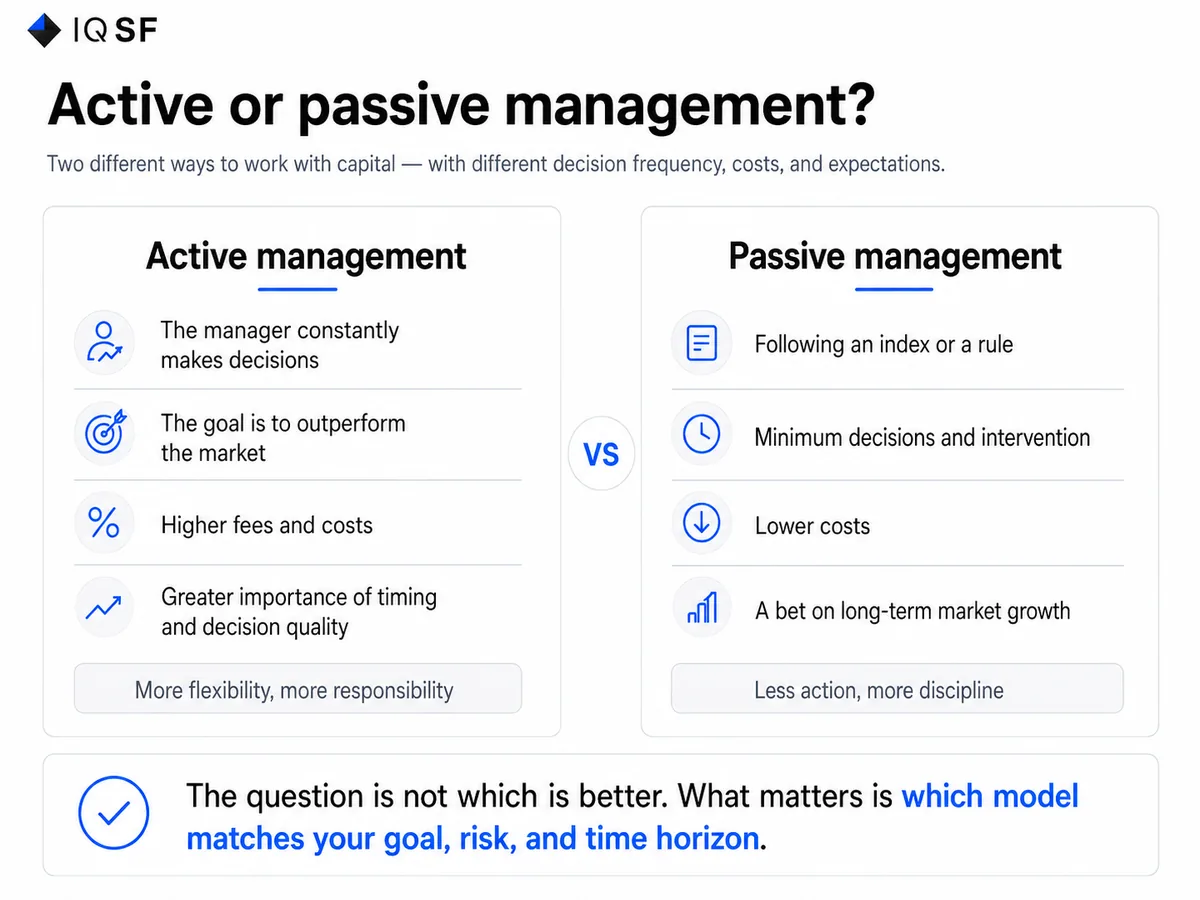
Active management means that the investment manager constantly makes decisions: when to enter, when to exit, and how to adjust position size as market conditions change.
Passive management, on the other hand, is based on following a predefined rule or index with minimal manual intervention.
In practice, the difference comes down to several criteria:
- Decision frequency. Active management means a constant flow of decisions by the manager. Passive management usually means rare rule-based rebalancing.
- Costs. Active management is usually more expensive because it requires ongoing expert work and often comes with a higher fund fee.
- Source of returns. Active management is justified where the market offers enough inefficiencies for regular decisions to add value beyond a passive alternative. Passive management is justified where the costs of active decisions, including timing mistakes and emotional decisions, eat away the potential advantage.
The difference is similar to choosing between cooking every dinner from scratch, subscribing to the same weekly meal kit, or hiring a personal chef with a clear menu. Each option can work, but each promises a different result for a different price.
Confusing them means paying for one model while expecting the result of another.
A good investment fund clearly explains which model it follows, rather than presenting one model as another under attractive packaging.
Delegated management in digital assets
A separate and rapidly growing category is the digital fund or crypto fund, where delegated management is applied to digital assets instead of traditional securities.
The logic is the same: the investor gives a mandate to the manager. But the asset class, custody infrastructure, and risk profile are different from those of a traditional fund.
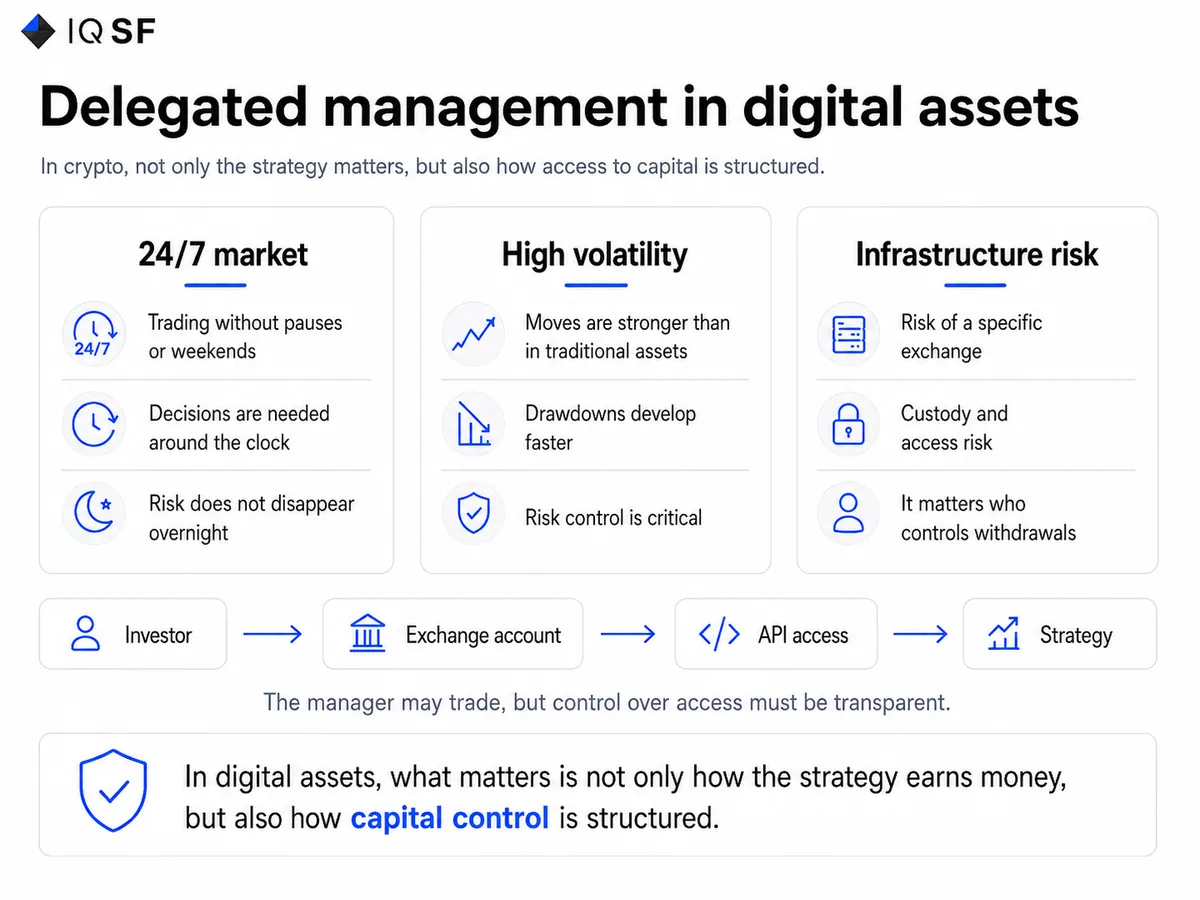
That is why, for a crypto fund, it is not enough to simply copy the structure of a traditional hedge fund. Discretionary asset management must be adapted to the specific nature of digital assets:
- a 24/7 market with no pauses and no weekends;
- high volatility compared with traditional assets;
- risks related to specific exchanges and custodians, which do not exist in the same form in a traditional investment fund.
How to choose a management model
When choosing between active management, passive management, and fully delegated management through a hedge fund or crypto fund, the key question is simple:
Are you ready to make investment decisions yourself, or do you prefer to delegate them to an investment manager with a clear mandate and a verifiable track record?
IQSF works under an active discretionary management model with a transparent mandate for digital assets. The investor understands exactly which strategy is being implemented and within which risk limits the management company operates.
This is not investment advice. It is an explanation of the difference between capital management models, so that the decision to choose a manager can be made consciously.
Frequently asked questions
What is discretionary asset management?
Discretionary asset management means an investor delegates capital to a manager who makes decisions within a pre-agreed mandate. The investor does not trade personally but also does not step fully away from the process, since the mandate defines what the manager can do and within which risk limits. This differs from a hedge fund mainly in how broad that mandate is.
What is the difference between a hedge fund and a discretionary account?
A hedge fund usually gives the manager a broader mandate than a conservative discretionary account. It can include borrowed funds beyond standard retail limits, short positions and derivatives, and alternative strategies such as arbitrage or market-neutral approaches. This wider mandate is why a hedge fund is generally associated with a more active trading model.
What is the difference between active and passive management?
Active management means the manager constantly decides when to enter, exit, and adjust position size, while passive management follows a predefined rule or index with minimal intervention. The two differ in decision frequency, in cost, since active management is usually more expensive, and in the source of returns. Confusing the two models means paying for one while expecting the result of the other.
How does delegated management work for digital assets?
Delegated management in digital assets follows the same logic as a traditional fund, but the asset class, custody, and risk profile differ. A crypto fund must adapt discretionary management to a 24/7 market, higher volatility than traditional assets, and risks tied to specific exchanges and custodians. IQSF operates under an active discretionary model with a transparent mandate for digital assets.