What is a hedge fund and how does it work?

In this article, we’ll explore what a hedge fund is, how it differs from a traditional investment fund, which strategies and financial instruments hedge funds use, how the “2 and 20” fee structure works, and what risks investors should consider before investing.
A hedge fund is a private investment fund for wealthy and professional investors that is allowed to do more than an ordinary fund: sell assets short, borrow to amplify positions, trade derivatives and run arbitrage. It pays for that freedom with exclusivity: not everyone may invest, money can be withdrawn only on set dates, and the manager takes a share of profits on top of an annual fee.
What is a hedge fund in simple terms?
A hedge fund pools money from a few large investors and gives the manager a broad mandate, and in exchange it may be sold only to a narrow circle of buyers.
The name goes back to the fund that sociologist and journalist Alfred Winslow Jones launched in 1949. He bought stocks he considered cheap and at the same time sold short the ones he considered expensive, so that a falling market would hurt the portfolio less. That is what "hedging" means: insuring against a loss. Jones also borrowed to increase his positions and charged 20% of profits, and the approach became widely known after a Fortune magazine article in 1966.
Many hedge funds today hedge nothing and bet in one direction only. The word describes a type of fund and a flexible mandate, not safety: a hedge fund can be more cautious than the market or far riskier than it.
Hedge fund vs mutual fund: key differences
A hedge fund differs from a mutual fund in who can invest, what the manager may do, how investors get their money back, what it costs and how much is disclosed publicly.
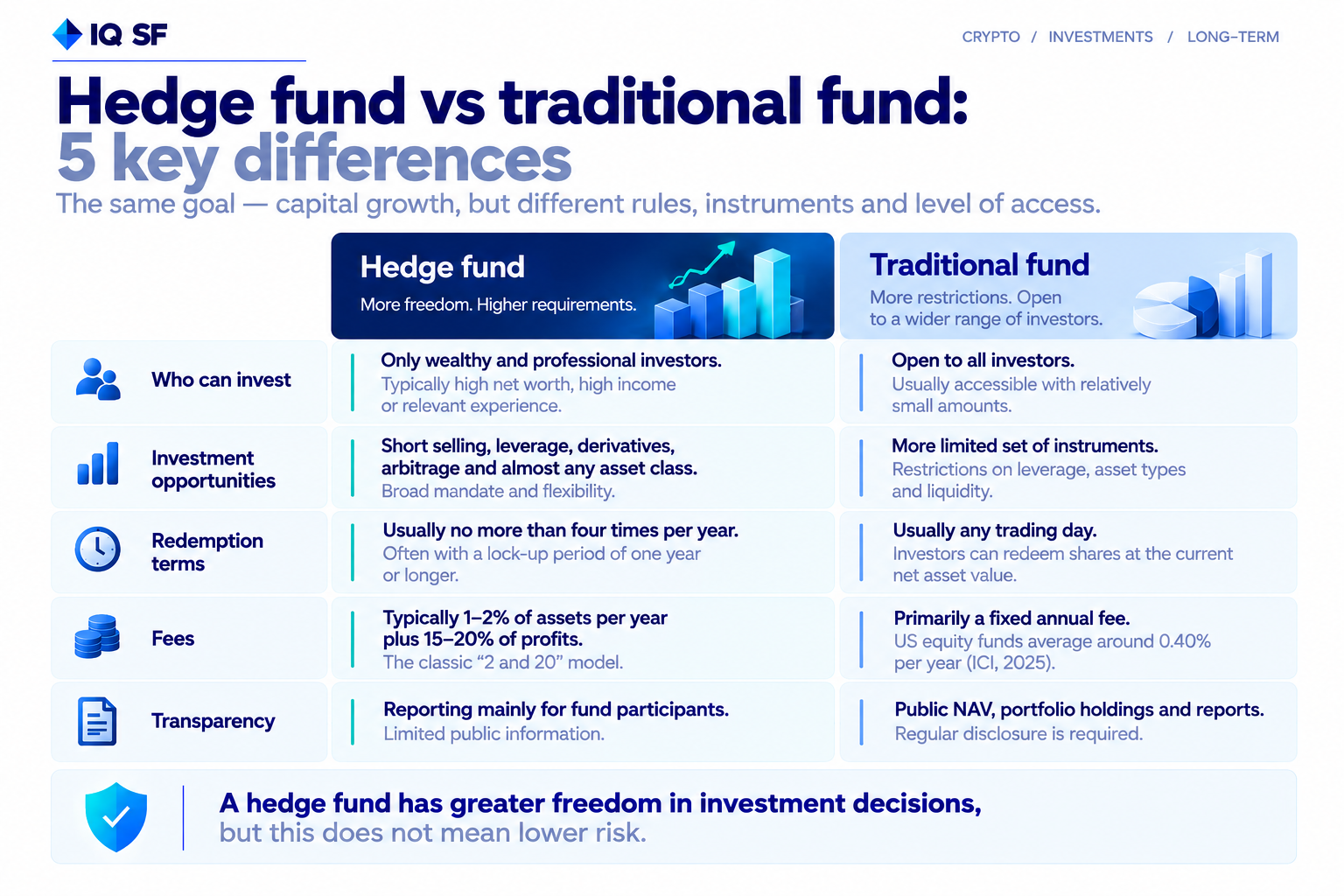
Feature | Hedge fund | Mutual fund |
Who can invest | Only wealthy and professional investors | Anyone, usually with a low minimum |
What is allowed | Short selling, leverage, derivatives, almost any asset | Limits on assets, leverage and illiquid holdings |
Getting money back | Typically four times a year or less, often after a lock-up of a year or more | Any business day at the next net asset value |
Fees | 1-2% of assets a year plus 15-20% of profits | An annual expense ratio |
Public disclosure | Reports to the fund's own investors, little public information | Prices, holdings and shareholder reports are public |
Hedge funds are not marketed to retail investors, and the obligations of a mutual fund, such as daily redemption at net asset value or keeping leverage within set limits, do not apply to them. Ordinary funds are also much cheaper. According to the Investment Company Institute, the average expense ratio of US equity mutual funds was 0.40% in 2025.
Who can invest in a hedge fund?
Hedge funds accept only investors able to judge the risk on their own and absorb a loss: people with large capital, high income or professional credentials.
The reason lies in how the fund works: leverage multiplies losses, money cannot be withdrawn on any day, some assets are hard to sell and value, and little is disclosed publicly. Thresholds for capital and income and other conditions of access differ from country to country. Each fund may also set its own minimum investment on top.
How do hedge funds make money?
Hedge funds earn with tools that ordinary funds are limited in using: short selling, borrowed money, derivatives and arbitrage between related assets.
Short selling means selling a borrowed asset in the hope of buying it back cheaper. Leverage multiplies both gains and losses. Arbitrage looks for price gaps between closely related assets, such as a bond and a futures contract on it. HFR, which compiles industry indices, groups hedge funds into four main strategies: equity hedge (long and short stock positions), event driven, macro and relative value. Equity hedge, the largest, managed $1.76 trillion at the end of the second quarter of 2026, out of a record $5.6 trillion for the whole industry.
The danger of leverage is best shown by Long-Term Capital Management. According to the Federal Reserve's history of the episode, at the end of 1997 the fund held about $30 of debt for every $1 of its own capital. In August 1998, its bets that price spreads would narrow went the other way, and it lost 44% of its value in that month alone. On September 23, 1998, fourteen banks and brokerage firms put $3.6 billion into the fund to avoid a fire sale of its positions.
Hedge fund fees: what "2 and 20" means
The classic "2 and 20" formula means 2% of assets a year for management plus 20% of profits for performance, and in practice the manager keeps well over a fifth of what the fund earns.
A simplified example: a fund earns 10% on $1 million, or $100,000. The 2% management fee takes $20,000, and the fund then keeps 20% of the remaining $80,000 of profit, another $16,000. The investor is left with $64,000, or 6.4% instead of 10%, while the manager collects 36% of the gain. In a losing year the management fee is still charged: if the fund falls 5%, the investor loses 7%.
Actual rates are now lower than the classic formula. HFR estimates that in the first quarter of 2026 the average industry-wide management fee was 1.32% and the average incentive fee 15.78%. Investor.gov describes the typical range as 1-2% of assets plus 15-20% of profits, usually subject to a high-water mark and a hurdle rate. How a high-water mark works, and why without it an investor pays twice, is explained in Manager fees: management fee, success fee and high-water mark.
Reporting: what a hedge fund investor can see
A hedge fund investor sees less than a mutual fund shareholder and has to find out alone who holds the assets, who values them and who audits the reports.
A hedge fund does not have to publish a daily price, and some of its assets are hard to sell and hard to value. Investor.gov advises reading the offering memorandum, understanding how assets are valued and how much of the valuation comes from independent sources, and checking when and how money can be redeemed. How the roles of manager, custodian and auditor are separated in a sound fund is covered in How to verify a fund or asset manager.
This material is for information only and is not individual investment advice.
Frequently asked questions
What is the difference between a hedge fund and a mutual fund?
A hedge fund is open only to wealthy and professional investors, can sell short and use leverage, lets investors withdraw only on set dates and takes a share of profits. A mutual fund is open to anyone, redeems shares on any business day and is limited in what it can hold and how much it can borrow.
Can an ordinary person invest in a hedge fund?
Only by meeting the conditions of access: hedge funds accept investors with large capital, high income or professional credentials who can judge the risk on their own and absorb a loss. Each fund may also set its own minimum investment on top.
Why is it called a hedge fund?
The first such fund, launched by Alfred Winslow Jones in 1949, hedged its stock purchases with short sales to depend less on the direction of the overall market. Today the name refers to a type of fund and a broad mandate rather than to any guaranteed protection.
Are hedge funds risky?
They can be. Leverage multiplies losses, money cannot be withdrawn on any day, some assets are hard to value, and fees take a noticeable share of profits. Long-Term Capital Management showed in 1998 that even a fund run by well-known managers can lose almost half its value in a single month.