Crypto futures explained: perpetual futures and their risks
In this article, we’ll explore how cryptocurrency futures work, the difference between traditional and perpetual contracts, how leverage and funding rates affect trading results, why even small price movements can trigger liquidation, and what risks beginners should understand before trading futures.
Crypto futures are contracts that settle on the price of a coin fixed when the trade is made, usually in cash, without the coin itself changing hands. Most trading happens in perpetual futures, which never expire and are kept close to the coin price by a funding rate that longs and shorts pay each other every few hours.
Futures let you take a position on a rise or a fall and use leverage. That makes them more dangerous for a beginner than buying the coin: losses arrive faster, holding a position costs money, and the exchange can close it without asking.
How do crypto futures work
A crypto futures contract is a contract on the price of a coin: the buyer gains when the price rises, the seller gains when it falls, and the exchange holds collateral from both sides and recalculates their results continuously.
The underlying asset is the coin price, usually an index built from several trading venues. Contract size is fixed: on CME, where regulated bitcoin futures have traded since December 2017, a standard contract covers 5 bitcoin. To open a position you post collateral, called margin, which is smaller than the position itself. The ratio of position to margin is the leverage.
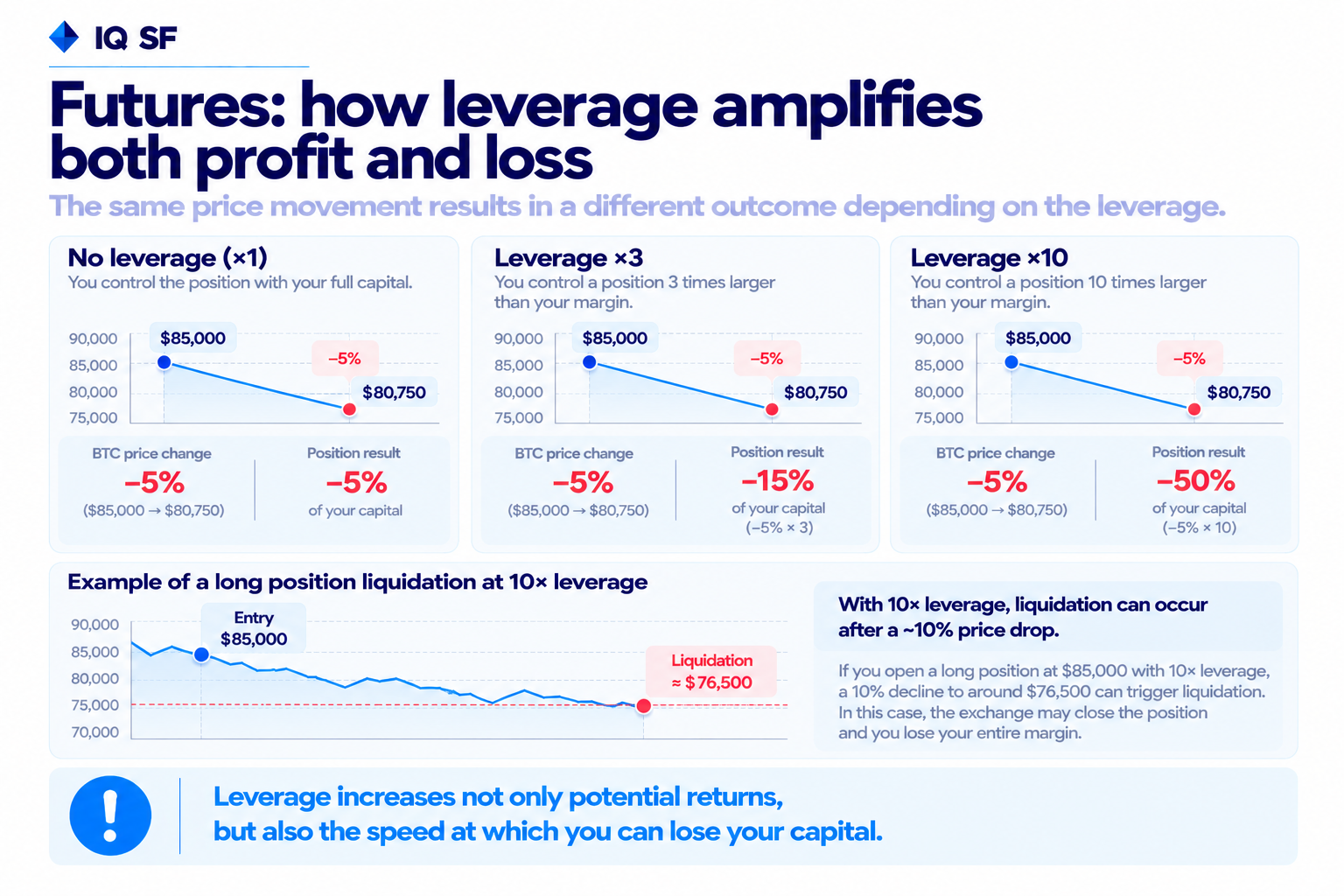
For example, at 10x leverage a position of 1 bitcoin at $85,000 needs $8,500 of margin. A 1% rise in price brings $850, or 10% of the money posted, and a 1% fall takes the same amount away.
According to Coinbase's shareholder letter for the second quarter of 2025, derivatives accounted for 75% of global crypto trading volume over the previous two years.
Perpetual vs dated futures: what is the difference
A dated futures contract has an expiry date, by which its price converges with the coin price, while a perpetual contract never expires and stays close to the market through the funding rate.
Dated contracts are usually monthly or quarterly; staying in the market past expiry means rolling into the next contract and paying commissions and the price gap.
Perpetual futures in crypto trace back to 2016, when the BitMEX exchange launched XBTUSD, a contract that followed the bitcoin price in dollars and never expired. There is nothing to roll, but there is a running cost: instead of a one-off settlement at expiry, the two sides exchange funding payments.
What is the funding rate and how is it calculated
The funding rate is a payment between longs and shorts in a perpetual contract: when the contract trades above the coin, longs pay shorts; when it trades below, shorts pay longs.
On Binance, most contracts pay funding every eight hours, at 00:00, 08:00 and 16:00 UTC. The formula includes a default interest component of 0.03% a day, or 0.01% per eight-hour interval, and the exchange charges no fee on these payments: the money goes directly from one side to the other. The payment is calculated on the size of the position, not on the margin. A $10,000 position at the base rate pays 10,000 × 0.0001 × 3 × 365 = 1,095 dollars a year, or 10.95%.
We went through all 7,715 funding payments on the BTCUSDT contract on Binance from September 10, 2019 to September 24, 2026. A long position of constant size would have paid 81.42% of its value over seven years. Longs were the paying side in 85.8% of payments. A third of all payments (35.2%) came in exactly at the base rate: under the Binance formula, a small gap between the contract and the index leaves the rate at its base level, so longs keep paying even in a quiet market. The cap on this contract is ±0.3% per eight hours, and the rate hit it twice: the upper bound on February 12, 2020 and the lower bound on March 13, 2020, when shorts were paying.
Year | Paid by a long, % of position size | Same at 3x leverage, % of own money |
2019, from September 10 | 2.31 | 6.9 |
2020 | 17.24 | 51.7 |
2021 | 30.61 | 91.8 |
2022 | 4.16 | 12.5 |
2023 | 7.87 | 23.6 |
2024 | 11.96 | 35.9 |
2025 | 5.13 | 15.4 |
2026, to September 24 | 2.15 | 6.4 |
Seven years in total | 81.42 | 244.3 |
Leverage does not change the payment itself, but it multiplies its share of your own money: in 2021, at 3x leverage, funding would have taken 91.8% of the margin posted. The cost also depends on the venue: over the same window, June 28 to September 24, 2026, an identical long paid between 1.21% and 1.64% of its size on three large exchanges.
Basis: why futures prices differ from spot
The basis is the gap between the futures price and the coin price: for a dated contract it shrinks to zero by expiry, and for a perpetual the funding rate keeps squeezing it almost all the time.
A hypothetical example: bitcoin trades at $85,000, and a quarterly contract 90 days before expiry trades at $86,700. The basis is 2% of $85,000, which is $1,700, or about 8.1% a year. The futures buyer pays this premium for getting exposure without buying the coins outright, and a seller who holds the coins collects it by expiry.
When futures trade above the coin, the market is in contango; below it, in backwardation. In a perpetual the gap shows up in the funding rate: the richer the contract, the more longs pay, and at a noticeable discount shorts pay.
Margin, leverage and liquidation
Liquidation is the forced closing of a position by the exchange when margin runs short, and at 10x leverage a move of about 10% against the position is enough to trigger it.
The liquidation level is checked against the mark price, derived from an index of several venues, not against the last trade. If the collateral left does not cover the loss, the exchange's insurance fund absorbs it, and when that fund runs dry, auto-deleveraging closes some profitable positions on the other side by force.
By our calculation on daily bitcoin candles from 2017 to 2026, at 10x leverage a position opened at the day's opening price, with no stop-loss and no added margin, reached liquidation within a month in 47.3% of cases on the long side and in 58.1% on the short side. An intraday fall of more than 9.6% from the open, enough to liquidate such a long, happened on 104 days over nine years.
Liquidation is triggered by the low, not by the close. On March 13, 2020, bitcoin fell 21.2% below its opening price and still closed the day 16.2% above it. On October 10, 2025, the day's low was 16.2% below the open while the close was down 7.3%, and according to CoinGlass data more than $19 billion of positions were liquidated within 24 hours, the largest such day on record. How position size and leverage control this risk is covered in our article on leverage and liquidation risk.
Why crypto futures are risky for beginners
Futures are risky for beginners because a sizing mistake can cost the entire margin, and costs are charged on the full position, not on the money posted.
Trading fees are also charged on the position. At 10x leverage and a 0.05% fee on entry and the same on exit, one round trip takes 1% of your own money, and funding for 2025, 5.13% of position size, would have eaten 51.3% of the margin at that leverage. The market never closes, so a sharp move at night can close a position while its owner sleeps.
Then there is the risk of the venue itself. On November 8, 2022, FTX halted customer withdrawals, and on November 11 it filed for bankruptcy, leaving customer money tied up in the proceedings for a long time.
How crypto futures are regulated
Rules for crypto futures differ by country, and several major regulators restrict them for retail investors.
In the United States, futures are overseen by the Commodity Futures Trading Commission: bitcoin futures have traded on CME since December 2017, and in July 2025 Coinbase launched CFTC-regulated perpetual-style futures for US customers with up to 10x intraday leverage.
In the United Kingdom, selling crypto derivatives to retail consumers has been banned since January 6, 2021, and in 2025 the Financial Conduct Authority confirmed that the ban stays.
In the European Union, crypto derivatives are financial instruments under MiFID II, and the MiCA regulation does not apply to them. Leverage on crypto contracts for difference for retail clients has been capped at 2:1 since 2018: ESMA set the limit, and national regulators later made it permanent.
This material is for information only and is not individual investment advice.
Frequently asked questions
What are crypto futures in simple terms?
They are contracts on the price of a coin in which the two sides receive or pay the price difference without handing over the coin. The buyer gains when the price rises, the seller when it falls.
What is the difference between perpetual and regular futures?
A dated contract has an expiry date, by which its price converges with the coin price. A perpetual has no expiry and is kept close to the market by a funding rate the two sides pay each other every few hours.
Who pays the funding rate?
When the perpetual contract trades above the coin, the rate is positive and longs pay shorts; when it trades below, shorts pay longs. By our calculation on the BTCUSDT contract on Binance from 2019 to 2026, longs were the paying side in 85.8% of payments.
Can you lose more than you invest with crypto futures?
On crypto exchanges the loss is usually limited to margin: with isolated margin, the amount assigned to the position; with cross margin, the whole account balance. A shortfall after liquidation falls on the insurance fund, but auto-deleveraging can also cut a profitable position.
Why are crypto futures risky for beginners?
Leverage speeds up losses, liquidation is triggered by the intraday low, and fees and funding are charged on the whole position. By our calculation, at 10x leverage almost half of long positions reached liquidation within a month.