Discretionary crypto management: how it works and where the line with a scam begins
In this article, we’ll explore how discretionary crypto management works, what structures investors may encounter, where the line between legitimate management and a scam begins, and which questions you should ask before transferring capital or granting trading access.
Someone made money in crypto in 2021, then gave it all back to the market in 2022.
A familiar story.
After that, he wrote us one sentence: “I no longer want to press the buttons myself, but I’m also afraid to hand my money over to someone I don’t understand.”
That is the main question behind discretionary crypto management: how can you let someone manage your capital without getting scammed?
Let’s break it down honestly, without advertising: what discretionary management in crypto is, how it works technically, and which signs help distinguish a legitimate fund from a scheme that may take your money.
What discretionary crypto management means
Discretionary management means that you do not trade yourself. Instead, you allow a manager or an algorithm to work with your capital according to a pre-defined strategy.
You receive the result after fees, while the manager earns a fee for their work.
In traditional finance, this is a well-established industry with licenses and regulation. In crypto, everything is younger and more aggressive: there is less regulation, which means the responsibility for choosing the right structure is almost entirely on you.
Three ways this can be structured
It is important to understand who you are giving money to and how. This determines both the level of risk and the degree of regulation.
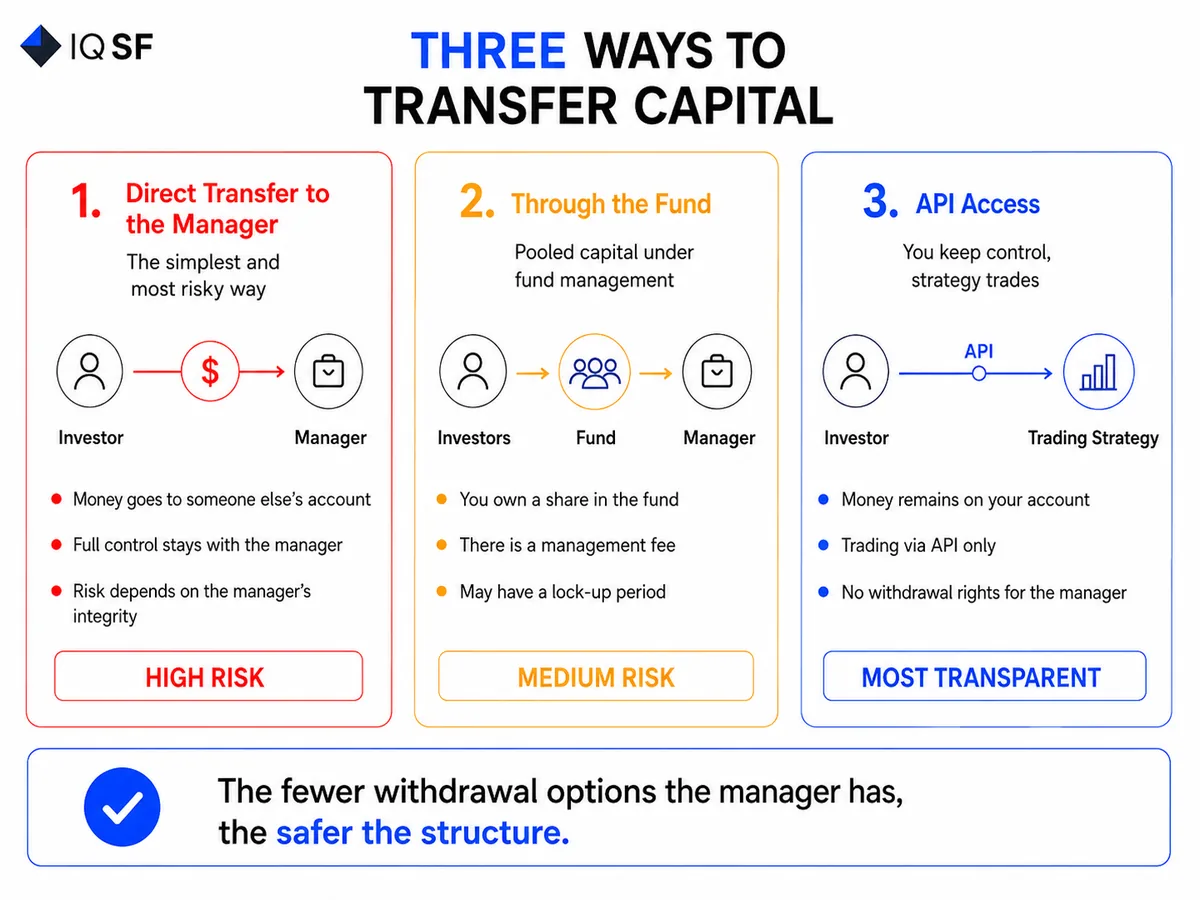
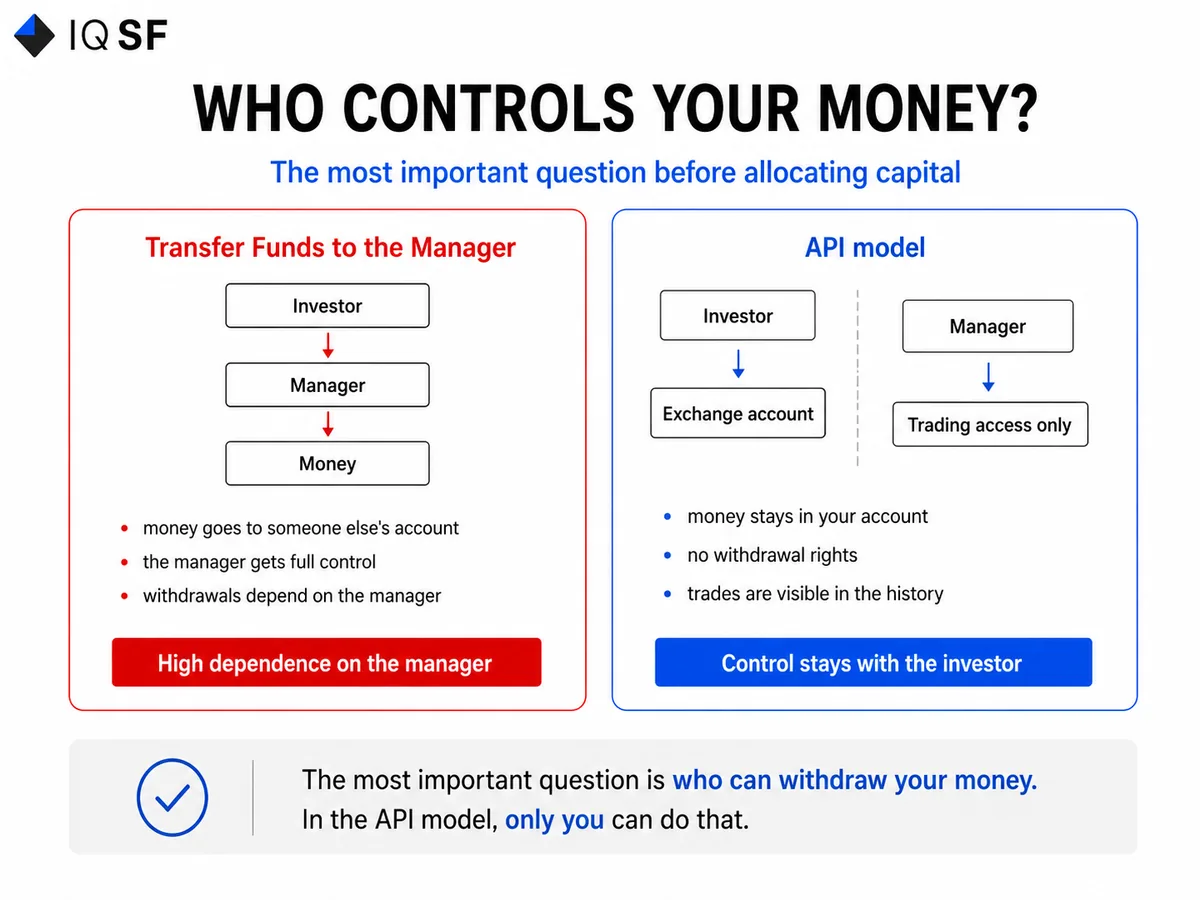
The first option is to transfer money directly to a manager. You send crypto to their account, and they trade it. This is the simplest and most dangerous route: your capital leaves your control completely, and you depend entirely on the honesty of the person on the other side.
The second option is a fund. In practice, you buy a share in a fund and place your capital under collective management. This format has its own nuances. There is usually a management fee, which is charged regardless of performance. There may also be lock-up periods: once the client invests, they cannot withdraw the money immediately and must keep it invested for a certain period of time. At the same time, this is usually a more regulated and formalized structure than simply transferring money to a private manager.
The third option is a model where control remains with you. Your money stays in your own account, and the manager receives only trading access through an API without withdrawal rights, or the capital is accounted for separately with withdrawals available only to you. The manager can trade, but cannot take your funds, and the strategy itself can be verified.
This is the most transparent format for an investor.
Strictly speaking, this is no longer discretionary management in the classic sense: you are not transferring money to anyone, you are only granting trading access.
This is exactly how we work. At IQSF, we use only algorithmic management and a systematic approach: the client connects their own account, and trading is executed through an API. Capital remains in your account, while we receive only a trading key without withdrawal rights.
The rule is simple: the fewer opportunities the manager has to withdraw your money without you, the safer the structure is.
Where the line with a scam begins
A scam almost always looks the same.
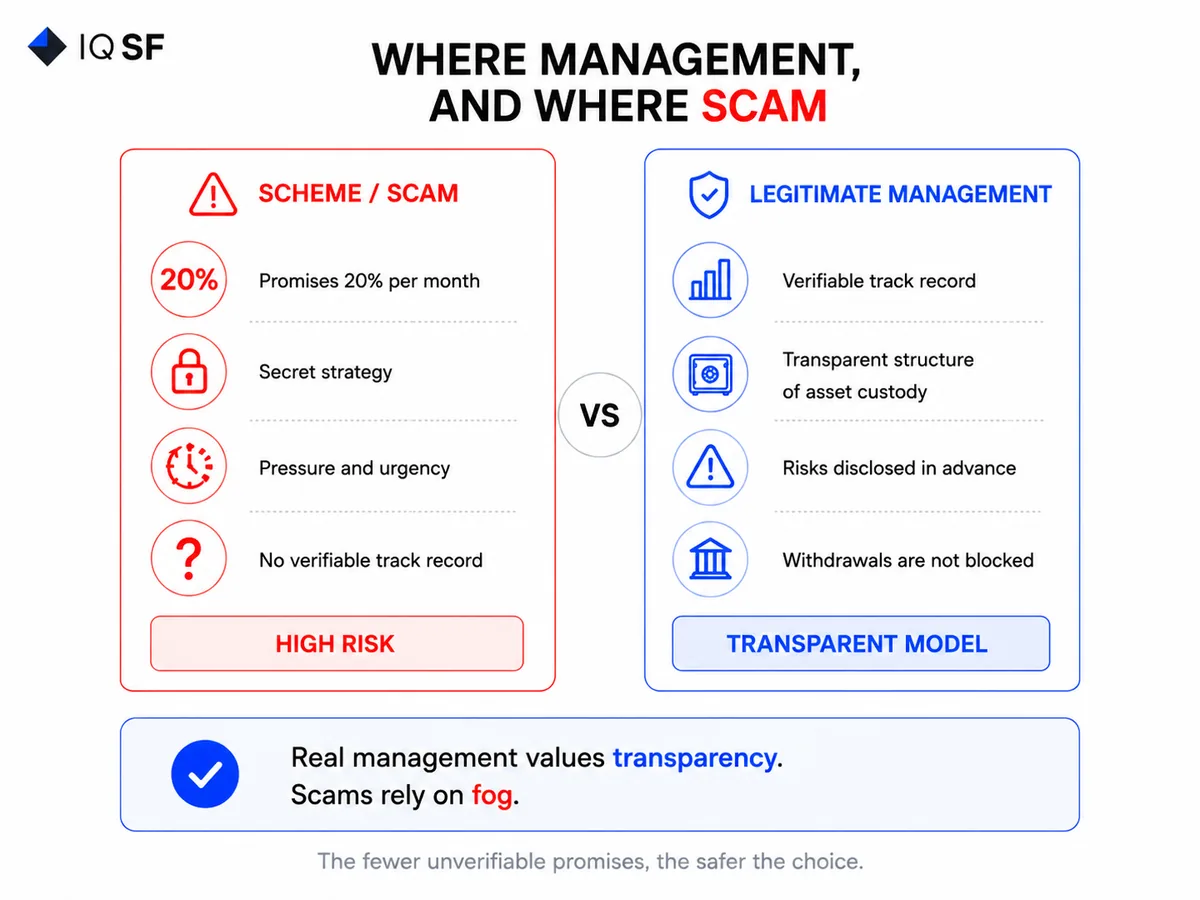
You are promised fixed returns such as “20% per month guaranteed.” Real markets do not work this way. There is no such thing as guaranteed high returns. There are only probabilities and risk.
The second warning sign is lack of transparency. You are not shown real trades, you are not given a verifiable track record, and success is explained by a “secret strategy.” Secrecy is often a way to hide the fact that there is no real result.
The third warning sign is pressure and urgency. “Spots are limited.” “Join before the pool closes.” A legitimate fund does not rush you, because it does not need your impulse. It needs your conscious decision.
The fourth warning sign is payments to old participants using money from new ones. If returns exist only while new investors keep coming in, this is a pyramid scheme, not asset management.
What honest management looks like
An honest fund shows a verifiable trading history, not a drawn-up equity curve.
It speaks openly about risks instead of hiding them behind the word “stable.” It charges a fee for performance, not a fixed fee just for “entry.” And it does not prevent you from withdrawing your own money.
A good sign is a High-Water Mark fee model, where the manager earns only if they grow your capital above its previous peak. In that case, their interests are aligned with yours.
Key takeaway
Discretionary crypto management can be a legitimate tool for those who do not want to trade on their own.
The danger is not the format itself, but who you give your money to and how.
Check where the capital is held, whether the manager has withdrawal rights, whether you are shown a real track record, and what exactly the fee is charged for.
If these four questions receive honest answers, you are likely looking at management.
If even one of them disappears into vague explanations, you are facing the risk of losing everything.
Five questions to ask before transferring money
Before handing over capital, ask the manager five direct questions and pay attention not only to the answer, but also to the reaction.
Where exactly is my money held, and do you have the right to withdraw it? An honest answer is specific, not “everything is secure with us.”
Can you show the trading history for the past year, including losing periods? If you are shown only profitable months, the history is incomplete.
What was your maximum drawdown, and when did it happen? A manager who says “there were almost no drawdowns” is either inexperienced or showing artificial numbers.
How is your fee structured? If the fee is charged for entry rather than performance, the manager’s interests are not aligned with yours.
What happens to my money if you shut down tomorrow? An honest model has a clear answer. A scheme does not.
Starting with a small amount as a test
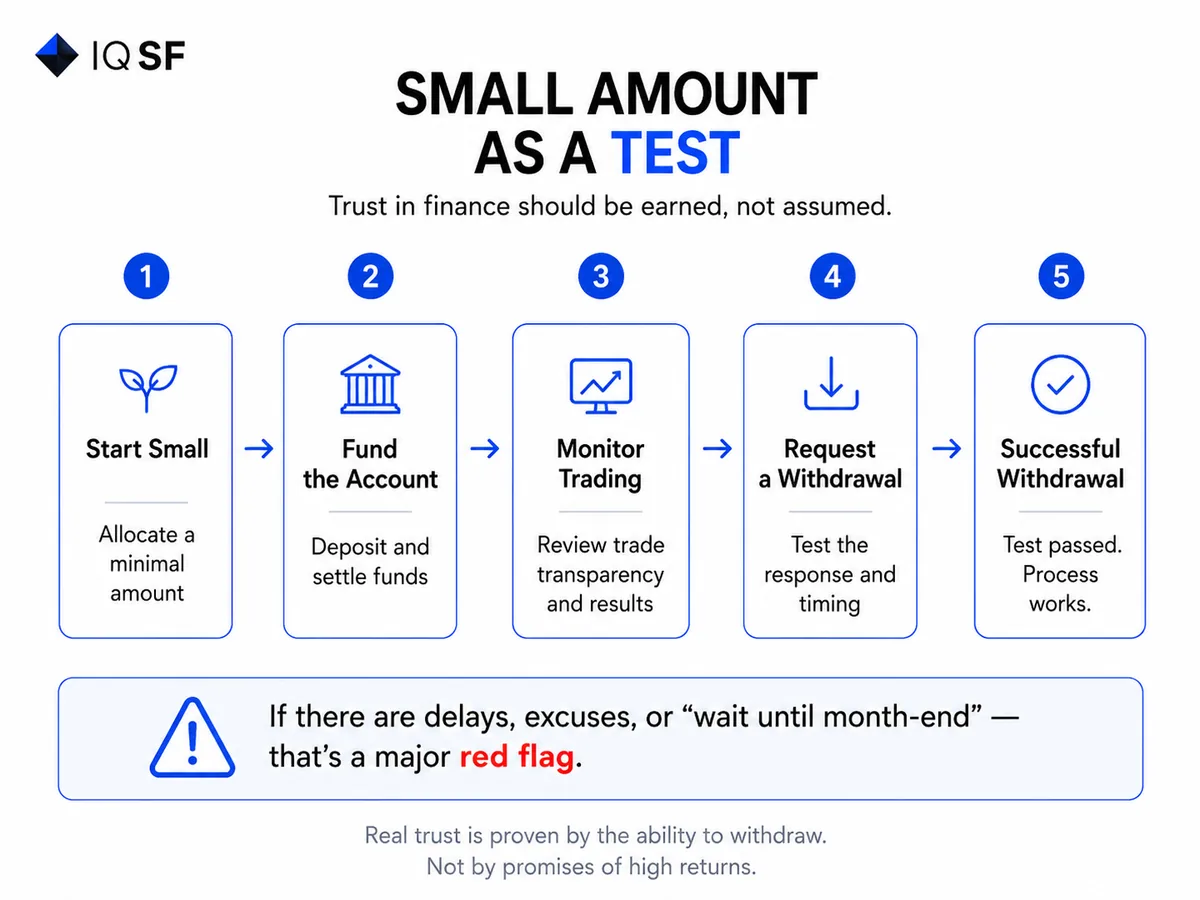
A separate practical rule: the first allocation should always be a small amount.
Not because you distrust someone personally, but because trust in finance is tested, not granted in advance.
Watch the full cycle: how the money enters, how performance is calculated, and how withdrawal works.
If delays, excuses, or “please wait until the end of the month” begin at the withdrawal stage, you have received the most important answer while the amount is still small.
How discretionary crypto management differs from copy trading and funds
When people look for someone to manage their crypto, they often confuse three different things.
Copy trading is when your account automatically mirrors the trades of a selected trader. The money remains with you, but you copy someone else’s decisions along with all their mistakes, and you pay a percentage of the profit. This may suit you if you are ready to choose who to copy and tolerate their drawdowns.
A crypto fund is when your capital is pooled together with money from other investors and managed by a team under a single strategy. In this format, the most important factor is the transparency of the pool: how your share is calculated and how you can exit.
Discretionary crypto management, in the strict sense, means individual work with your capital according to an agreed strategy and risk profile. What makes it different from the first two formats is that the strategy can be adjusted to you: acceptable drawdown, aggressiveness, and assets.
None of these formats is automatically better by default. What matters is understanding which one you are being offered, because the risks and fees are different in each case.
How much discretionary management costs and how to read the fee structure
The question “How much does discretionary crypto management cost?” almost always comes down to the fee structure, not a single number.
There can be a management fee: a fixed percentage of assets per year, charged regardless of performance.
There can be a performance fee: a percentage charged only on profits.
There can also be a combination of both.
The most investor-friendly model is a performance fee with a High-Water Mark condition. This means that the manager receives their percentage only when your capital reaches a new high.
If there was a loss, the manager must first recover it, and only after that starts earning again.
This aligns their motivation with yours: they are not incentivized to chase risk just to show a beautiful number, because they earn nothing during a drawdown.
If the manager’s main income comes from a fixed entry fee or a “package,” ask yourself what they are really earning from: your result or the fact that you brought them money.
How to choose a manager and not get burned by reviews
When searching for discretionary crypto management, the first thing you usually see is reviews.
Treat them carefully: positive reviews can be bought, and negative ones can be written by competitors. Reviews are noise, not proof.
Proof is a verifiable trading history, a clear capital custody structure, and direct answers to the five questions above.
A good sign is when the manager openly shows their worst periods and calmly explains them.
A bad sign is when all communication is about returns, with no mention of risk.
Key takeaway
Discretionary crypto management can be a legitimate tool for those who do not want to trade on their own.
The danger is not the format itself, but who you give your money to and how.
Check where the capital is held, whether the manager has withdrawal rights, whether you are shown a real track record, and what exactly the fee is charged for.
A separate note about IQSF.
At IQSF, we do not provide discretionary management and do not ask clients to transfer capital to us.
We use only algorithmic management and a systematic approach: the client connects their own account, and all trading is executed through an API.
Your funds remain in your own exchange account. We receive only trading access without withdrawal rights, and every trade is visible in the real history.
Your money always remains under your control, and only you can withdraw it.
We publish detailed insights on crypto, funds, and risk management in our Telegram channel.
Frequently asked questions
What is discretionary crypto asset management?
Discretionary management means you do not trade yourself: a manager or algorithm works with your capital according to a pre-defined strategy, and you receive the result after fees. It can be structured as sending funds directly to a manager, buying a share in a fund, or granting trading access through an API while capital stays in your own account. The less control a manager has over withdrawing your money, the safer the structure.
How can you tell a legitimate crypto manager from a scam?
A scam typically shows four signs together: promises of fixed guaranteed returns, lack of a verifiable trading history, pressure to decide quickly, and payouts to old participants funded by new ones, which is a pyramid scheme. A legitimate manager shows a verifiable trading history including losing periods, explains risk openly, and never blocks withdrawals of your own funds.
What is a High-Water Mark fee, and why does it matter for investors?
A High-Water Mark fee means the manager earns a performance fee only after your capital reaches a new peak above any previous one. If a loss occurs, the manager must recover it first before earning anything again, which aligns their incentive with yours instead of rewarding them for chasing risk. A fixed fee charged just for entry, regardless of performance, does not offer this alignment.
How is discretionary management different from copy trading or a crypto fund?
In copy trading your account mirrors another trader's trades while the money stays with you, and you pay a percentage of profit for copying their decisions and drawdowns. A crypto fund pools your capital with other investors under one strategy, where the key factor is how transparently your share is calculated. Discretionary management is individual work with your capital under an agreed strategy and risk profile, adjusted specifically to you.
Does IQSF take client money into discretionary management?
No. IQSF does not provide discretionary management and does not ask clients to transfer capital: it uses only algorithmic management, the client connects their own account, and all trading is executed through an API. Funds stay in the client's own exchange account, IQSF receives only trading access without withdrawal rights, and every trade is visible in the real history.