How to verify a fund or asset manager: structure, reporting, and audit

In this article, we’ll explore how to verify a fund or asset manager before investing, why structure, role separation, reporting, and audit matter, how pooled funds differ from managed accounts, and which questions help investors assess the transparency and safety of a capital management model.
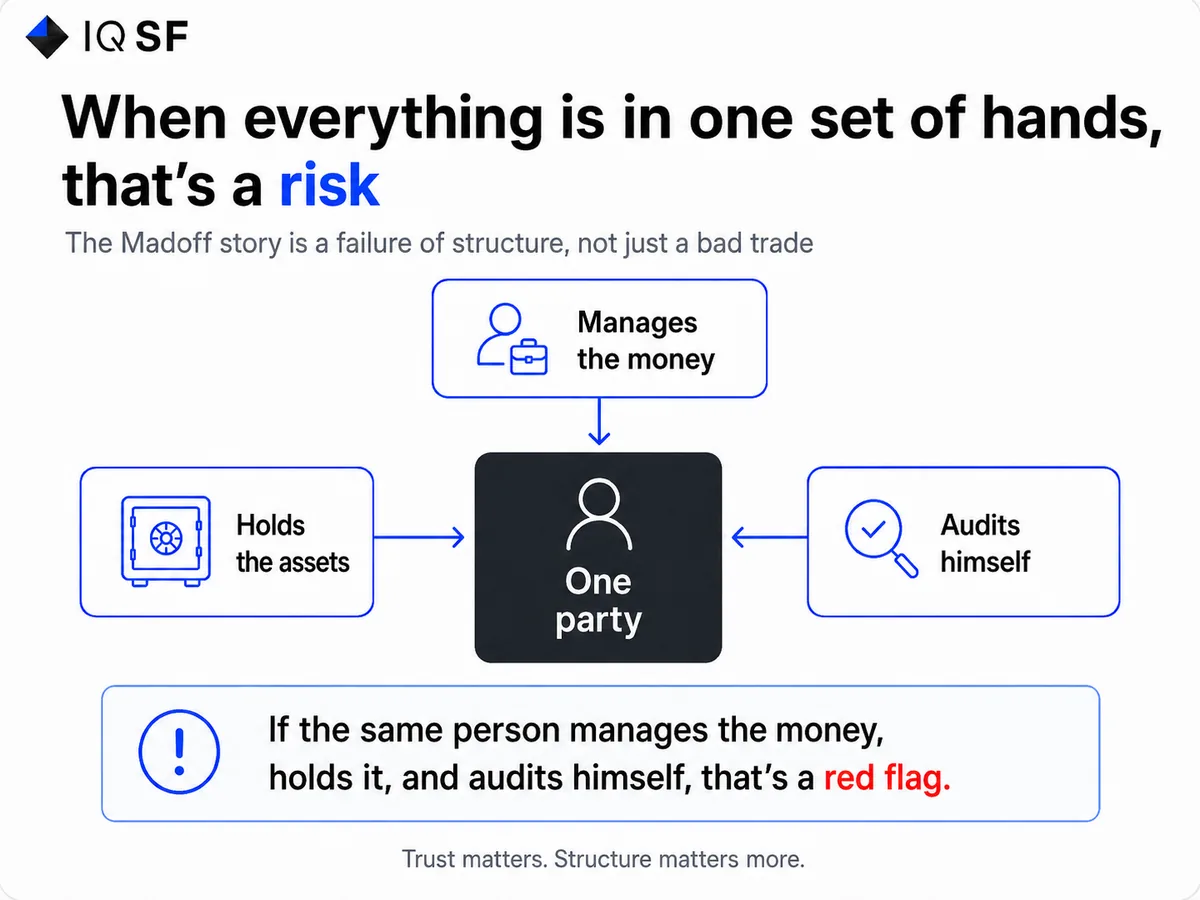
In December 2008, Bernard Madoff was arrested – an asset manager who had shown investors stable returns for decades and was considered a living legend of Wall Street.
His scheme did not collapse because someone discovered a bad trade. It collapsed because there was no proper structure behind it: Madoff managed the money himself, held the assets himself, and effectively checked himself.
For years, the audit of his $65 billion fund was signed off by a three-person accounting firm operating from a small office in the suburbs.
This is not just a story about a fraudster’s luck. It is a story about the absence of structure – and about how no one bothered to check it properly.
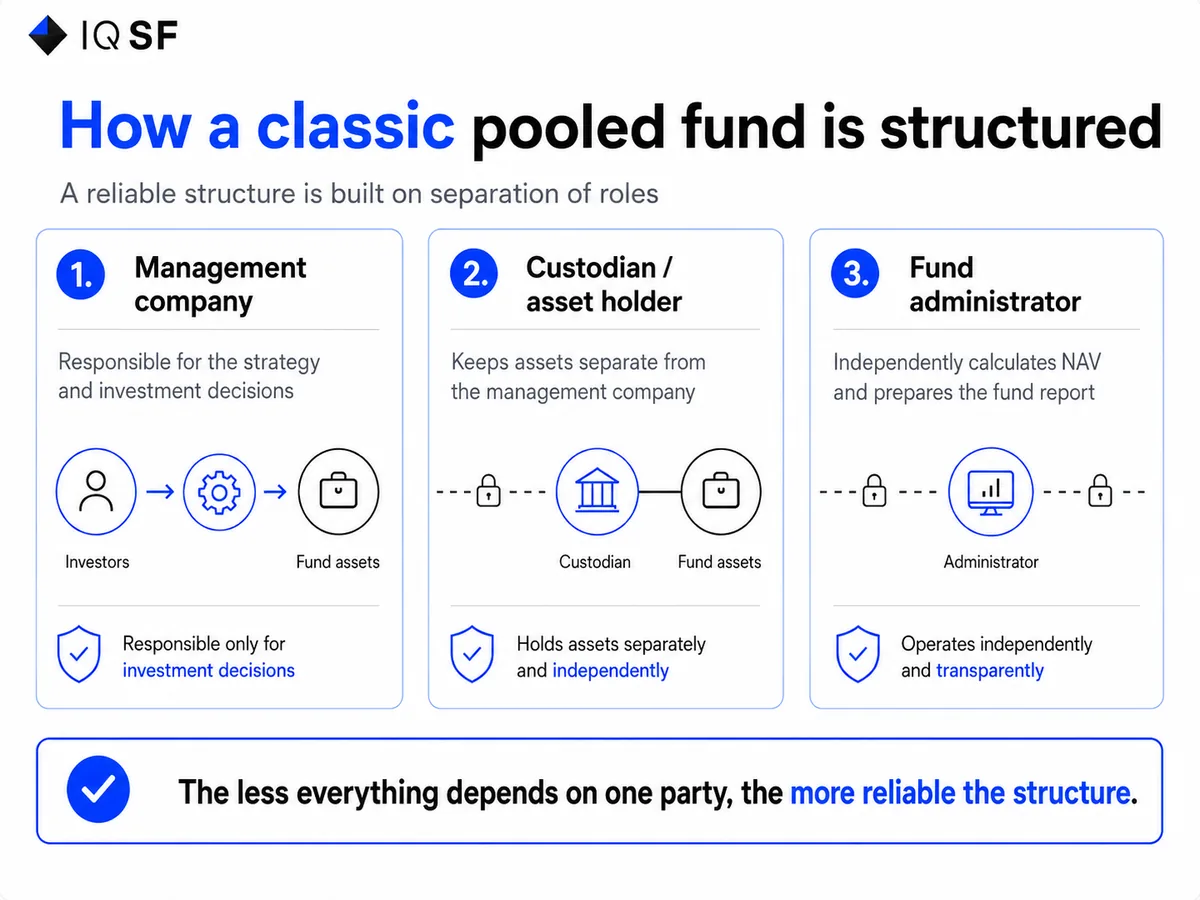
What the structure of a traditional pooled fund consists of
Investment management in a mature traditional fund is built on separation of roles, not on one person having access to everything at once.
A typical fund structure usually includes at least three independent roles:
- The investment manager, who is responsible for the investment strategy and trading decisions, but does not physically hold client assets.
- The asset holder, which may be a restricted exchange account or a custodian, separated from the investment manager and not directly subject to its instructions to withdraw funds.
- The fund administrator, who independently calculates the net asset value (NAV) and prepares fund reports without relying on the investment manager’s own opinion about its results.
This separation reduces the risk that the same party manages the money, holds the assets, and reports back to itself at the same time.
At this level, investment management is not only about who correctly predicted the direction of the market. It is about whether the process can withstand scrutiny at the most uncomfortable moment: during withdrawals, during a drawdown, or during a change in the team.
The same logic applies as in a restaurant: if the same person cooks the dish, checks the quality, and writes a positive review about themselves, it is strange to fully trust that assessment — even if the food itself is objectively good.
Role separation in a traditional fund solves exactly this problem. Independent verification is carried out by someone who has no reason to hide behind the overall result.
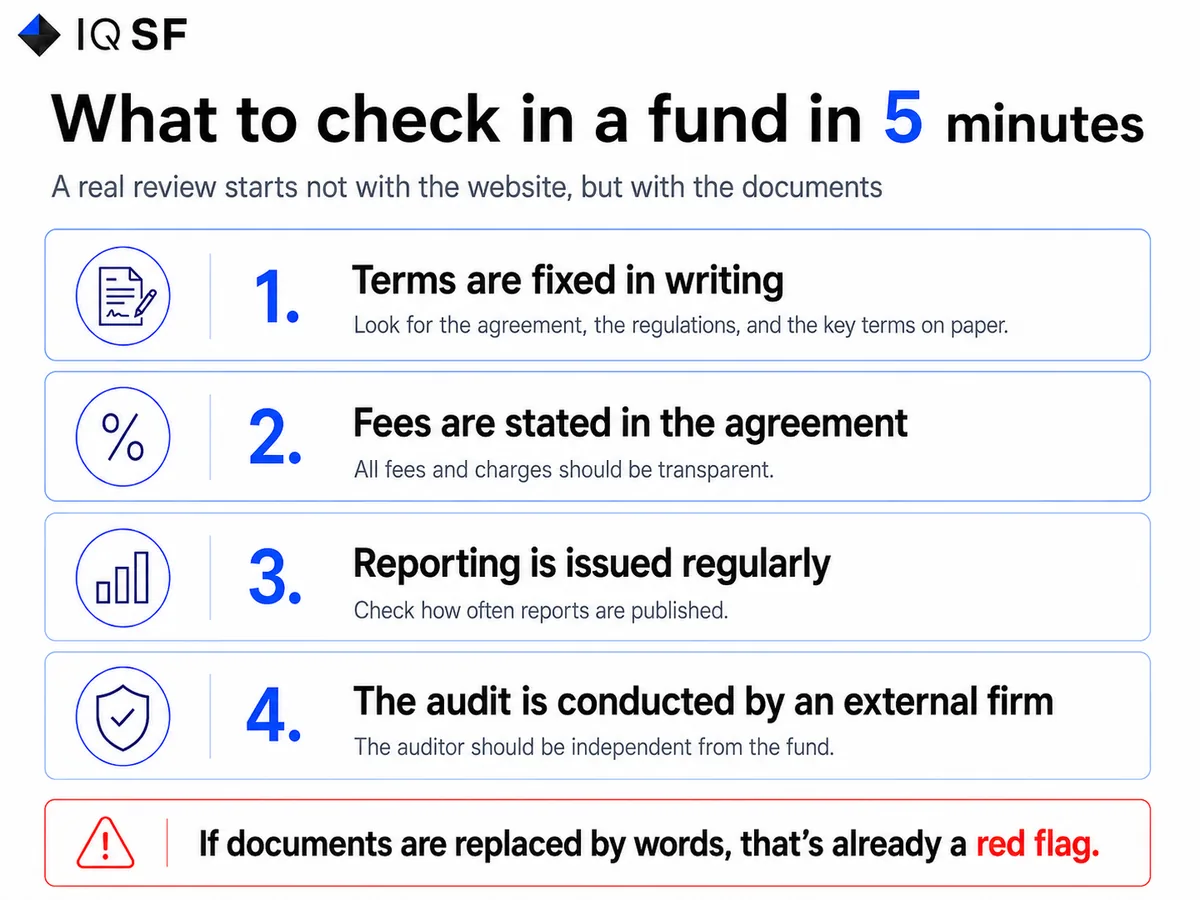
Fund verification: what to check first
A real fund review does not start with a website or a presentation. It starts with documents.
A serious pooled fund should have at least the following:
- The terms are documented in writing, not explained informally in a chat.
- The fee structure is transparent and stated in numbers in the agreement: the management fee and performance fee are defined in advance, not decided after the year’s results.
- Reporting is issued regularly and includes the full performance history, not selected screenshots of the best months.
- The audit is conducted by an external independent firm, and the investment manager is ready to show the results rather than simply claim that an audit exists.
A private fund without written terms, a clear fee structure, and verifiable reporting is not an investment fund in the professional sense. It is a promise packaged in a polished form.
A separate red flag is an investment manager that avoids a direct answer about the audit or refers to “commercial confidentiality” when the question concerns basic reporting to investors.
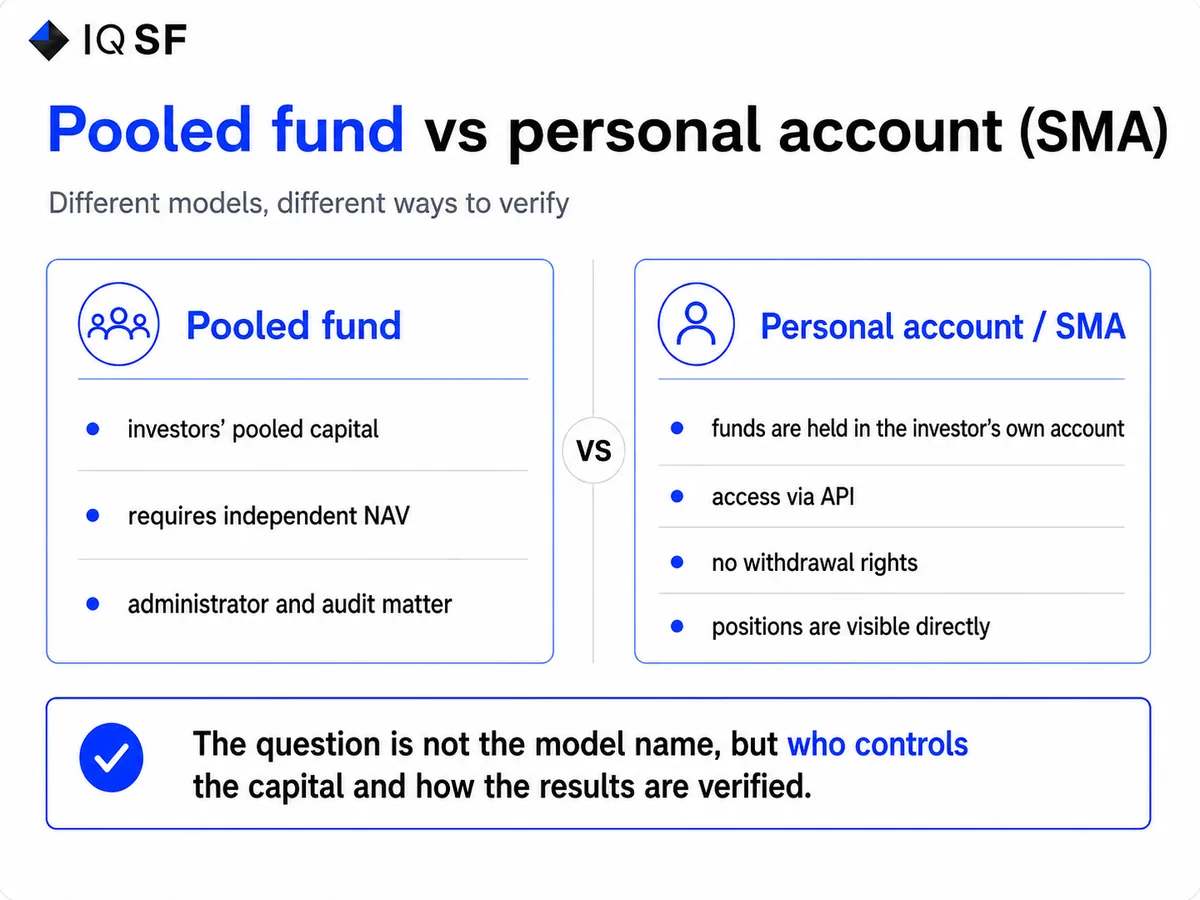
What if it is not a pooled fund, but a personal account
Not every form of professional management is structured as a pooled fund with an independent NAV administrator.
There is another model: a managed account, or SMA.
In this model, the capital remains in the investor’s own exchange account, while the manager receives trading access through an API without withdrawal rights.
This structure does not involve a common pool. As a result, there is no classic “fund audit” in the same form that a pooled fund requires, because the investor does not need to rely on someone else’s valuation of the assets.
The investor sees their own account directly, in real time, through the exchange.
This is not a weaker form of verification. It is a different set of questions:
- Can the manager physically withdraw funds? In a proper structure, no.
- Can the investor see the real positions in their own account at any moment? In a proper structure, yes.
- Are the terms and fees documented in writing before the result, rather than after it? In a proper structure, yes.
IQSF operates through the personal account model, not a pooled fund structure.
The investor’s capital remains in their own exchange account. Management is carried out through an API without withdrawal rights, and reporting for each strategy is provided regularly.
We do not have an independent third-party audit in the classic pooled fund sense, because there is no pooled vehicle that would require an independent NAV calculation.
Instead, positions in the client’s account can be checked directly by the client themselves, without an intermediary.
This is not investment advice. It is an explanation of how professional capital management can be structured and what should be checked before – not after – money has already been transferred.
Frequently asked questions
What made Bernard Madoff's fraud possible?
Madoff's fraud was possible because there was no separation of roles: he managed the money, held the assets, and effectively checked himself, so no independent party could catch the problem. For years the audit of his $65 billion fund was signed off by a three-person accounting firm operating from a small suburban office. He was arrested in December 2008.
What three roles should a legitimate pooled fund separate?
A legitimate pooled fund separates at least three roles: an investment manager who makes trading decisions but does not hold client assets, an asset holder such as a custodian not subject to the manager's withdrawal instructions, and an administrator who independently calculates net asset value and prepares reports. This reduces the risk that one party manages the money, holds the assets, and reports on itself.
What should investors check before trusting a fund with money?
Investors should check that the terms are documented in writing and that the fee structure, including the management fee and performance fee, is stated in numbers in advance. They should confirm regular reporting with the full performance history and an audit by an external independent firm. A manager who avoids a direct answer about the audit is a red flag.
What is a managed account (SMA) and how does it differ from a pooled fund?
A managed account, or SMA, keeps the investor's capital in their own exchange account, and the manager gets trading access through an API without withdrawal rights, so there is no common pool of assets. Because there is no pooled vehicle, there is no classic fund audit requiring an independent NAV calculation; the investor can see their own account and positions directly through the exchange. IQSF operates through this personal account model.