Double risk in capital management: what happens to drawdown and returns when risk is doubled
In this article, we’ll explore why doubling risk multiplies both sides of a strategy’s equity curve, how higher risk affects drawdowns and returns at the same time, and why investors should choose their risk level before the cycle begins, not at the bottom of a drawdown.
The most common question from investors sounds like this: can we take higher risk, but only on the side where it increases profit?
The short answer is no. And the reason is not the manager’s caution, but the structure of the model itself.
Risk is a multiplier, not a switch
When you double risk, you do not add a separate setting called “earn more.” You multiply the entire curve by two, including its lower part.
Take a $1 million account and a strategy with a historical drawdown of 25%. Double the risk. The drawdown becomes 50%, meaning that at that moment the account will show $500,000 instead of $750,000. But the same multiplier also works on recovery: a cycle that would have produced 60% will produce 120%.
This is one decision, not two separate ones. You cannot keep the second half and reject the first.
Why higher risk does not mean a higher probability of losses
The illusion comes from language. In everyday speech, the word “risk” means the probability of a bad outcome, something close to danger. In capital management, risk means the amplitude of movement in both directions.
When an investor hears “higher risk,” they imagine a higher probability of losses. Then the question sounds logical: can we increase returns without increasing the probability of losses?
But the risk setting does not change the probability. It changes the size. A strategy with doubled risk does not start making mistakes more often. It simply does the same things in double size. Both wins and losses.
It is similar to a car: if you double your speed, you do not necessarily start making more mistakes on turns. But every mistake becomes more expensive, and every gain in time becomes larger.
What happens when risk is reduced at the bottom of a drawdown
The problem is not the math. The problem is the moment when the decision is made.
Higher risk is chosen on a calm day, while looking at the upper part of the curve. It is rejected on the day when the account shows a 50% loss, while looking at the lower part of the curve. Several months pass between these two days, and in practice the decision is made by a different person, with a different emotional state and a different time horizon.
Let’s look at a typical scenario in numbers.
An investor deposits $1 million with doubled risk. During the first four months, the market is favorable, and the account grows to $1.4 million. The feeling is excellent, the decision seems correct, and the investor starts thinking about adding more.
Then the market turns. Three months later, the account is at $700,000. That is a 50% drawdown from the peak and a 30% loss from the initial investment. Every morning the number is lower than the day before, and the end is not visible.
At this point, the investor asks to reduce risk back to the base level. The decision looks completely reasonable: stop the bleeding.
But here is what happens next. The market recovers, and the strategy works through the drawdown. With doubled risk, the account would have returned to $1.4 million and continued higher. With base risk switched on at the bottom, the recovery is twice as slow, and by the end of the cycle the account is around $1 million.
The investor paid the full price for doubled risk in the form of a deep drawdown, but received only half of the compensation because they exited the higher-risk mode exactly before that mode started earning the money back.
This is the most expensive way to handle risk: take it on the way up and remove it at the bottom.
Why the risk level is fixed in writing
This is why the risk level is chosen once, before the start, and fixed in writing. Not because it can never be changed, but because it should be changed in a calm state, not at the bottom of a drawdown.
A written decision works like an agreement with your past self. The person who made the decision saw both sides of the curve. The person sitting in front of the screen at the bottom of a drawdown sees only one.
The wording can be simple. The risk level is this. The expected maximum drawdown is this percentage and this amount of money. A change in the risk level is possible no earlier than after a full cycle is completed, or if there are signs of strategy degradation, but not because of the current drawdown.
The last part is the most important. It removes in advance the only reason why risk is usually reduced at the wrong moment.
How to choose a risk level: a practical test
Before agreeing to doubled risk, look at the lower boundary and ask yourself an honest question: if in six months the account shows exactly this amount, will I stay in the strategy or close it?
Not “could I theoretically tolerate it,” but exactly this: will I stay, or will I close it?
If the answer is “I will close it,” doubled risk is not suitable for you, no matter how attractive the upside looks. A strategy that you exit at the bottom does not give you the upper part of the curve. It gives you only the lower part.
There is also a practical test that clarifies a lot. Take the amount you plan to invest, multiply it by the expected drawdown, and say the result out loud as a fact. Not “maybe, temporarily,” but “the account will show this amount, and this is a normal scenario.”
If that sentence creates internal resistance, the risk level should be reduced. And it should be reduced now, while the cost is only missed upside, not later, when the cost becomes a realized loss.
What doubled risk does not do
Doubled risk does not turn a bad strategy into a good one. If the strategy has no edge, doubling risk simply accelerates the path to zero.
Doubled risk does not shorten time. It may seem that the target will be reached twice as fast, but as amplitude increases, the depth of drawdowns increases too, and recovering from a deeper hole takes more time. Acceleration and braking increase at the same time.
And doubled risk does not scale endlessly. Starting from a certain level, the probability of irreversible loss appears, after which recovery is impossible mathematically, not psychologically. The whole difference between risk and a bet is this: risk can be survived, while a bet is either won or lost.
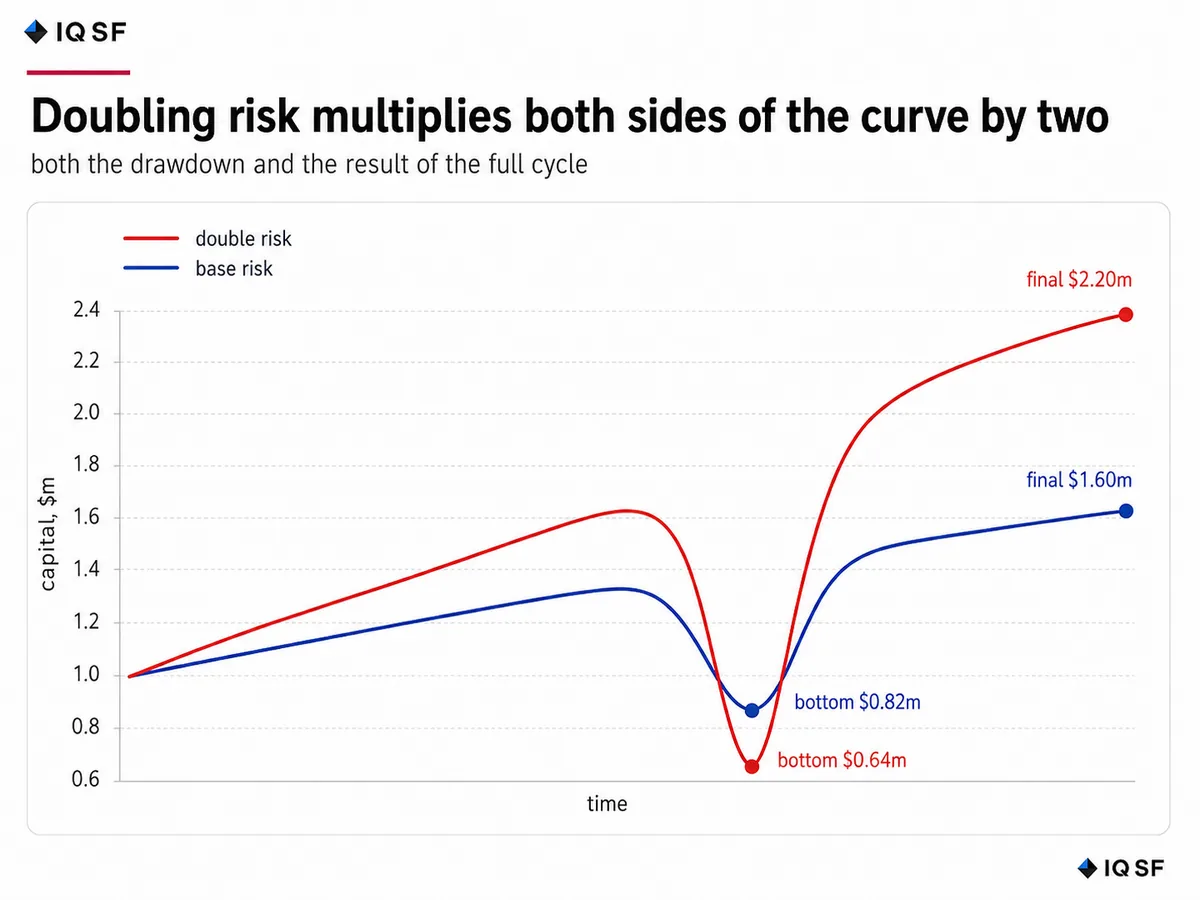
Chart 1. Doubling risk multiplies both sides of the curve by two: the drawdown and the result of the cycle.
Frequently asked questions
What actually happens when you double the risk level in a trading strategy?
Doubling risk multiplies the entire equity curve by two, both the drawdown and the recovery. A $1 million account with a historical drawdown of 25% would see that drawdown become 50% at doubled risk, while a cycle that would have produced a 60% gain would instead produce 120%. It is one decision affecting both sides of the curve, not a way to keep the upside while avoiding the downside.
Does higher risk mean a higher probability of losing money?
No, higher risk changes the size of outcomes, not their probability. In everyday language risk sounds like danger, but in capital management it means the amplitude of movement in both directions, so a strategy with doubled risk does not make mistakes more often, it simply produces bigger wins and bigger losses. It is comparable to doubling a car's speed: mistakes are not necessarily more frequent, but each one becomes more costly.
Why is cutting risk during a drawdown often the wrong decision?
Because it locks in the worst part of the cycle while giving up the recovery that follows. In a typical example, an investor who cuts doubled risk back to base level after a 50% drawdown sees the strategy recover twice as slowly, ending the cycle near the original capital instead of returning to the higher peak the doubled-risk mode would have reached. The full cost of the drawdown is paid, but only half the recovery is received.
How should an investor decide what risk level to accept before investing?
Calculate the expected drawdown in real money, then ask honestly: would you stay invested or close the position if the account showed exactly that amount six months from now? If the answer is close it, that risk level does not suit you, since abandoning a strategy at the bottom means missing the recovery that follows. The chosen level should be fixed in writing and changed only after a full cycle, not because of a temporary drawdown.