How to invest a large sum of money: 10 million rubles in 2026
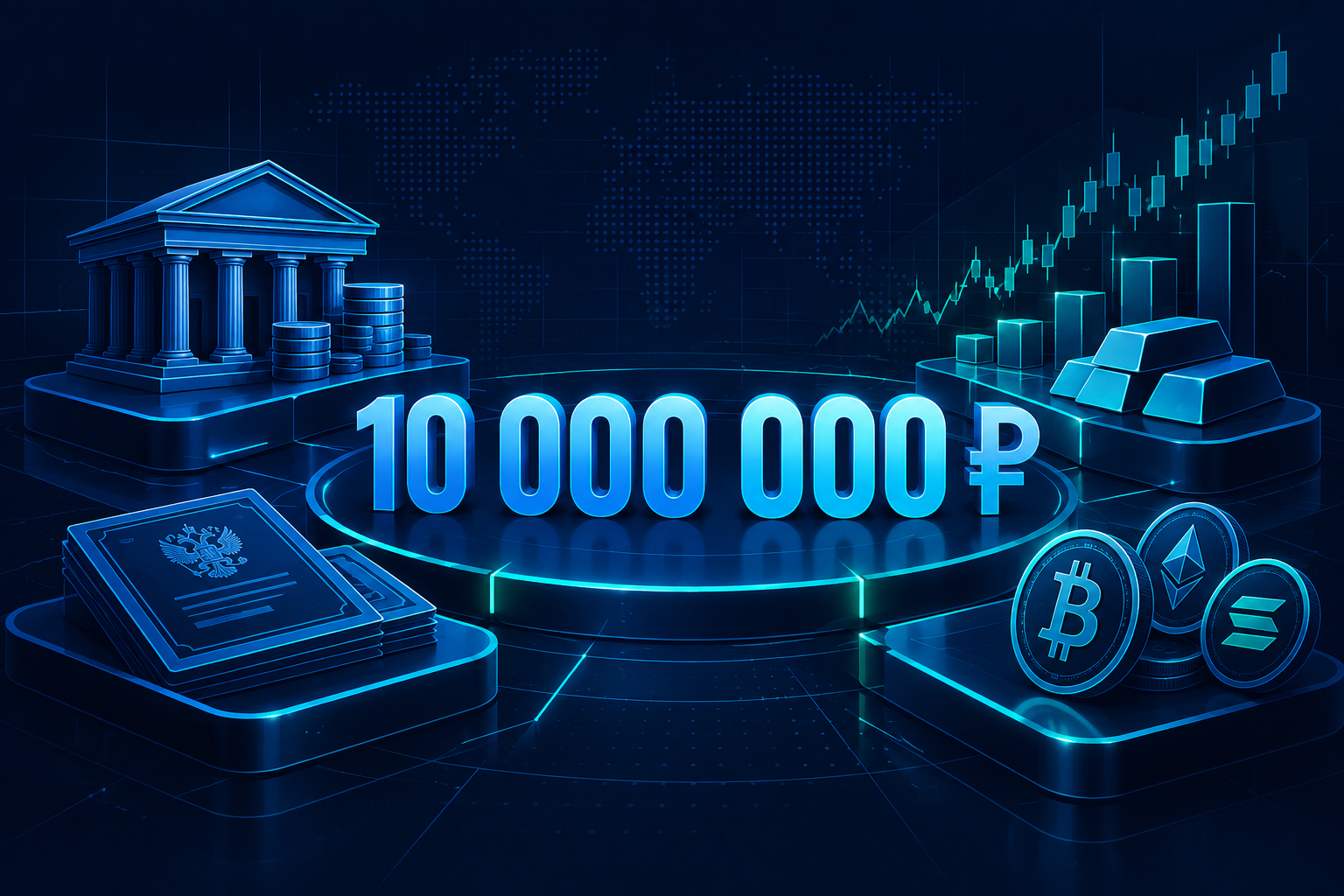
In this article, we’ll explore how to allocate RUB 10 million across bank deposits, government bonds, stocks, and higher-risk assets, how deposit insurance limits affect capital allocation, and why portfolio structure should be built around the level of risk an investor is prepared to take.
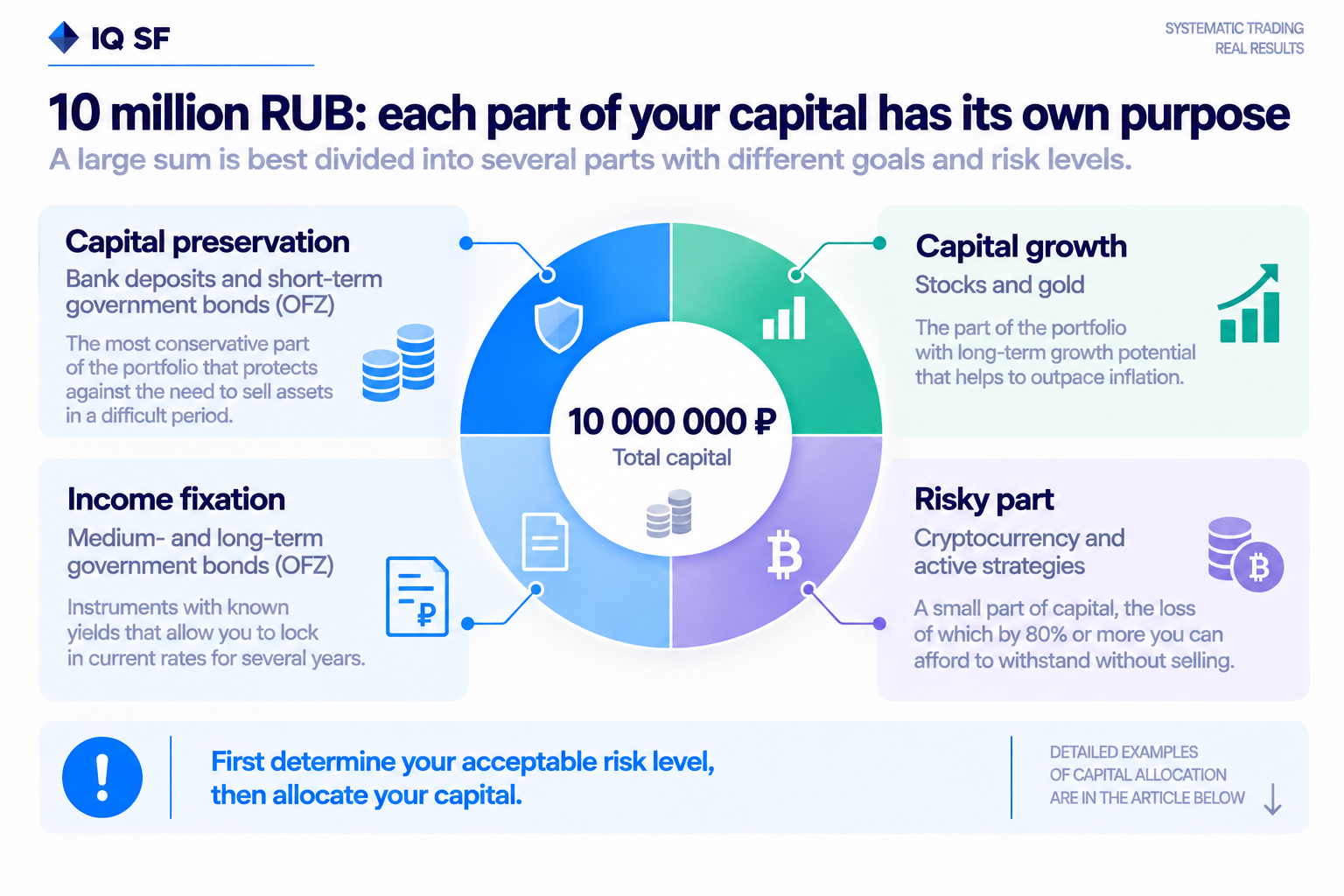
How to invest a large sum of money such as 10 million rubles in 2026: split it into several parts, each with its own job. The safe part sits in deposits spread across banks and in OFZ government bonds, the growth part goes into stocks and gold, and risky assets such as crypto get only the amount whose 50-80% fall you could sit through without selling.
For scale, 10 million rubles is about $118,600 at the Bank of Russia rate of 84.34 rubles per dollar on 26 September 2026. As of September 2026, the Bank of Russia key rate is 14% (decision of 11 September), the average maximum deposit rate at the ten largest banks is 13.0%, the 10-year OFZ yields 16.65%, and annual inflation is 6.3%. The MOEX Russia Index is down 17.8% year to date, gold in rubles is up 14.5% over 12 months, and bitcoin in rubles is down 22%. Below we look at what each part earns and where its risk lies, then stress-test three ways to allocate the capital.
How to invest a large sum of money: where to start
A large sum is invested after three decisions: how much to keep in reserve, how long the money can stay invested, and what loss in rubles you can live with without selling.
A reserve covering 6-12 months of expenses sits separately in a deposit or savings account and stays out of the allocation. Its job is to make sure you never have to sell stocks or bitcoin at the bottom to pay for a repair or medical bill.
The time horizon decides which instruments are even on the table. Money for an apartment you plan to buy next year does not belong in assets whose 30-50% declines take years to recover. Deposits and OFZ maturing around the date you need the money fit that job.
It helps to name the acceptable loss in rubles: “I can live with 10 million turning into 8 million for a while.” That number later sets the share of risky assets. Recovery math works against the investor: a 20% fall needs a 25% gain to get back, a 50% fall needs 100%. More on this in our article on recovering from a drawdown.
There is no need to rush. While the plan is being drawn up, the money can sit in a short deposit at around 13% a year: a hasty decision tends to cost more than a month of thinking.
What bank deposits and OFZ bonds pay in Russia in September 2026
In September 2026, ruble deposits and OFZ bonds pay between 13% and 16.65% a year before tax against 6.3% inflation, so the safe part of the capital is currently ahead of rising prices.
Instrument | % a year | Date | Source |
Key rate | 14.00 | 11.09.2026 | Bank of Russia |
Deposits, average maximum rate at the 10 largest banks | 13.0 | 2nd ten days of September 2026 | Bank of Russia |
1-year OFZ | 13.68 | 25.09.2026 | OFZ zero-coupon yield curve, Bank of Russia |
3-year OFZ | 15.58 | 25.09.2026 | same |
5-year OFZ | 16.18 | 25.09.2026 | same |
10-year OFZ | 16.65 | 25.09.2026 | same |
Annual inflation | 6.3 | estimate as of 07.09.2026 | Bank of Russia |
Long OFZ bonds let you lock in a high yield for years ahead. A deposit cannot do that: when it matures, you roll it over at the new rate, and that rate follows the key rate down. In the last ten days of September 2025, the same Bank of Russia indicator stood at 15.55%; now it is 13.0%.
Long bonds carry a different risk: their price falls when market yields rise. The past year showed this clearly. Between September 2025 and September 2026, the Bank of Russia cut the key rate from 17% to 14%, yet the 10-year OFZ yield rose from 14.76% to 16.65%. The Moscow Exchange government bond price index RGBI lost 3.1% over 12 months, and only coupons pushed the total return index RGBITR up 8.6%. An investor who holds a bond to maturity receives the coupons and face value known on the day of purchase. One who sells early, while yields are rising, locks in a loss.
Is it safe to keep 10 million rubles in one bank? Insurance and tax
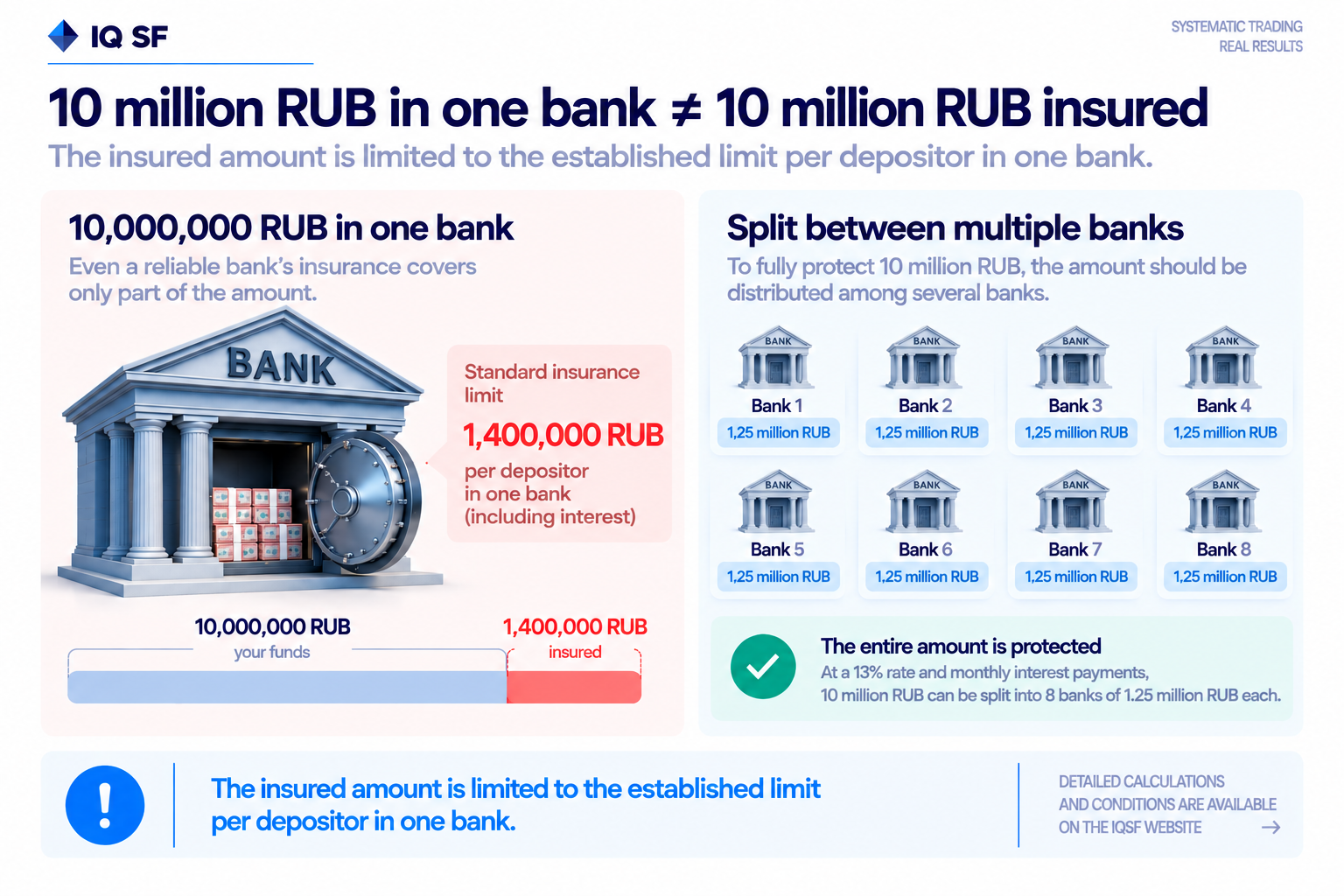
Ten million rubles in a single bank are insured only up to 1.4 million, so to keep the whole sum plus interest protected at a rate of about 13%, it has to be spread across at least nine banks.
Russia’s Deposit Insurance Agency pays out up to 1.4 million rubles per person per bank, and accrued interest counts toward that limit. At 13% a year, no more than 1.24 million rubles can go into one bank (1.4 million / 1.13), otherwise the balance with interest will exceed the limit by the end of the year. 10 million / 1.24 million = 8.1, so you need nine banks. If interest is paid out monthly to a card at another bank, eight are enough.
A higher limit applies in special cases (Finuslugi data, September 2026): up to 2.8 million rubles for irrevocable deposits and savings certificates with a term of more than three years, and up to 10 million rubles for money from certain life events, such as the sale of a home or an inheritance, with supporting documents. An ordinary large deposit does not qualify.
Tax. Interest on all of a person’s deposits for 2026 is tax-free up to 160,000 rubles: 1 million rubles multiplied by the highest key rate on the first day of any month of the year (16% on 1 January 2026). Interest above that is taxed at 13%, and the part of interest income above 2.4 million rubles a year at 15%.
Example under 2026 rules | Amount |
Deposits | RUB 10,000,000 |
Interest for a year at 13% | RUB 1,300,000 |
Tax-free | RUB 160,000 |
Income tax at 13% on RUB 1,140,000 | RUB 148,200 |
Income after tax | RUB 1,151,800, or 11.5% a year |
Real return at 6.3% inflation | about 4.9% a year |
Russian stocks and gold: the last 12 months to September 2026
In the 12 months to 25 September 2026, Russian stocks lost 8.5% including dividends while gold in rubles gained 14.5%: two assets often held side by side ended almost 23 percentage points apart.
The MOEX Russia Index closed at 2,273.87 points on 25 September 2026. That is 17.8% down since the start of the year and 47% below its closing high of 4,287.52 points on 20 October 2021, so the index needs to gain 89% to get back there. It has been below that peak for almost five years, which is why money needed soon does not go into stocks. The MCFTR total return index, which includes dividends, lost 8.5% over 12 months.
The Bank of Russia reference price of gold was 11,695.60 rubles per gram on 25 September 2026, 14.5% higher than a year earlier. Gold does not rise in a straight line either: the price is 12.8% below its high of 13,407.69 rubles on 19 March 2026. The ruble price of gold depends on both the world price and the ruble exchange rate, so it can fall when the ruble strengthens even while gold rises in dollars. In 2022, the reference price fell 61.9% between 11 March and 1 October.
How much of a large sum should go into bitcoin and crypto
The crypto share of a 10-million-ruble portfolio is set by how deep the falls go: in nine years bitcoin has twice lost more than 75% and took 847 and 1,074 days to return to its high.
Our calculation from daily BTCUSDT closes on Binance, 17 August 2017 to 24 September 2026: ten declines of more than 20% from the all-time high, nine of them completed. The median trip from a high back to that high took 117 days, but the deep declines dragged on for years. On 72.2% of days the price closed more than 20% below its high, and only 3.2% of days set a new high.
The current drawdown is not over. The high of $124,659 came on 6 October 2025 and the low of $58,625 on 30 June 2026 (down 53%). On 24 September 2026 bitcoin was at $84,410, 32% below its high, and needs a 48% gain to get back.
In money terms: if 1 million rubles is set aside for crypto, a repeat of the 2018 and 2022 falls (83.2% and 76.6% in dollars) would temporarily leave roughly 170,000 to 235,000 rubles of it. That amount only makes sense if such a loss would not force you to sell everything else.
Leverage turns a drawdown into a loss. By our calculation on the same daily data, a 5x position opened at the daily open, with no stop and no added margin, would have been liquidated within a month in 22.5% of cases for longs and 31% for shorts.
Since 1 September 2026, Federal Law No. 282-FZ “On Digital Currencies and Digital Rights” has been in force. Under it, a non-qualified investor buys through a broker only digital currencies admitted to organized trading, after a risk-knowledge test and within an annual limit set by the Bank of Russia. Ten million rubles is not enough for qualified investor status by assets: since 1 January 2026 the threshold is 24 million rubles. We covered other ways to invest in crypto beyond buying and holding bitcoin in a separate article.
Algorithmic strategies: returns only alongside drawdowns
An algorithmic strategy in the crypto market belongs in the risky part of the capital, and the only fair way to compare it with a deposit is by risk: how deep and how long its drawdowns are.
As an example, here are four IQ Security Fund strategies from the strategy dashboard as of 27 September 2026 (Quantum Alpha as of 28 September). The figures describe the past and promise nothing: past performance does not guarantee future results.
Strategy | Dashboard period | CAGR | Max drawdown | Longest drawdown, days | Worst month |
Basket 50 | 01.08.2019-27.09.2026 | 81.66% | -28.59% | 234 | -15.90% |
Basket 70 | 01.08.2019-27.09.2026 | 80.89% | -23.08% | 162 | -15.90% |
Basket 70 TF | 12.01.2025-27.09.2026 | 83.98% | -32.46% | 162 | -11.40% |
Quantum Alpha | 03.01.2021-28.09.2026 | 19.03% | -3.94% | 298 | -1.98% |
The baskets’ high annual returns come with drawdowns of up to 32.46% and a worst month of minus 15.9%. Quantum Alpha’s drawdowns are shallow, with a maximum of minus 3.94%, but its longest one lasted 298 days: almost ten months without a new high. The strategies trade on crypto exchanges, so market risk comes with platform risk and, for a ruble investor, currency risk. Before choosing any strategy, find out where the money is held and who has access to it: we compared the formats in SMA, fund or copy trading.
Capital allocation: three ways to split 10 million rubles
Capital allocation means deciding in advance which share of the money is there to be kept safe, which is there to beat inflation, and which is there to grow at the risk of losses.
The three examples below show how to do the math; they are not a ready-made recipe. For each one we ran a stress test: how much the portfolio would lose if every part repeated its worst drawdown in rubles over the full history of the data at the same time. It is a harsh scenario, because these assets had their worst drawdowns in different years: stocks in 2008, bitcoin in 2018, OFZ and gold in 2022. Yet 2022 also showed that in rubles all four can fall in the same year.
Portfolio part | Preserve | Balanced | Growth |
Deposits and OFZ up to 1 year | RUB 6.0m | RUB 4.0m | RUB 2.5m |
OFZ with 3-10 years to maturity | RUB 2.5m | RUB 2.5m | RUB 2.5m |
Stocks (tracking the MOEX Russia Index) | RUB 0.5m | RUB 1.5m | RUB 2.5m |
Gold | RUB 1.0m | RUB 1.0m | RUB 1.0m |
Risky part: crypto, strategies | 0 | RUB 1.0m | RUB 1.5m |
Loss in the stress test | RUB 1.66m (16.6%) | RUB 3.21m (32.1%) | RUB 4.35m (43.5%) |
The calculation uses the worst drawdowns in daily data from the Moscow Exchange, the Bank of Russia and Binance: OFZ (RGBITR index) minus 26.9% from January 2021 to March 2022, stocks (MCFTR index) minus 73.6% from December 2007 to October 2008, gold minus 61.9% from March to October 2022, and bitcoin in rubles minus 81.0% from December 2017 to December 2018. The bitcoin drawdown stands in for the risky part. Deposits within the insurance limit do not fall in nominal terms, and neither do short OFZ held to maturity.
Using the table is simple: find the row with a loss you are prepared to live through. If a temporary loss of 3.2 million out of 10 is unacceptable to you, the balanced option is already too risky, even if it beats a deposit in good years.
Once a year the shares go back to their starting weights: sell what has grown beyond plan and top up what has lagged. That keeps the portfolio from quietly turning into a bet on one asset. Why diversification does not always help is covered in five myths about diversification.
Five mistakes when investing a large sum of money in 2026
The five mistakes below cost money whatever assets you choose, and each can be checked against your own numbers in advance.
1. Buying last year’s winner. Gold is up 14.5% over 12 months, but anyone who bought at the March 2026 high was 12.8% down as of 25 September.
2. Keeping more than 1.4 million in one bank. Anything above the limit, interest included, is not insured.
3. Putting the risky part in on a single day. Entering in stages over several months is calmer than trying to call the bottom. Why investors so often enter at a bad moment is covered in a separate article.
4. Ignoring costs. We recalculated the trade log of the Basket 50 strategy, 2,900 executions from September 2024 to July 2026, at different commission rates. At 0.1% per trade, commissions over the period would have come to 88% of average capital; at 0.04%, 35%, and the final result on the very same trades differed several times over. Broker fees, exchange spreads and management fees work the same way.
5. Selling at the bottom with no plan. Bitcoin spent 72% of days more than 20% below its high. If the share was chosen in advance based on an acceptable loss, those stretches do not force a sale.
This material is for information only and is not individual investment advice.
Frequently asked questions
How much interest does 10 million rubles earn per month?
At the 13.0% average maximum rate of the largest banks (September 2026), 10 million rubles earns about 108,000 rubles a month before tax, roughly $1,280. After income tax under 2026 rules, about 96,000 rubles remain. When the deposit is rolled over, the rate may be lower: a year ago it was 15.55%.
Can you live off the interest on 10 million rubles?
About 96,000 rubles a month after tax is possible today, but if you spend all the interest, the capital slowly loses value: annual inflation was 6.3% in September 2026. To keep its purchasing power, about 630,000 rubles of income a year has to stay in the capital. That leaves roughly 43,000 rubles a month to spend.
Is it safe to keep a large sum of money in one bank?
You can, but only 1.4 million rubles including interest will be insured. To have the whole sum and a year of interest at 13% insured, you need nine banks. The exceptions are irrevocable deposits of more than three years (up to 2.8 million) and money from special life events such as the sale of a home (up to 10 million).
How much of a large sum should go into crypto?
There is no universal share; it is sized from the loss you can accept. In nine years bitcoin has twice fallen more than 75% and took 847 and 1,074 days to return to its high. If losing three quarters of that part would not make you sell the rest, the share is one you can handle. Since 1 September 2026, a non-qualified investor in Russia buys crypto through a broker within an annual limit.