Ponzi scheme red flags: how to spot the next Finiko in 5 minutes
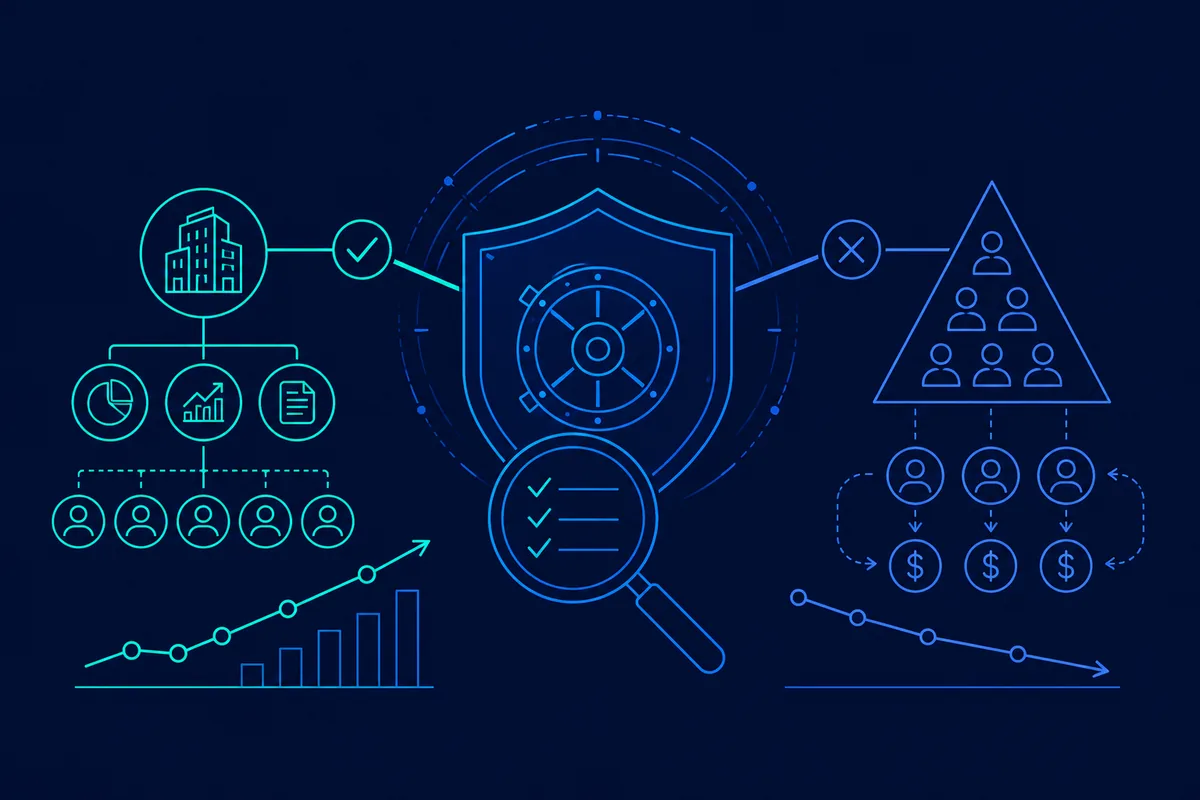
In this article, we’ll explore how to tell a legitimate investment fund from a Ponzi scheme in just 5 minutes, which red flags investors should watch for, and why transparency, capital control, and performance-based fees are key to protecting your money.
A well-designed Ponzi scheme does not look like a Ponzi scheme. It often looks like a successful fund: a polished website, client reviews, growth charts, and confident people in suits.
That is why people do not lose money because they are “stupid.” They lose money because they do not know what to look at.
Let’s break down seven signs that help distinguish a legitimate fund from a financial scheme. You can check them in five minutes – and those five minutes may be worth more than everything else.
This is the most important question.
In a real fund, returns come from the market: from trades, strategies, and asset management. In a Ponzi scheme, returns come from new investors. Old participants are paid with the money of new ones, and as long as new money keeps coming in, the scheme survives. Once the inflow stops, everything collapses.
If the answer to “Where does the profit come from?” is vague instead of clear and logical, that is a warning sign.
“We guarantee 15% per month” is not an investment offer. It is a red flag.
Markets do not provide guarantees. Any honest return is a combination of probability and risk, not a promise. High fixed returns without risk exist only in the presentations of financial pyramids.
A legitimate fund shows a verifiable history: real trades, real drawdowns, and real periods of losses.
A Ponzi scheme shows only a smooth upward curve and explains it with a “secret strategy.” Secrecy is often a way to hide the fact that there is nothing real to show.
Every real strategy has losing periods. If a fund is transparent, it will show its maximum drawdown.
If you are told that losses never happen at all, you are most likely being misled. A complete absence of losses is not an achievement. It is often a sign that the numbers are artificial.
A key question is where your capital is physically held and who has the ability to withdraw it.
In a transparent structure, withdrawals remain under your control, while the manager works with the capital but cannot simply take it. If the money is transferred to an account controlled only by the other party, you are depending entirely on someone else’s honesty.
A fair fee structure is linked to performance.
The High-Water Mark model means that the manager earns only if they increase your capital above its previous peak. A Ponzi scheme, by contrast, often earns through entry fees or rewards for attracting new participants, because its real source of income is the inflow of new money.
“Spots are limited.”
“Bring a friend and earn a percentage.”
“Join before the window closes.”
The more pressure you feel through urgency, and the more emphasis there is on referral bonuses, the higher the chance that you are dealing with a scheme.
A real fund does not depend on whether you bring someone else into it.
How to use this checklist
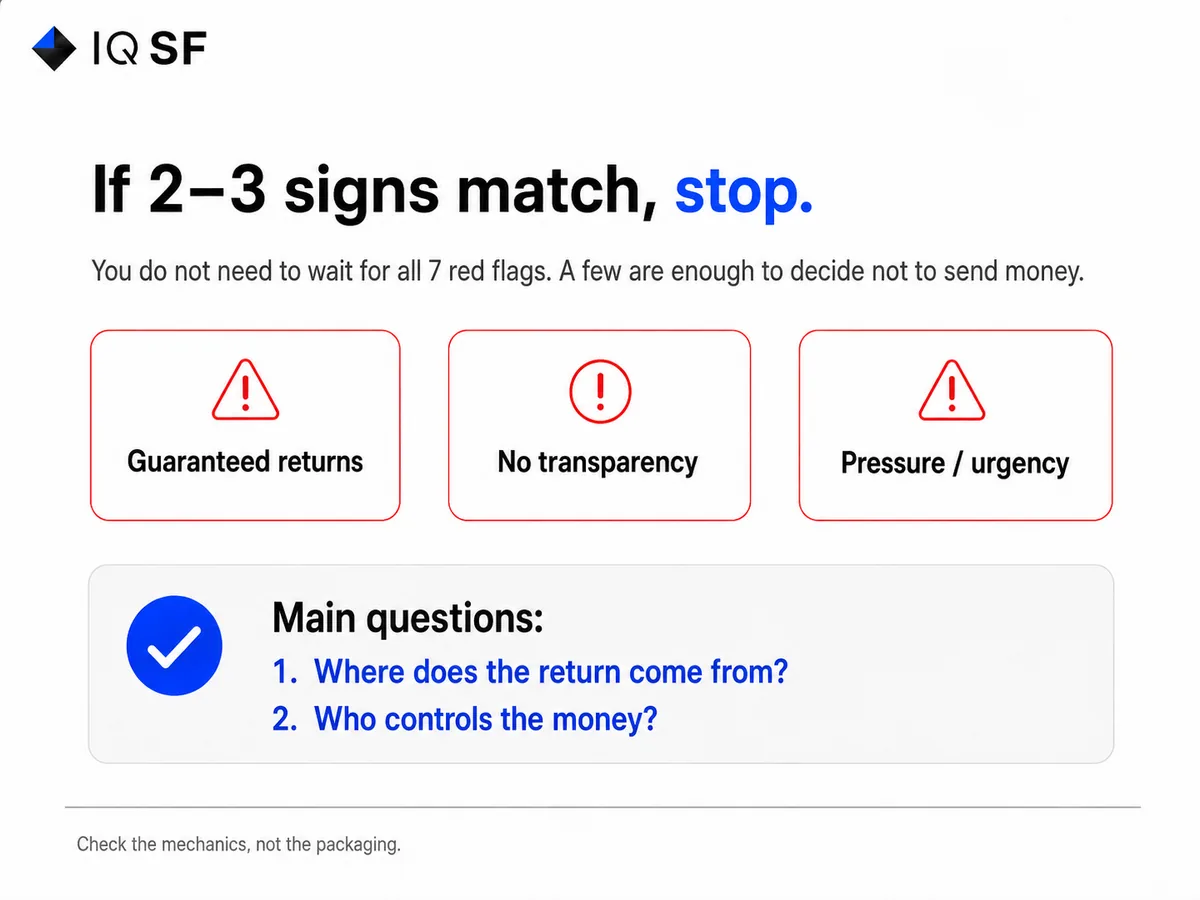
You do not need all seven signs to appear. Two or three red flags are already enough to stop and investigate further.
The most important signs are the first and the fifth: where the returns come from and who controls the money. If there is no clear answer to these questions, the rest becomes secondary.
Five minutes spent asking these questions is cheaper than losing all the capital you could have protected.
What this looks like in practice
Imagine two presentations.
In the first one, you see a smooth curve that rises month after month with almost no declines. You are promised stable returns and gently pushed to act quickly because “the pool is closing soon.” When you ask about losing periods, you are told that the strategy is “so well-optimized that drawdowns are practically nonexistent.” When you ask where the returns come from, you hear vague explanations about “closed algorithms.” You are asked to transfer funds to a corporate account, and withdrawals are said to be available “upon request.”
In the second presentation, you see a real performance history with fluctuations, drawdowns, and negative months. The maximum drawdown is clearly stated. The source of returns is explained in simple terms. Your funds remain under your control, the fee is charged only on profits above the previous peak, and no one pressures you to make a decision immediately.
Both presentations may look professional on the surface.
But in substance, the first one contains almost all seven red flags, while the second one passes the basic transparency test. The difference is not in the design of the website. The difference is in the answers to seven simple questions.
What not to do
Do not treat reviews and payment screenshots as proof. Both can be created in less than an hour.
Do not assume that visibility equals reliability. Ponzi schemes often buy advertising from influencers and look loud precisely during the phase when they are actively attracting new participants.
Do not make decisions under pressure. Urgency is a tool that prevents you from calmly asking the seven questions that matter.
The most expensive mistake an investor can make is skipping the check because “everything looked serious.” A serious appearance is often the very packaging that schemes pay for first.
The main difference between a ponzi scheme and a fund in one sentence
If we remove everything unnecessary, the difference between a financial pyramid and a legitimate fund comes down to one question:
Where does the money for payouts come from?
In a real fund, it comes from the market. In a Ponzi scheme, it comes from new participants.
The seven signs above are simply different ways to identify this difference.
So when someone offers you an investment opportunity, ask yourself one key question:
If no new people bring money tomorrow, who will be paid – and from what source?
A legitimate fund has an answer because its returns come from asset management. A Ponzi scheme does not have an answer, because without new inflows, there is nothing left to pay out. That is exactly when it collapses.
The most common signs of a financial pyramid
If we reduce the most common signs of a financial pyramid to a short list, they include:
- promises of high guaranteed returns;
- a strong focus on attracting new participants;
- referral bonuses;
- lack of transparency;
- “secret” strategies;
- urgency and pressure;
- difficulties with withdrawals.
The more of these signs appear, the less room there is for doubt.
It is especially important to be cautious when the presentation focuses less on how the company actually earns money and more on how much you can earn by inviting friends. Real returns from asset management do not depend on whether you bring someone else into the system.
What to do if You have already invested
If you suspect that you may have entered a Ponzi scheme, do not wait.
Try to withdraw your funds, ideally a significant portion, and observe the reaction. Delays, new conditions, or requests to “deposit more in order to unlock the withdrawal” are very strong warning signs.
Save all correspondence, documents, and transaction records. Do not agree to “invest more to save the previous investment.” This is a classic way of extracting more money from the victim.
The best protection, of course, happens before the investment is made. Five minutes of due diligence before transferring funds is far more valuable than any attempt to recover money afterward.
IQSF’s approach
At IQSF, we structure our work so that investors can evaluate us against these same seven criteria: verifiable performance history, separated capital control, and performance-based fees.
We share more insights on funds, strategies, transparency, and risk management in our Telegram channel.
Frequently asked questions
What is the most important question to ask before investing in a fund?
Ask where the returns actually come from. In a legitimate fund, profit comes from the market, from trades, strategies, and asset management, while in a Ponzi scheme it comes from new investors' money paying earlier participants, which is why the scheme collapses once new inflows stop. A vague answer to this question is already a warning sign.
Why is a guaranteed monthly return a red flag?
Because markets do not provide guarantees, and any honest return combines probability with risk rather than a fixed promise. High fixed returns without risk exist mainly in the presentations of financial pyramids, while a legitimate fund shows a verifiable history that includes real drawdowns and losing periods.
Who should control withdrawals in a legitimate investment structure?
The investor should. In a transparent structure, withdrawals remain under the investor's own control while the manager works with the capital but cannot simply take it, whereas money transferred to an account controlled only by the other party leaves the investor dependent entirely on someone else's honesty.
How many warning signs does it take before you should be concerned about a fund?
Not all seven need to appear. Two or three red flags, such as guaranteed high returns, pressure to act quickly, referral bonuses, or difficulty withdrawing funds, are already enough to stop and investigate further. The most important signs remain where the returns come from and who controls the money.