Private wealth management: how it works and who to trust

In this article, we’ll explore how private wealth management works, the different ways to manage capital, who controls and safeguards investors’ assets, how management fees are structured, and what to look for when choosing a manager to reduce risks and maintain control over your money.
Private wealth management is a service in which a professional invests the money of one person or family under agreed rules: choosing assets, keeping risk within set limits and reporting on results. The manager worth trusting is one whose custody arrangements and results can be checked without asking the manager: client money sits apart from the firm's own, and returns are published together with drawdowns.
What is private wealth management?
Private wealth management always involves three roles: the owner of the money, the manager who makes decisions, and the custodian who actually holds the assets.
The owner sets the frame: goals, time horizon, and the size of a temporary decline at which they would want to stop. Professionals often write this down as an investment policy statement. The manager works inside that frame. The custodian, usually a bank or a broker, keeps the records and carries out only permitted transactions. The more strictly these roles are separated, the less depends on one person's word.
Think of a car with a hired driver. The driver picks the route and the speed, but the title stays with the owner, and the driver cannot sell the car.
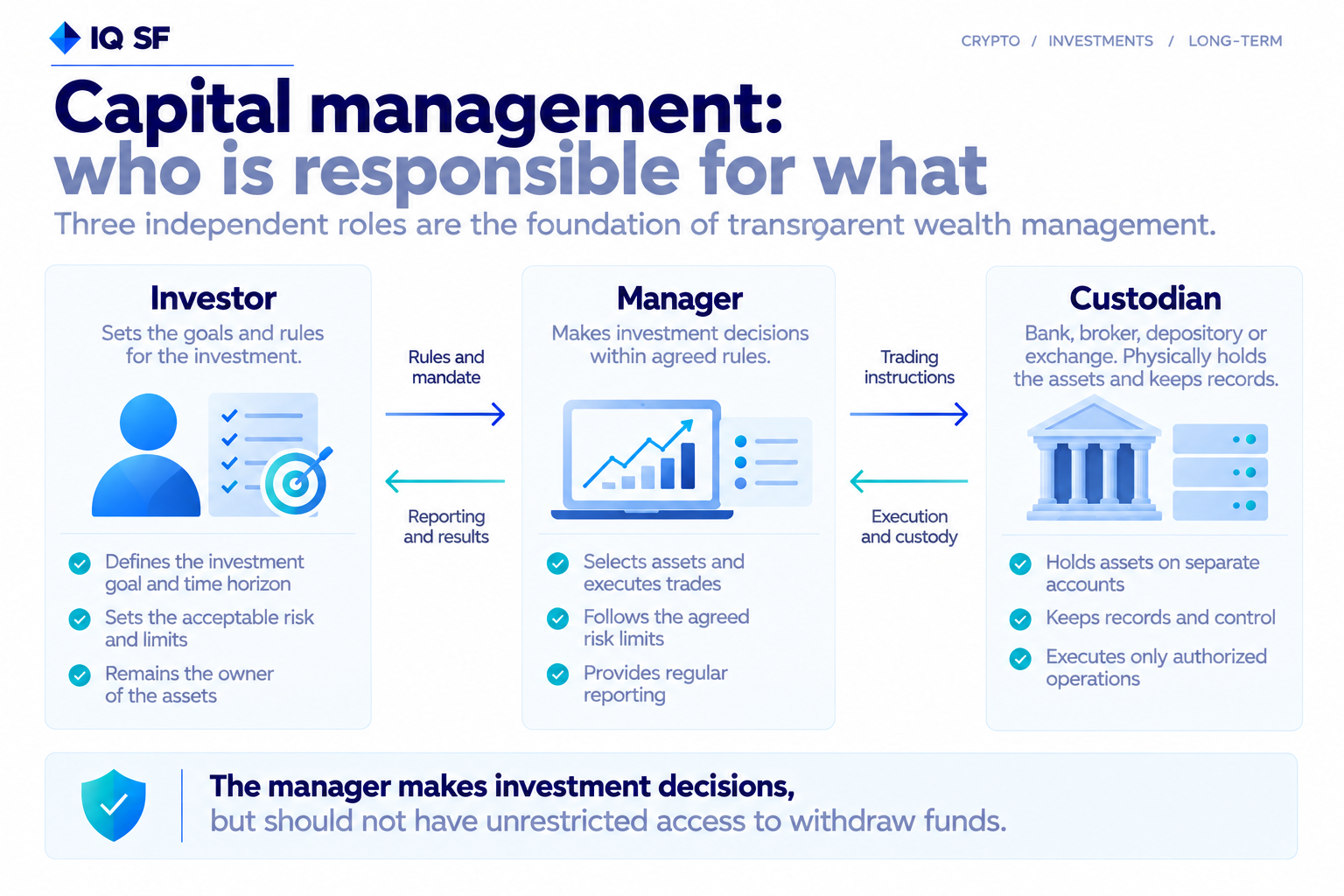
How does wealth management work?
A wealth management relationship runs on a written mandate, an independent custodian and regular reports that the client can compare with the custodian's own statements.
First comes the mandate: what the money is for, how long it can stay invested, which assets are allowed and how deep a decline is acceptable. Then the manager builds the portfolio and adjusts it as markets move. The assets usually stay with a separate custodian, and comparing the custodian's own statements with the manager's report reveals any gap at once.
Types of wealth management services
Wealth management formats differ mainly in whose name the assets are held under and who can withdraw them, and that decides what protects the owner on a bad day.
Format | Where the assets sit | Who makes decisions | What protects the owner |
Private bank | Client accounts at the bank and its brokerage arm | Client advised by a private banker, or a discretionary team | Accounts in the client's name, written mandate |
Investment adviser | Client account at an independent custodian | Adviser under a discretionary agreement | Fiduciary duty, independent custodian |
Mutual fund or other pooled fund | Fund assets held by a custodian | Fund manager under the fund's rules | Custodian, audited reports |
Family office | Accounts of the family and its companies | A team hired by the family | Contracts and governance the family writes |
Separately managed account (SMA) | The client's own brokerage or exchange account | Manager with trading rights and no withdrawal rights | Money never leaves the client's account, access can be revoked |
Copy trading | Client account on a platform | Platform copies a strategy author's trades | Platform rules, the client can switch off at any time |
A family office is the most private format: it serves only one family, is owned and controlled by that family and does not offer its services to the public, so protection comes from the contracts and governance the family writes itself.
In a separately managed account and in copy trading the logic is the reverse of a fund: the money does not move to the manager, who only receives the right to trade. What happens to client money in each format when a manager or platform fails is covered in SMA, fund or copy trading: where investor money is held.
What is fiduciary duty in wealth management?
A fiduciary must put the client's interests ahead of its own, and it pays to know in advance whether the person managing your money works to that standard.
Fiduciary duty has two parts: a duty of care, which means giving advice that serves the client's objectives, and a duty of loyalty, which means disclosing or eliminating conflicts of interest instead of quietly profiting from them. Not everyone who recommends investments works to this standard, and some follow a related but separate one. Ask in writing which standard applies to your account and to every product recommended to you.
How much does private wealth management cost?
The price of wealth management is the manager's fee plus trading costs, and with frequent trading the costs can outweigh the fee.
For advisers paid as a share of assets, Kitces Research puts the median fee at about 1% a year for a $1 million client (June 2025), with rates usually stepping down on larger balances. Funds and strategy managers often add a performance fee, a share of profits. Here the key term is the high-water mark: the fee is charged only on gains above the previous peak of the client's capital, otherwise the client pays twice for recovering from the same drawdown. The variants are explained in Manager fees: management fee, success fee and high-water mark.
Trading costs come on top. We re-ran the trade log of our Basket 50 strategy, 2,900 executions from September 2024 to July 2026, with different exchange fee rates and a starting capital of $100,000: at 0.100% per execution the result was +30%, at 0.040% it was +126%. This is not the strategy's dashboard result but the same trades at different execution costs, so ask about the fee rate and the trading venue before signing.
How to choose a wealth manager you can trust
A trustworthy wealth manager is not the one with the highest returns, but the one whose every claim can be verified without the manager's help.
1. The manager follows your country's rules. These rules differ from country to country, and confirmation comes from an independent source, not from the manager's own word.
2. Client money kept apart from the manager. A custodian account in the client's name, or an account in the client's own name where the manager can trade but not withdraw. A request to wire money to the manager's personal account or card, or to grant withdrawal access, ends the conversation.
3. Daily statistics with drawdowns. Returns are shown next to risk: maximum drawdown, the longest drawdown period, the worst month, for every day rather than in selected screenshots. Our strategy dashboard works this way: as of October 4, 2026, Basket 50 shows a compound annual growth rate of 81.43%, a maximum drawdown of -28.59% and a longest drawdown period of 241 days, and that drawdown was still open on the cut-off date. Past performance does not guarantee future results.
4. Reports from an outside source. Statements from the custodian, broker or exchange, which the manager cannot produce alone.
5. Fees in writing before money moves. Rates, the base they are charged on and the high-water mark are in the contract.
6. No guaranteed returns. Returns cannot be known in advance, so a promise of high returns with little or no risk, of overly consistent returns or of a "guaranteed" opportunity points to a scheme rather than a skilled manager.
How much money should you give a wealth manager?
The sensible amount is calm money: funds you will not need for several years and whose temporary decline by the depth of the strategy's drawdown you can live through without ending the agreement.
The test is simple: multiply the amount by the maximum drawdown of the strategy you are considering. With a 30% drawdown, $100,000 temporarily becomes $70,000. If that number makes you want to pull out at once, the amount is too large for you. The next drawdown can be deeper than the last one, so an emergency fund and money for purchases in the coming year do not belong in this amount.
This material is for information only and is not individual investment advice.
Frequently asked questions
What does a private wealth manager do?
A private wealth manager invests a person's or family's money under an agreed mandate covering goals, time horizon and acceptable decline. They build and adjust the portfolio and report on results and costs. The client remains the owner of the assets, which normally sit with a separate custodian.
Is a wealth manager a fiduciary?
Not always. Some managers and advisers owe their clients a fiduciary duty of care and loyalty, while others who recommend investments follow a related but separate standard. Ask in writing which standard applies to your account and to every product recommended to you.
How much money do you need for private wealth management?
Each firm sets its own minimum. Fees are usually tiered: Kitces Research puts the median at about 1% a year for a $1 million client, with lower rates on larger balances.
What protects money with a wealth manager?
Mostly the structure: the assets usually sit with a separate custodian rather than with the manager, and in a separately managed account the money never leaves the client's account and access can be revoked. None of this protects against a falling market, so only calm money belongs with a manager.