Managed accounts: what actually happens and what rights the manager gets

In this article, we’ll explore how managed accounts work, what permissions a manager receives through an API key, why trading access doesn’t mean withdrawal access, what risks investors still face, and how to independently verify trading performance.
A managed account is an arrangement where funds stay in the investor’s own account while the manager receives limited access and trades that account according to their strategy. The key difference from handing over money is that the assets never change owner and never physically move.
Technically, access is granted through an API key carrying a set of permissions. That set defines exactly what the manager can do with your money, and it is what you should understand before signing anything.
Below: key permissions, additional restrictions, the limits of the protection this arrangement provides, and how it differs from adjacent formats.
Three permissions, and why the third is unnecessary
Read. Allows viewing balance, positions and operation history. Changes nothing. Such a key is as safe as access can be: the worst it enables is knowing what is happening in your account.
Trade. Allows opening and closing positions. This is the permission the whole arrangement exists for: without it, managing a strategy is impossible.
Withdrawal. Allows moving funds out of the account. It is never required to manage a strategy, under any architecture, any strategy and any venue.
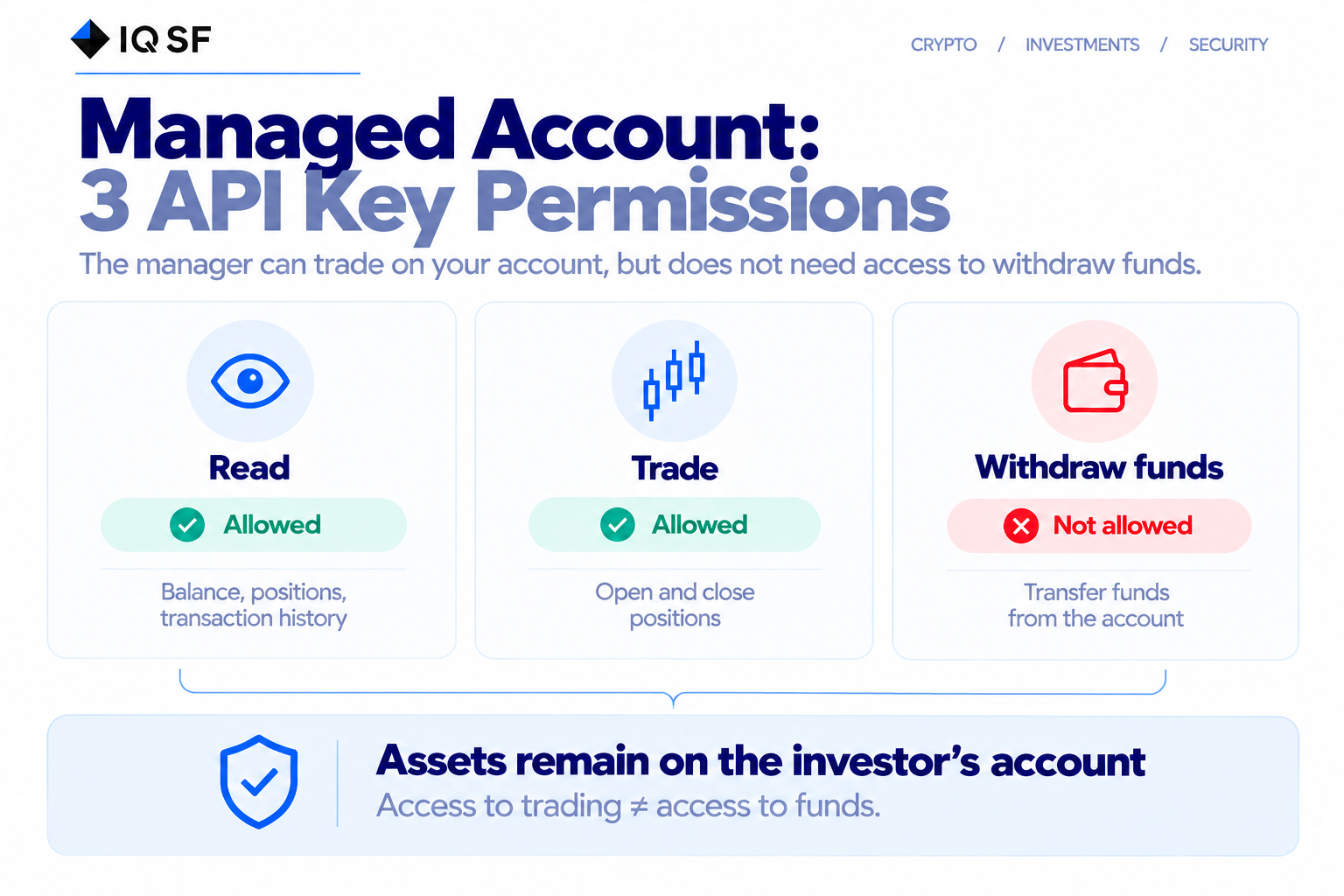
That last point is worth remembering word for word, because on its own it settles most security questions. A manager who needs a key with withdrawal enabled is asking for more than the work requires.
Worth knowing separately: some venues allow withdrawals to be restricted to a whitelist of pre approved addresses. This intermediate option is sometimes offered as a compromise. For managing a strategy it remains excessive: it adds nothing to the work.
What else limits access, beyond permissions
Besides permissions, keys carry settings that the investor controls and usually does not know about.
IP binding. Most venues let you restrict a key to a specific server address. A stolen key launched from anywhere else stops working. The setting is free and removes an entire class of scenarios, including a leak on the manager’s own side.
Revocation. The investor can revoke a key at any time, unilaterally, without notice and without the manager’s consent. It takes seconds in the exchange interface and requires nobody’s participation.
Expiry. Some venues allow an expiry date on a key. Useful for a trial period: access ends by itself, with nothing to remember.
A separate sub account. Many exchanges allow opening a sub account and issuing a key limited to it. Management then happens on a ring fenced portion of funds, while the rest of the main account is inaccessible entirely. A simple measure that caps risk at the infrastructure level rather than by agreement.
What remains your risk
The arrangement removes one class of risk and leaves the rest, and that deserves stating plainly, because this is where the unpleasant surprises live.
Removed: the risk that the manager walks off with the money. With a correctly issued key, they physically cannot withdraw it.
Not removed: market risk. The strategy can perform badly, and a loss in your account is your loss.
Not removed: venue risk. Funds sit at an exchange, and its reliability becomes part of your risk. You chose the exchange as a trading venue, but it effectively acts as custodian.
Not removed: position size risk. Trading rights allow leveraged positions, and money can be lost that way without a single withdrawal. The absence of withdrawal rights protects against theft, not against risk.
The practical consequence of that last point: limits on position size and maximum leverage must be fixed explicitly rather than assumed. Where the venue allows it, part of those limits can be set technically, through a sub account and leverage settings, and that is more reliable than any agreement.
How to verify what is happening
The main advantage of the arrangement is that verification does not depend on the manager’s report. All operations are recorded on the exchange side and available to you as account owner.
History can be exported independently and used to compute results: returns for a period, maximum drawdown, recovery time, leverage actually used, trade count, and every cost charged, funding included.
We built IQ Metrics for this: it connects through a read only key, reads operation history and computes the figures itself. The difference from a supplied report is fundamental: a report shows what someone chose to show; operation history shows what happened.
If the report diverges from the export, that does not necessarily mean deception. More often it is methodology: performance can be measured on closed trades or including open positions, with costs or without, adjusted for deposits or not. But discovering the divergence and its cause in month one beats discovering it a year later.
How this differs from adjacent formats
Copy trading. A trader’s positions are mirrored into your account, with replication parameters usually limited by platform settings. The manager does not see your account and does not tailor execution to it. Simpler to connect, less flexible.
Managed account. The strategy is executed in your account directly, sized to it and bound by agreed constraints. More flexible, requires explicit agreements on limits.
Transferring funds into a pool. Money is transferred and you receive units. This is no longer a managed account: assets change owner, and counterparty risk appears.
What the first two share matters most: the money stays yours, and access is revoked by you at any time.
A practical connection sequence
Open a separate sub account and move into it the amount intended for the strategy.
Create a key with read and trade permissions, no withdrawal rights, bound to the manager’s server address and, where possible, with an expiry date.
Fix in writing the limits on position size, leverage and instruments.
Create a separate read only key for yourself or for a verification service, so results can be computed independently.
After a month, reconcile what you computed against what was claimed, and discuss any divergence.
In short
A managed account is access, not a transfer of money. Assets stay in your account, the manager works through a key with trading rights, and withdrawal rights are never needed.
Theft risk is removed; market risk, venue risk and position size risk remain. Limits on size and leverage are fixed separately and set technically where possible, and results are verified from operation history rather than from a supplied report.
Not an individual investment recommendation. Past performance does not guarantee future returns.