Crypto staking explained: yields and risks

In this article, we’ll explore how crypto staking works, where Ethereum and Solana staking rewards come from, why earning more coins doesn’t guarantee profits in dollars, what risks investors face from validator penalties, withdrawal delays, and intermediaries, and why USDT “staking” is fundamentally different from traditional staking.
Crypto staking means locking coins in a proof-of-stake blockchain in exchange for rewards paid by the network. The rewards come in the same coin, mostly from newly issued tokens and fees, so they do not protect you from a fall in that coin's price, and nobody guarantees them. Below: where staking yields come from, what Ethereum and Solana paid in 2026, what can go wrong, and why "USDT staking" works in a completely different way.
What is crypto staking in simple terms?
Staking works like a security deposit that a network participant puts up to be trusted with confirming transactions: honest work earns rewards, while mistakes and cheating cost part of the deposit.
Bitcoin blocks are confirmed by miners, who spend electricity. In proof-of-stake networks, such as Ethereum since September 2022, a stake of coins does that job instead, and the participants who put it up are called validators. Running your own Ethereum validator takes 32 ETH and a server that stays online around the clock. Everyone else stakes through intermediaries: they delegate coins to a validator (as on Solana or Cardano), hand them to a liquid staking protocol, or use an exchange product.
Where do staking rewards come from?
Staking rewards are paid by the network itself, mostly by issuing new coins, so a large part of them is funded by diluting holders who do not stake.
Take Solana. According to 21Shares, as of 24 August 2026 the nominal staking yield was about 5.25% a year, with network inflation around 3.78%. By our calculation, stakers' share of the network grows by roughly 1.4% a year, while holders who do not stake see their share shrink by about 3.6%. Most of the "yield" here offsets inflation rather than creating new value.
Even more important, rewards are paid in coins. If ether falls 30% over a year and staking adds 2.61% in ether, the result in dollars is minus 28.2%.
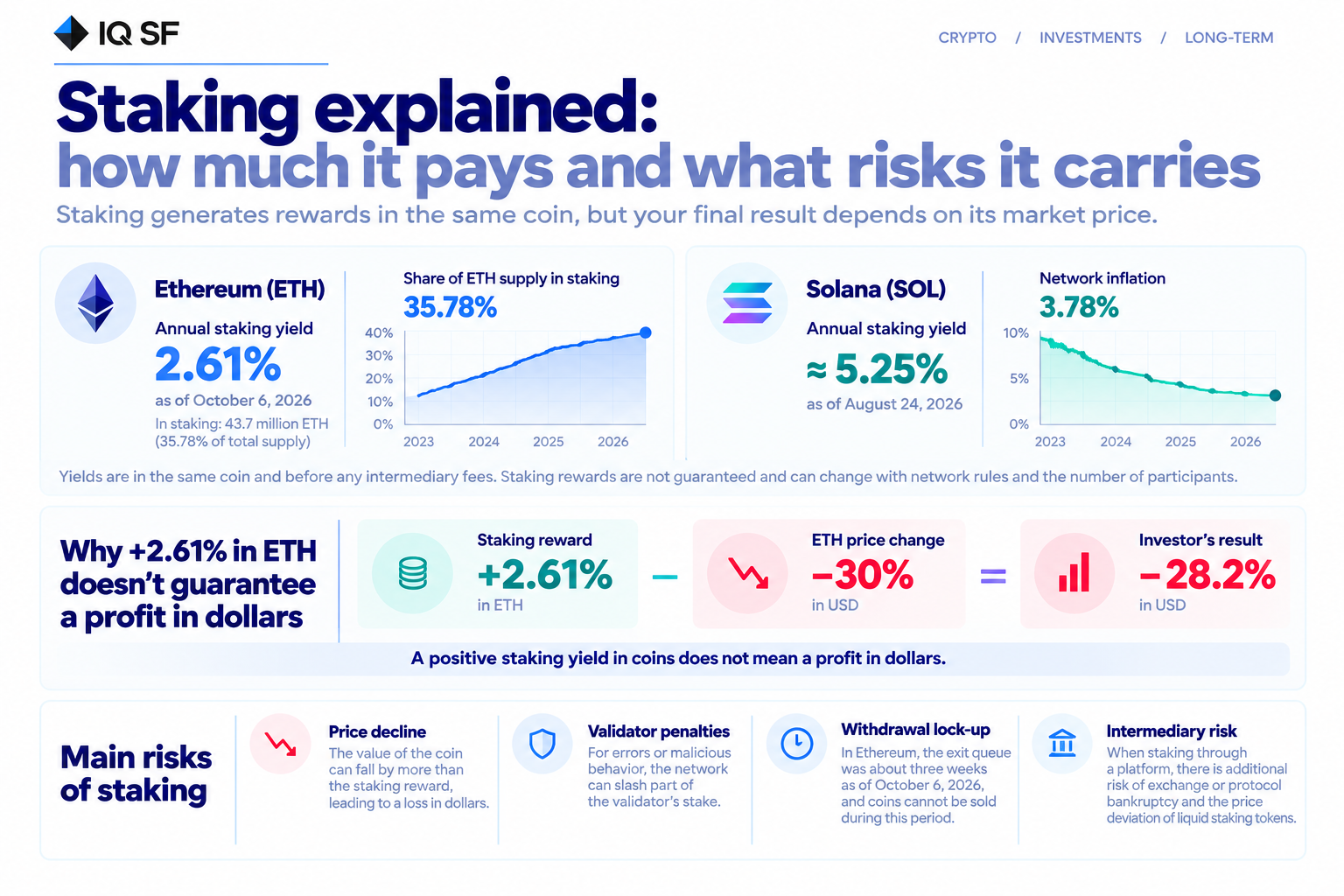
How much does staking pay? Yields in 2026
On Ethereum and Solana, staking paid between 2.6% and 5.3% a year in 2026, in the coins themselves; other networks pay both less and more, and the numbers move with network rules and participation.
• Ethereum: 2.61% a year as of 6 October 2026, according to beaconcha.in data, with 43.7 million ETH, or 35.78% of supply, staked. The more ether is staked, the smaller the reward per coin.
• Solana: about 5.25% as of 24 August 2026. On 28 August, 67% of validator votes, against a 66.67% threshold, backed a faster cut in new issuance: the disinflation rate rose from 15% to 30% a year. 21Shares estimates the staking yield could fall to about 3% within two years.
Staking through an intermediary pays less by the amount of its fee. These figures are a dated reference: nobody promises a staking yield, and a network can change it by vote.
Staking risks: slashing and lock-up periods
Two risks are built into the network itself: penalties for validator mistakes, and the time during which you cannot sell your coins.
Slashing is a penalty the network takes from the stake of a validator that signs conflicting data. On Ethereum, since the Pectra upgrade of 7 May 2025, the initial penalty is 1/4096 of the stake, but when many validators are punished at the same time, an additional penalty grows and, in the extreme case, takes the whole stake. On 10 September 2025 the network slashed 39 validators run by two operators after errors during server maintenance and migration; each lost about 0.3 ETH.
You cannot leave staking instantly. As of 6 October 2026 the Ethereum exit queue was 14 days and 21 hours, plus up to 7.5 days before funds arrive, about three weeks in total. The queue grew almost fivefold from the start of October after a large provider began withdrawing validators following a security incident. During all that time you cannot sell the coins, even if the price is falling.
Platform risk and liquid staking depegs
When an intermediary stakes your coins, its own risks are added to the network's: the platform can go bankrupt, and the receipt token can trade below the coin.
In 2022 three large platforms that paid interest on crypto went bankrupt: Voyager (5 July), Celsius (13 July) and BlockFi (28 November). In the Celsius bankruptcy, coins in its Earn program, about $4.2 billion across roughly 600,000 accounts, were found to belong to the company, which left account holders as unsecured creditors. Who actually holds the coins and who has access to them is the subject of our article on where investor money is held.
A liquid staking protocol gives you a receipt token, such as stETH for ether, which you can sell at any time, but only at the market price. In June 2022, when withdrawing ether from staking was not yet technically possible (it became possible on 12 April 2023), selling by large holders pushed stETH below ether: on 29 June the gap was 4%.
Method | Where the yield comes from | What capital is exposed to | How fast you can exit |
On the network: own validator or delegation | New coins and network fees | Coin price, validator penalties | By network rules; about three weeks on Ethereum as of 6 October 2026 |
Liquid staking | The same, minus the protocol's fee | Smart contract bugs, receipt token trading below the coin | At once, by selling the receipt token at market price |
Staking on a platform | The same, minus the platform's cut | Platform bankruptcy or freeze | On the platform's terms |
"USDT staking" | Interest from borrowers | Platform bankruptcy, borrower default | On the product's terms |
USDT staking: why it is not really staking
USDT cannot be staked in the network sense: it is issued by a company, Tether, not by validators, and nobody earns it for securing a blockchain.
What platforms call "USDT staking" is in substance a loan: the tokens go to borrowers, usually leveraged traders, or into a lending protocol. Borrowers pay the interest, and the rate floats with demand for borrowed dollars. The issuer itself pays holders nothing: Tether keeps the income from its reserves, and its operating profit in the second quarter of 2026 was about $1.5 billion.
The risk of such a product sits with the platform and the borrower, not the network: Celsius, Voyager and BlockFi also paid interest on stablecoins. The higher the promised rate on a "digital dollar", the more important the question of where it comes from; the signs that help answer it are collected in our seven signs of a Ponzi scheme.
Before you stake: five questions to ask
Before staking, it helps to know five things: which coin the reward is paid in, who funds it, who holds the coins, how fast you can get out and what a quick exit costs.
1. Which coin is the reward paid in? If it is the coin you stake, the reward does not protect you from a fall in its price: the result in dollars depends on the price of the coin itself.
2. Who funds the reward? On the network, mostly newly issued coins, so a large part of it is funded by diluting holders who do not stake. In "USDT staking", borrowers pay, and the risk sits with the platform and the borrower.
3. Who holds the coins? If a platform does, the risk of its bankruptcy comes on top of the network's risks: Voyager, Celsius and BlockFi, which paid interest on crypto, all went bankrupt in 2022.
4. How fast can you get out? On Ethereum, as of 6 October 2026, exiting took about three weeks, and during all that time you cannot sell the coins.
5. What does a quick exit cost? A liquid staking receipt token can be sold at once, but only at the market price, which can be below the coin: on 29 June 2022 the gap for stETH was 4%.
This list leaves out rules and taxes: they depend on the country you live in.
This material is for information only and is not individual investment advice.
Frequently asked questions
What is staking in crypto?
Staking means locking coins in a network where transactions are confirmed by validators who put up a stake. The network pays rewards in the same coin for taking part and takes part of the stake for validator mistakes. You can stake yourself or through a validator, a protocol or a platform.
How much can you earn from staking?
As a dated reference: 2.61% a year in ether as of 6 October 2026, according to beaconcha.in, and about 5.25% on Solana as of 24 August 2026. The yield is not promised: it depends on network rules, participation and the intermediary's fee, and the result in dollars depends on the coin's price.
Can you lose money staking crypto?
Yes. The main risk is a fall in the coin's price: after a 30% drop, a 2.61% yearly reward still leaves you at minus 28.2% in dollars. On top of that come validator penalties, waiting to withdraw (about three weeks on Ethereum in October 2026), platform bankruptcy and receipt tokens trading below the original coin.
Is USDT staking safe?
It is not staking but a loan of tokens to a platform, or through it to borrowers, so its risk depends on the platform and the borrowers. In 2022 the bankruptcies of Celsius, Voyager and BlockFi turned customers who earned interest, including on stablecoins, into creditors of the platforms. The USDT issuer pays holders no interest.