Manager fees: management fee, success fee, and high water mark in simple terms
In this article, we’ll explore how management fees, success fees, and high water marks work, why fee structure can change the real cost of investing, and how investors can avoid paying twice for the same growth after a drawdown.
A manager’s compensation usually consists of two parts: a fixed management fee and a share of the profit earned. The fixed fee is charged regardless of performance, while the profit share is charged only if there is profit. Most unpleasant surprises are hidden in the second part.
Below, we explain both models, what a high water mark is, why without it an investor can pay twice for the same growth, and how much each structure costs in numbers. At the end, there is a checklist of what should be written in the agreement.
Management fee: the fee for managing capital
A management fee is a fixed percentage of assets under management, usually one to two percent per year, charged regardless of performance. It is usually deducted in parts, most often monthly or quarterly.
The logic is simple: the manager has infrastructure, data, staff, and legal costs regardless of whether the year was profitable. The fixed component covers these expenses.
For the investor, two things matter here.
First: what base the percentage is calculated from. It can be calculated from the amount at the beginning of the period, the average amount during the period, or the amount at the end of the period. The difference becomes meaningful when the account moves: if the base is taken at the end of a growing period, the investor pays more.
Second: whether this fee is charged during a losing period. Usually yes, and this is normal by design. But the investor should understand that the fixed component works like a headwind: it adds to the drawdown.
Success fee: a share of the profit
The second component is usually between ten and thirty percent of the profit earned during the period. This is where the agreement deserves the closest reading.
There are four key parameters.
Calculation period. Month, quarter, or year. The shorter the period, the more often the manager locks in their share, and the less favorable the structure becomes for the investor when the curve is uneven.
Calculation base. Profit may be calculated from the increase in account value or from a certain threshold. There is also a structure with a hurdle rate, meaning a minimum return below which no success fee is charged at all.
Deduction method. From the account or as a separate payment. If the fee is deducted from the account, working capital decreases, which affects compound growth.
High water mark. This is the most important point, and it deserves a separate section.
High water mark: what it is and why without it investors pay twice
A high water mark is a mechanism where the success fee is charged only on the part of the profit that exceeds the previous historical high of the account value.
The easiest way to show this is with numbers. The account starts with $1 million, the success fee is 20%, and the calculation period is quarterly.
Without a high water mark:
| Quarter | Account value at the end | Profit for the quarter | Success fee |
|---|---|---|---|
| First | $1,300,000 | $300,000 | $60,000 |
| Second | $900,000 | Loss | $0 |
| Third | $1,200,000 | $300,000 | $60,000 |
Total paid: $120,000. At the same time, over three quarters the account grew from $1 million to $1.2 million, meaning the investor’s actual profit was $200,000, while the fee on that profit was $120,000. That is 60% of the result.
With a high water mark:
| Quarter | Account value at the end | High water mark | Profit above the high water mark | Success fee |
|---|---|---|---|---|
| First | $1,300,000 | $1,000,000 | $300,000 | $60,000 |
| Second | $900,000 | $1,300,000 | None | $0 |
| Third | $1,200,000 | $1,300,000 | None | $0 |
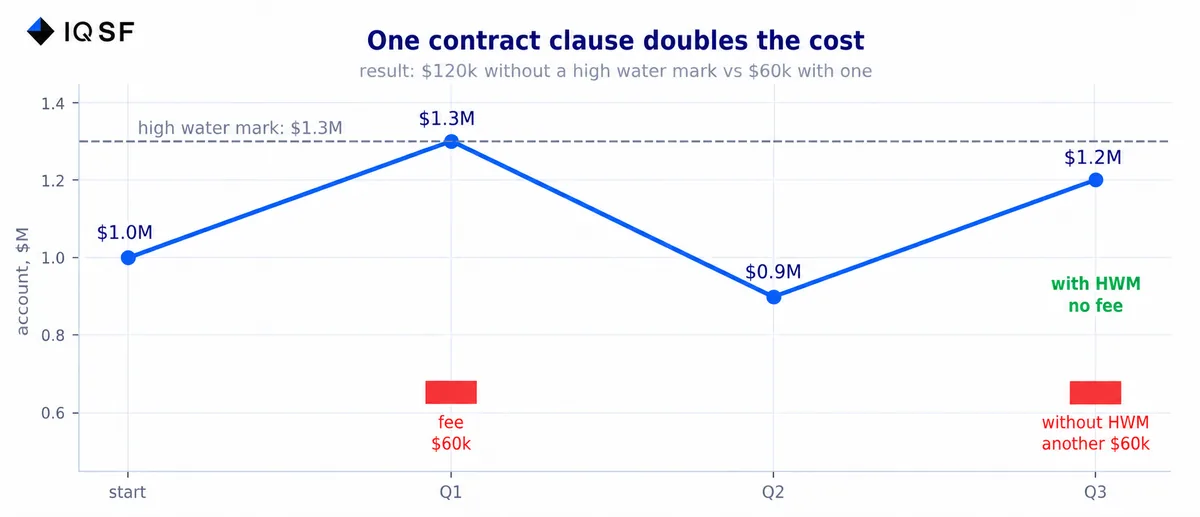
Chart 1. The same account: without a high water mark, the fee is charged twice
Total paid: $60,000. In the third quarter, there is no fee because the account has not yet exceeded its previous high of $1.3 million. From the investor’s point of view, the manager was still recovering the drawdown, not creating new profit.
The difference is twofold on the same curve. That is why the absence of a high water mark is not a minor detail, but a structural flaw in the agreement.
There is also a softer version that sometimes appears: a high water mark that resets once a year. It is better than having none at all, but worse than a permanent one. If the drawdown happens near the end of the calendar year, the mechanism resets exactly when it is needed most.
What happens when funds are withdrawn
There is a separate question that investors rarely ask before signing: how is the fee calculated if the investor withdraws part of the funds in the middle of the period?
There are two possible structures. The first: when funds are withdrawn, the success fee is fixed and calculated on the withdrawn part. The second: the fee is charged only at the end of the period on the remaining amount, while the withdrawn funds are not subject to the fee.
The second structure creates an obvious imbalance, so the first one is usually used. But the wording should still be checked, because disputes around this issue happen regularly.
It is also worth clarifying whether there is a lock-up period and an early withdrawal penalty. An early withdrawal fee can be a perfectly legitimate part of the structure, but it must be disclosed in advance.
Costs that are not called fees
In addition to the manager’s compensation, there are expenses that reduce the result but usually do not come up in conversations about fees.
Exchange trading fees. These are paid on every entry and exit. For a strategy that makes forty trades per month, this is a meaningful amount, especially with leverage: the fee is charged on the position size, not on the deposit.
Funding on perpetual futures. Funding is charged or paid every eight hours depending on the direction of the position and market conditions. Over longer holding periods, it can accumulate into a significant amount.
Slippage. This is the difference between the calculated entry price and the actual execution price. It is not formally a fee, but it reduces the result in exactly the same way.
All three are trading costs and are usually already included in the performance curve shown by the manager. But this should be verified with a direct question: is the displayed return before or after costs?
How to compare offers
Comparing one number does not work. A manager with a 2% fixed fee and a 10% success fee may turn out to be more expensive or cheaper than a manager with no fixed fee and a 30% success fee, depending on the final result.
A practical method is to calculate the total fee under three scenarios.
| Scenario | What we calculate |
|---|---|
| Good year: return 60% | How much I pay under each fee model |
| Average year: return 15% | The same calculation |
| Losing year: minus 20% | How much I pay despite the loss |
The losing scenario usually makes everything clear. A model with a high fixed component still charges fees in a losing year, while a model without a fixed component charges nothing.
What should be written in the agreement
The list is short, but every point should be checked directly:
- management fee size and calculation base;
- success fee size and calculation period;
- whether there is a high water mark and how it is updated;
- whether there is a hurdle rate, if applicable;
- how fees are calculated in case of partial withdrawal;
- whether there is a lock-up period and an early withdrawal penalty;
- who bears trading costs and whether they are included in the displayed return.
If even one point is not written down, it should be discussed and fixed in writing before transferring money. Verbal agreements about fees tend to become disagreements at the first drawdown.
Short conclusion
A fee is not good or bad by itself. It is the price of access to a result that the investor would not have achieved independently. What can be bad is a structure where compensation is charged for something that is not a new result.
The main question when reading the agreement is simple: does the investor pay twice for the same growth? If there is a permanent high water mark, the answer is no. If there is no high water mark, every recovery after every drawdown will be charged as if it were a new victory.
Frequently asked questions
What is the difference between a management fee and a success fee?
A management fee is a fixed percentage of assets under management, usually one to two percent per year, charged regardless of performance and typically deducted monthly or quarterly. A success fee is usually between ten and thirty percent of the profit earned during a period, so it is only charged when there is profit. The fixed fee covers the manager's ongoing costs, while the profit share is where most unpleasant surprises tend to hide.
What is a high water mark and why does it matter?
A high water mark is a mechanism where the success fee is charged only on profit that exceeds the account's previous historical high. Without one, an investor can pay twice for the same growth: an account moving from $1 million to $1.3 million, down to $900,000, and back to $1.2 million paid $120,000 in fees on an actual profit of $200,000. With a high water mark, the same account would have paid only $60,000.
Do investors pay management fees even in a losing year?
Yes, a fixed management fee is normally charged regardless of whether the period was profitable, since it covers the manager's ongoing infrastructure and staff costs. Comparing a good year with a 60% return, an average year with 15%, and a losing year with a 20% loss shows a model with a large fixed component still charges fees in the losing year, while a model without one charges nothing. That is the clearest comparison.
What trading costs are separate from the manager's fee?
Results are also reduced by exchange trading fees paid on every entry and exit, funding on perpetual futures charged every eight hours, and slippage between the calculated and actual execution price. For a strategy making forty trades a month, exchange fees alone become meaningful, especially with leverage. These costs are usually reflected in the manager's performance curve, but it is worth asking if the return shown is before or after them.