The psychology of money: why investors sell exactly at the bottom

In this article, we’ll explore why investors often sell at the market bottom, how prolonged drawdowns affect emotions and decision-making, which psychological biases drive fear and impulsive selling, and how predefined investment rules can help investors stay disciplined during market downturns.
Investors sell at the bottom not because they misread the market, but because by that point they have spent months in a state where the decision is made by exhaustion. A drawdown works through time rather than logic: first anxiety, then habituation, then depletion, until selling becomes a way to stop something unpleasant rather than an investment decision.
Hence the conclusion worth the rest of this article. Exit rules are written when the portfolio is doing well, because in a bad moment there is nobody left to write them.
Below: why losses feel stronger than gains, how the stages of a drawdown work, which techniques genuinely help, and the question to ask yourself before entering.
Why losses feel stronger than gains
Behavioural research gives a stable ratio: a loss is felt roughly twice as intensely as the pleasure from an equivalent gain. Minus ten percent registers like plus twenty, with the sign reversed.
Every other behaviour follows from that asymmetry. Investors take profits too early, because they want to lock in something pleasant. And they hold losses too long, because closing turns a paper loss into a real one.
This is not a character flaw. Perception works this way for everyone, including those who know about it. Knowing does not switch off the reaction; it allows you to build a process in advance where the reaction does not make decisions.
The four stages of a drawdown
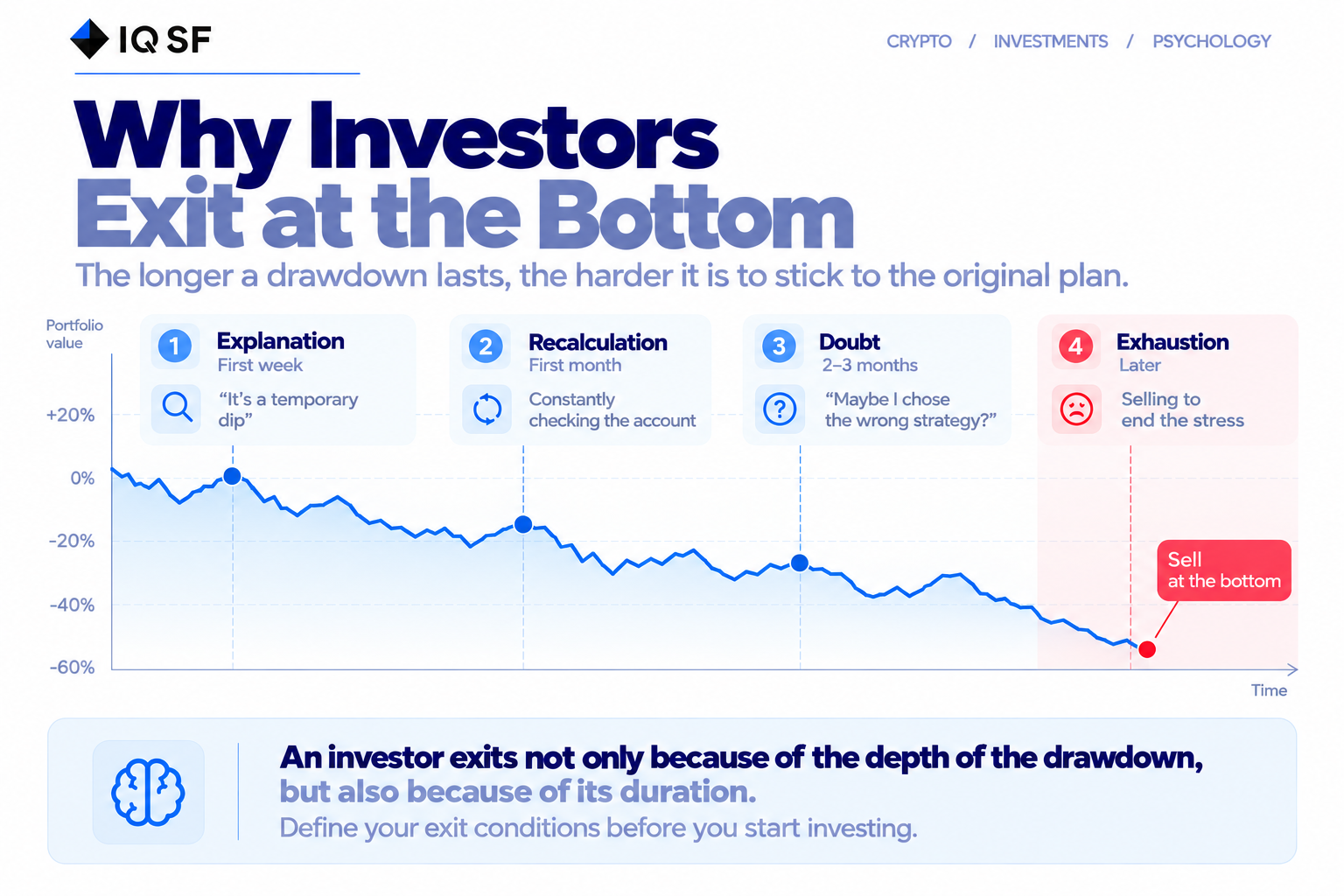
Week one: explanation. The investor looks for a reason and finds one. The market, the news, seasonality. An explanation is calming and permits doing nothing. Decisions at this stage are usually sound, because the resource is still there.
Month one: recounting. Frequent account checking begins. Every refresh is a micro decision, and each one spends a little of the available resource. The first distortion appears here: the more often you look, the more fluctuation you see, and the worse things feel at identical numbers.
Months two and three: doubt. The question shifts from “what is happening in the market” to “did I choose wrong”. Comparisons with other people’s results appear here, and they are almost never in your favour, because you will compare yourself with whoever is doing well right now. Those doing badly are simply not in view: they are quiet.
After that: depletion. The decision is made in order to stop thinking about it. It will be phrased rationally, usually as “I have revised my approach”, but the cause is no longer rational.
The unpleasant part of this sequence is that depth matters less than duration. A twenty percent fall recovered in a month is easier to live through than a ten percent one that drags on for six. Depth acts on the first stage; duration acts on all the rest.
Three biases that amplify the effect
Recency. Recent events feel more important than distant ones. After three bad months, the sense that “this is how it will be from now on” appears regardless of what a multi year history shows.
Survivors in view. You see the results of those who publish them. Those who publish are usually the ones doing well. So the average result around you always looks better than yours, and that is a property of the sample rather than an assessment of your result.
Endowment. What you already own feels more valuable than it is, until it starts falling. Then the reverse kicks in: you want rid of the source of unpleasant emotion, even though the numbers have not changed.
What actually works
Exit conditions written in advance. Not “if things get really bad” but specific numbers: at what drawdown and after what duration do I reconsider. Written before entry, they act as an external rule rather than a decision that must be made in a poor state.
Limiting how often you check. Daily account checking does not improve results and measurably worsens how you feel. Weekly or monthly removes most of the load and affects decisions not at all: a strategy that requires daily investor intervention is not a strategy.
Position size set by tolerance, not by conviction. The question at entry is not “how much will I earn” but “what drawdown can I sit through without selling”. A position you cannot sit through will not work even if the strategy was right.
Separating decisions from emotion in time. A simple rule: any decision made on a day of sharp movement is postponed twenty four hours. Most of them do not survive the night.
A pre described bad scenario. Before entering, it helps to write down what a normal bad period for this strategy looks like: how many months, what depth, how often it has happened before. Then the bad period, when it arrives, is recognised as expected rather than as catastrophe.
Numbers instead of impressions. The impression left by an equity curve and the actual figures diverge more than people expect. We built IQ Metrics so that facts replace impressions: the service reads operation history through a read only key and computes drawdown, recovery time and the rest itself.
What does not work
Willpower as a plan. The intention to “hold on” is not a process and does not survive month three.
Averaging down without a rule. Adding to a position in a drawdown can be part of a strategy if it is described in advance with sizes and conditions. Adding as a reaction to discomfort is increasing exposure at the worst moment.
Reading news for reassurance. A news stream during a drawdown amplifies recency and adds no information about your strategy.
Switching strategy mid drawdown. Moving to another approach at the point of depletion usually means entering it at its peak, because the one chosen is whichever is doing well right now.
The question to ask yourself before entering
How many consecutive months am I prepared to see a negative balance while doing nothing.
If the honest answer is one month, then a strategy with a historical six month drawdown does not suit you, whatever its returns. This is not a question of courage but of compatibility: the product and your tolerance must match, otherwise someone else gets the result and you get the experience.
In short
Selling at the bottom is the result of exhaustion, not of analytical error. Drawdowns act through duration more than depth.
Three things work: exit conditions written in advance as numbers, position size matched to tolerance rather than conviction, and checking results against data rather than against the impression a chart leaves.
A strategy abandoned at the bottom did not work, however correct it was on paper.
Not an individual investment recommendation. Past performance does not guarantee future returns.