What happens to open positions when you withdraw funds from a crypto strategy

In this article, we’ll explore what happens to open positions when you withdraw funds, what determines exit costs, how immediate and planned withdrawals differ, and what investors should check before investing.
Investors often imagine a withdrawal as a simple process: submit a request and receive the funds. But when a crypto trading strategy has open positions, there is an important process between those two events.
The final value of a withdrawal depends not only on the strategy's reported performance, but also on how and when open positions are closed, market liquidity, slippage, and execution costs.
Understanding this process is especially important for investors evaluating a crypto fund, managed account, or systematic crypto trading strategy.
Why you cannot always simply withdraw your money
Funds held in a trading account are rarely completely idle when a withdrawal request is submitted. Part of the capital may be used as margin or collateral for open positions.
To release that capital, those positions first need to be closed.
Closing a position means executing a new transaction at the current market price, not at the price shown in the previous monthly report.
This leads to an important consequence: the value of an investment at the time of withdrawal will not necessarily equal the value shown in the latest performance report.
The final result is determined when the relevant positions are actually closed. Depending on market movements and execution quality, the difference can be either positive or negative.
What determines the cost of exiting a crypto trading strategy
The cost of closing positions generally consists of three components.
1. Bid-ask spread
Every market has a difference between the best available buying and selling prices.
Crossing this spread creates an execution cost regardless of the size of the position. On highly liquid crypto pairs, the cost may be only a fraction of a basis point. On less liquid markets, it can become materially larger.
2. Market impact
A large order cannot always be executed at the best quoted price.
If the order is significant relative to the available order book liquidity, it consumes several price levels. As a result, the average execution price becomes worse than the price visible at the top of the order book.
Importantly, market impact is nonlinear. Doubling the size of a position can increase execution costs by more than two times.
This is why liquidity and strategy capacity matter when evaluating a crypto asset manager.
3. Timing risk
The alternative to closing a large position immediately is to unwind it gradually.
This reduces market impact, but introduces another risk: the market can move while the position is being closed.
The longer the liquidation process takes, the greater the exposure to price movements during execution.
These three costs cannot all be minimized simultaneously.
Closing immediately increases market impact. Closing gradually reduces market impact but increases timing risk.
The appropriate execution horizon therefore depends partly on market volatility. The more volatile the asset, the more expensive it can become to wait.
Why crypto funds may have a redemption notice period
This is one reason a crypto fund or asset manager may specify a withdrawal or redemption notice period.
A notice period of two weeks or one month can allow positions to be reduced gradually as the trading strategy naturally closes existing trades.
Instead of forcing an immediate liquidation, the manager can incorporate the withdrawal into the normal execution process.
There is an important distinction here: a withdrawal notice period is not necessarily the same as a lock-up period.
In a separately managed account where the exchange account belongs to the investor, the investor may technically be able to terminate access at any time by revoking the manager's API key.
The difference is economic.
With a planned withdrawal, positions can be unwound gradually. With an immediate exit, the investor may bear the full cost of closing them at once.
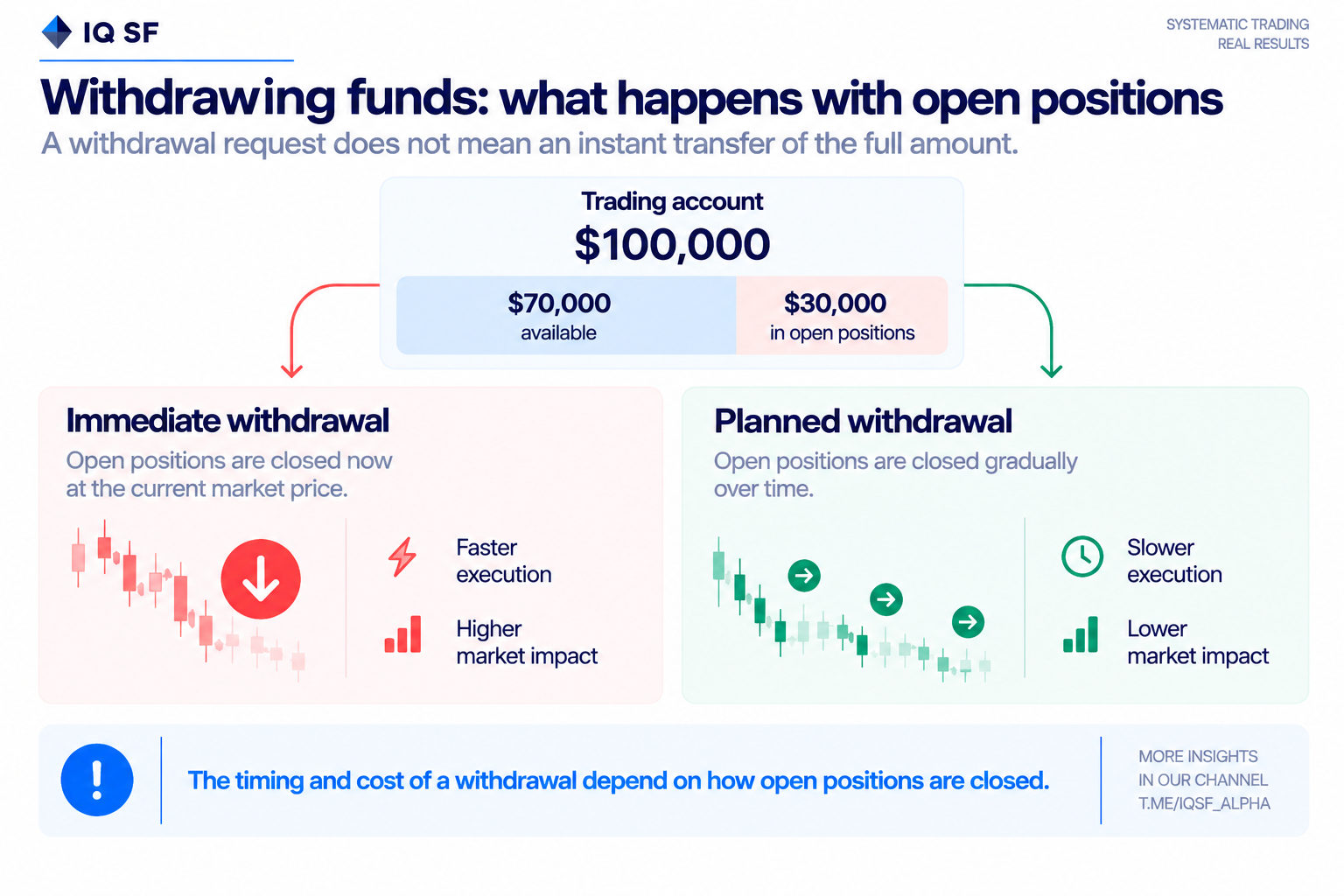
Immediate vs. planned withdrawal: why execution matters
An immediate withdrawal may require open positions to be liquidated at current market prices, potentially increasing slippage and market impact.
A planned withdrawal gives the strategy more time to reduce exposure under normal trading conditions.
This is why two investors leaving the same strategy with the same account balance can theoretically receive different execution outcomes depending on when and how their positions are closed.
For investors, the relevant question is therefore not only:
"How quickly can I withdraw?"
It is also:
"What happens to open positions when I request a withdrawal?"
Who pays the cost of a withdrawal?
The answer should be clearly defined in the investment management agreement.
There are three common structures.
The exiting investor pays
The investor requesting the withdrawal bears the associated execution costs.
This directly links the cost to the decision that created it: one investor chooses to exit, and that investor pays the cost of unwinding the relevant exposure.
Withdrawal costs are shared across investors
In a pooled fund structure, liquidation costs may affect the entire pool.
This creates a potential conflict: one investor makes the decision to withdraw, while other investors may indirectly bear part of the cost.
During periods of market stress, this structure can also create a first-mover advantage, where investors who exit earlier may receive better execution than those who leave later.
The asset manager pays
This may sound more attractive, but the cost does not necessarily disappear.
It may instead be incorporated into management fees or other charges, meaning investors pay for it indirectly over time.
Separately managed accounts work differently
With separately managed crypto accounts, one investor's positions do not have to be liquidated to fund another investor's withdrawal.
Each account is managed independently.
As a result, there is no common redemption queue, and another investor's exit does not directly force trades in your account.
This is one of the structural differences investors should understand when comparing a pooled crypto fund with a separately managed account.
Four things to check before investing
Before allocating capital to a crypto fund or managed trading strategy, clarify four points:
The exact withdrawal notice period. It should be stated in days rather than described as a "reasonable period."
How open positions are closed. Are they liquidated immediately or gradually, and who determines the execution schedule?
Who bears withdrawal and execution costs. The agreement should clearly identify whose account absorbs them.
The typical position size relative to market liquidity. Large positions relative to available order book depth can make exit costs materially more important.
The fourth point is particularly useful when evaluating the liquidity risk of a crypto trading strategy.
If a typical position is large relative to normal trading volume or order book depth, liquidation costs are no longer a minor operational detail. They become part of the strategy's expected economics.
An answer such as "we will decide when the time comes" leaves an important part of the investment structure undefined precisely when an investor may need liquidity most.
Partial withdrawals can be an alternative to a full exit
A partial withdrawal is often overlooked.
Reducing an allocation rather than exiting completely means that only part of the exposure needs to be unwound. This can reduce execution costs while allowing the investor to retain exposure to the strategy and continue observing its performance.
For example, reducing an allocation by half generally requires less market liquidity than liquidating the entire position at once.
Investors should therefore check whether the management agreement permits partial withdrawals and whether a minimum withdrawal amount applies.
A clause requiring withdrawals to be made only in full removes this intermediate option. Any concern then becomes a binary decision between keeping the entire allocation or exiting completely.
The key question for investors
Liquidity is not simply about whether withdrawals are "allowed."
For a trading strategy with open positions, investors need to understand how those positions become cash.
Before investing, the important questions are: How long does the withdrawal process take? How are open positions unwound? What execution costs can arise? Who ultimately bears those costs?
The answers determine the difference between liquidity on paper and liquidity that can actually be realized in the market.
Frequently asked questions
Why can't you simply withdraw your money instantly from a crypto trading strategy?
Because part of the capital is often tied up as margin for open positions, and those positions need to be closed at the current market price before the funds can be released. As a result, the value received at withdrawal is determined when the positions are actually closed, not by the figure shown in the last performance report, and the difference can go either way.
What determines how expensive it is to exit a crypto trading strategy?
Three components: the bid-ask spread, which is paid on every exit regardless of size, market impact, which grows faster than the size of the position itself, and timing risk, which appears when closing is spread out and the market moves during that period. These three cannot all be minimized at once, since closing immediately increases market impact while closing gradually increases timing risk.
Why do some crypto funds require a notice period before withdrawals?
A notice period of two weeks or a month lets the manager reduce positions gradually as the strategy naturally closes trades, instead of forcing an immediate liquidation. This is different from a lock-up: in a separately managed account the investor can typically revoke access at any time, but an immediate exit means bearing the full cost of closing positions at once rather than spreading it out.
What should an investor check before investing regarding withdrawal costs?
Clarify the exact withdrawal notice period in days, how open positions are closed and who sets that schedule, who bears the resulting execution costs, and how large typical positions are relative to market liquidity. It is also worth checking whether partial withdrawals are allowed, since reducing an allocation by half generally requires less market liquidity than closing the entire position at once.