Hedging explained: how funds protect capital
In this article, we’ll explore how hedging works, how investment funds protect capital using futures, options, and offsetting positions, what risk protection costs, and why reducing potential losses often means giving up some potential returns.
Hedging means opening a second position that makes money when your main investment loses value, so a bad outcome hurts less. It works like insurance: you pay for protection with a premium, an interest rate gap or part of your future upside. Below are the main ways to hedge, with examples priced in October 2026 and our own data on the cost of holding perpetual futures.
What is hedging in simple terms?
To hedge is to set up, in advance, a trade that pays off in exactly the scenario you are worried about.
Take a bakery and a farmer. In spring, the bakery agrees on a price for the autumn wheat harvest. If wheat gets more expensive by autumn, the bakery still pays the spring price. If wheat gets cheaper, it overpays, but it knows its costs for the whole year. The farmer, on the other side of the same contract, is protected from a price collapse.
A hedge does not make an investment more profitable. It narrows the range of outcomes: the worst case gets softer, and so does the best case. You do not have to protect everything: hedging half a position leaves you half of both the upside and the downside. That share is called the hedge ratio.
How to hedge: futures, options and offsetting positions
Hedging tools differ in how you pay for protection: futures take away your upside, options cost money upfront, and offsetting positions and diversification protect only partly.
Hedging with futures
Selling a futures contract for the same amount locks in the price of an asset: losses on the asset are covered by gains on the futures, and gains on the asset are eaten by losses on the futures.
An investor holding $100,000 of bitcoin sells $100,000 of bitcoin futures. If the price drops 30%, the coins lose $30,000 and the short futures position gains roughly the same. If the price rises 30%, the opposite happens: the upside goes to whoever bought the futures.
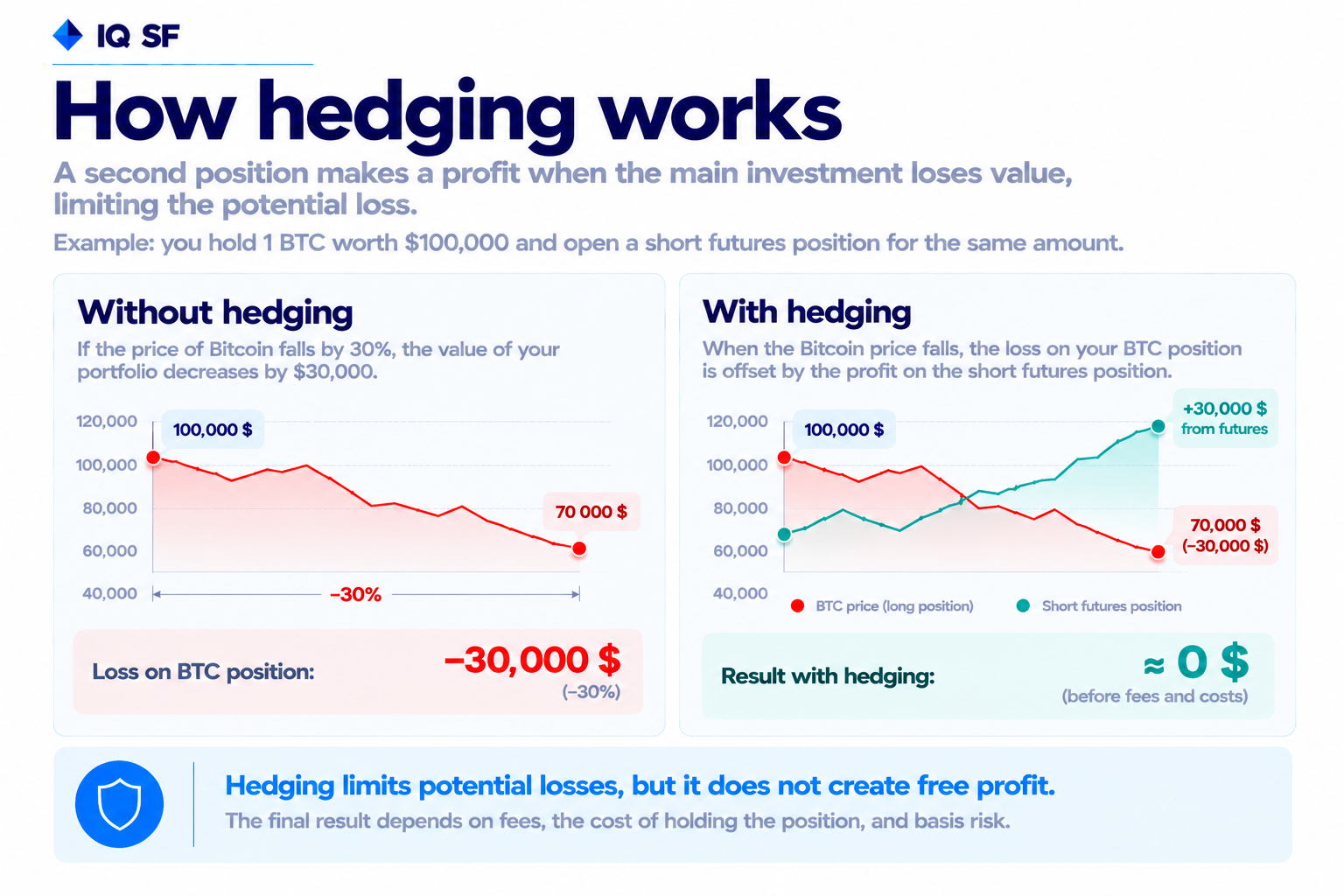
This hedge has two weak spots. Futures require collateral, called margin, and if the price spikes the exchange can force-close the short once margin runs out, even while the asset itself is rising. And futures never track the asset perfectly: the gap is the basis, and the risk of it moving is basis risk.
Hedging with options: the protective put
A put option gives you the right to sell an asset at a preset price. It works like an insurance policy: you pay the premium upfront and keep any upside.
The same holder buys a three-month put with a strike 10% below the current price, so the position is protected below $90,000. By our Black-Scholes calculation at 35% annualized implied volatility, that protection costs about $2,530, or 2.5% of the position. According to CoinDesk, DVOL, the index of bitcoin's expected 30-day volatility, sat around 35 points as of 6 October 2026.
If the price falls 30%, the loss is $12,530 instead of $30,000: $10,000 down to the strike plus the premium. If the price rises 30%, the holder keeps $27,470, which is the whole gain minus the premium.
Options get expensive when the market is scared. At 70% implied volatility the same protection would cost about $8,400, 3.3 times more. Insurance is cheapest when things are calm and most expensive in a panic, exactly when people want it most.
Offsetting positions and diversification
An offsetting position in a similar asset, or plain diversification, protects only partly: it works while assets move differently and weakens in a crisis, when everything falls together.
A fund that owns several bank stocks can short a bank sector index. If the whole sector drops, the second trade covers part of the loss, and the result depends on whether the chosen banks beat the sector. Long-short strategies build on this idea, as we covered in our article on long-short and crypto arbitrage strategies.
Diversification reduces the risk of any single stock or coin, not the risk of the whole market. In 2022 the S&P 500 lost 18.1% including dividends and the Bloomberg US Aggregate bond index lost 13%, even though bonds are supposed to offset stocks. Why owning more assets is not the same as being protected is the subject of our five myths about diversification.
Currency hedging: a euro and dollar example
Currency hedging locks in the exchange rate for a future purchase or sale of a currency, and its price is set by the gap between the two currencies' interest rates.
A US company has to pay a European supplier €100,000 in a year. The ECB reference rate on 5 October 2026 was $1.1204 per euro, so at today's rate that bill is worth $112,040. To remove that risk, the company signs a forward with its bank: a contract to buy euros in a year at a rate fixed today. Plug the rates in force in early October 2026 into the interest rate parity formula, 3.75-4% for the Federal Reserve and 2.50% for the ECB deposit rate, and the one-year forward comes out at about $1.134-1.137, roughly 1.3% above today's rate.
That is not a bank markup: dollars kept until payment day earn more interest than euros, and the forward evens out the difference. Real quotes also depend on the bank's margin, so these figures are an estimate.
The same gap works the other way for a European investor who owns US shares and hedges the dollar back into euros: at these rates the hedge costs about 1.3% a year, while an American hedging European shares picks up roughly the same amount. There is also the natural hedge: an exporter who earns and spends in the same currency barely cares about the exchange rate.
How much does hedging cost?
There is no free hedge: options cost a premium, futures cost you the upside plus margin, currency forwards cost the rate gap, and diversification works worst in a crisis.
On perpetual futures, the cost of holding a position is the funding rate: every eight hours one side pays the other, and the money passes between traders rather than to the exchange. By our calculation across all 7,715 BTCUSDT funding payments on Binance from 10 September 2019 to 24 September 2026, a long position of constant size would have paid 81.42% of its size, including 30.61% in 2021 and 2.15% in 2026 through 24 September. A short position used to hedge bitcoin received those payments more often than it paid them: longs paid in 85.8% of funding rounds. But the market sets the rate. When everyone rushes to go short, funding turns negative and shorts start paying. The lowest rate in seven years came on 13 March 2020, during the crash.
Method | How it protects | What protection costs | What the holder keeps |
Selling futures | Locks in the asset price | Margin, fees, basis; funding on perpetual futures | Neither gains nor losses from price moves |
Buying a put option | Caps the loss at the strike | Premium: about 2.5% for three months in our example, 3.3 times more in a panic | All the upside minus the premium |
Offsetting position | Covers a sector or market drop | Loss on the second trade if it goes wrong | The difference between two assets |
Diversification | Cuts single-asset risk | Returns below the best asset in the portfolio | Market-wide risk |
Currency forward | Fixes the rate for a future deal | The rate gap: about 1.3% a year for euro and dollar in October 2026 | A known rate, without gains from its moves |
How funds hedge risk
Funds usually do not hedge everything: they choose which risk to protect against, how much of it and at what price, and they limit the rest through position size.
Four techniques are common. Market neutrality: long positions in some assets and short positions in an index, so the result depends on picking assets rather than on market direction. Tail hedging: cheap options far from the current price that expire worthless for years and pay off in a rare crash. Partial currency hedging of investments held in another currency. And limits: caps on any single asset, on leverage and on drawdown, beyond which positions get cut.
Hedging makes sense when there is a specific date and amount: a payment in another currency, a harvest to sell, an obligation to meet. When the horizon is long and there is no date, a hedge turns into a running cost: buying the put from our example every quarter at the same volatility would cost about 10% of the position a year. For a private investor, the cheapest way to limit risk is position size: an amount you can comfortably leave alone for several years does not need insurance against every swing.
This material is for information only and is not individual investment advice.
Frequently asked questions
What is hedging in simple terms?
Hedging means opening a second trade that makes money if your main one starts losing, such as selling futures on an asset you own or buying a put option on it. The loss in a bad scenario gets smaller, but so does the gain in a good one.
Is hedging the same as insurance?
In spirit, yes: you pay now to limit a loss later. Insurance is bought from an insurer, while a hedge is built with a market trade. A futures hedge also takes away your upside, which an insurance policy never does.
How much does it cost to hedge?
In our example, a three-month put protecting against a drop of more than 10% cost about 2.5% of the position at 35% volatility, and a one-year euro forward came out about 1.3% above the spot rate at October 2026 interest rates. Futures need no upfront payment, but they take away the upside and require margin.
Can you hedge crypto?
Yes, with the same tools: dated and perpetual futures and options. The price of such a hedge moves with the market: by our calculation, bitcoin funding cost a long position 30.61% of its size in 2021 and 2.15% in 2026 through 24 September. A separate risk is that the hedge lives on a trading venue, and that venue's problems become your hedge's problems.