Trading robot: How it works and when to trust it with money
In this article, we’ll explore how trading robots work, what risks come with automated trading, and what investors should check before trusting an algorithm with real money.
A trading robot is a program that trades on its own by rules written in advance: it reads prices, checks conditions and sends orders to an exchange or broker with no human involved. Trust it with money only after checking its real trade history at your own fee level, with a loss limit known in advance: a robot guarantees nothing and simply executes its rules.
How does a trading robot work?
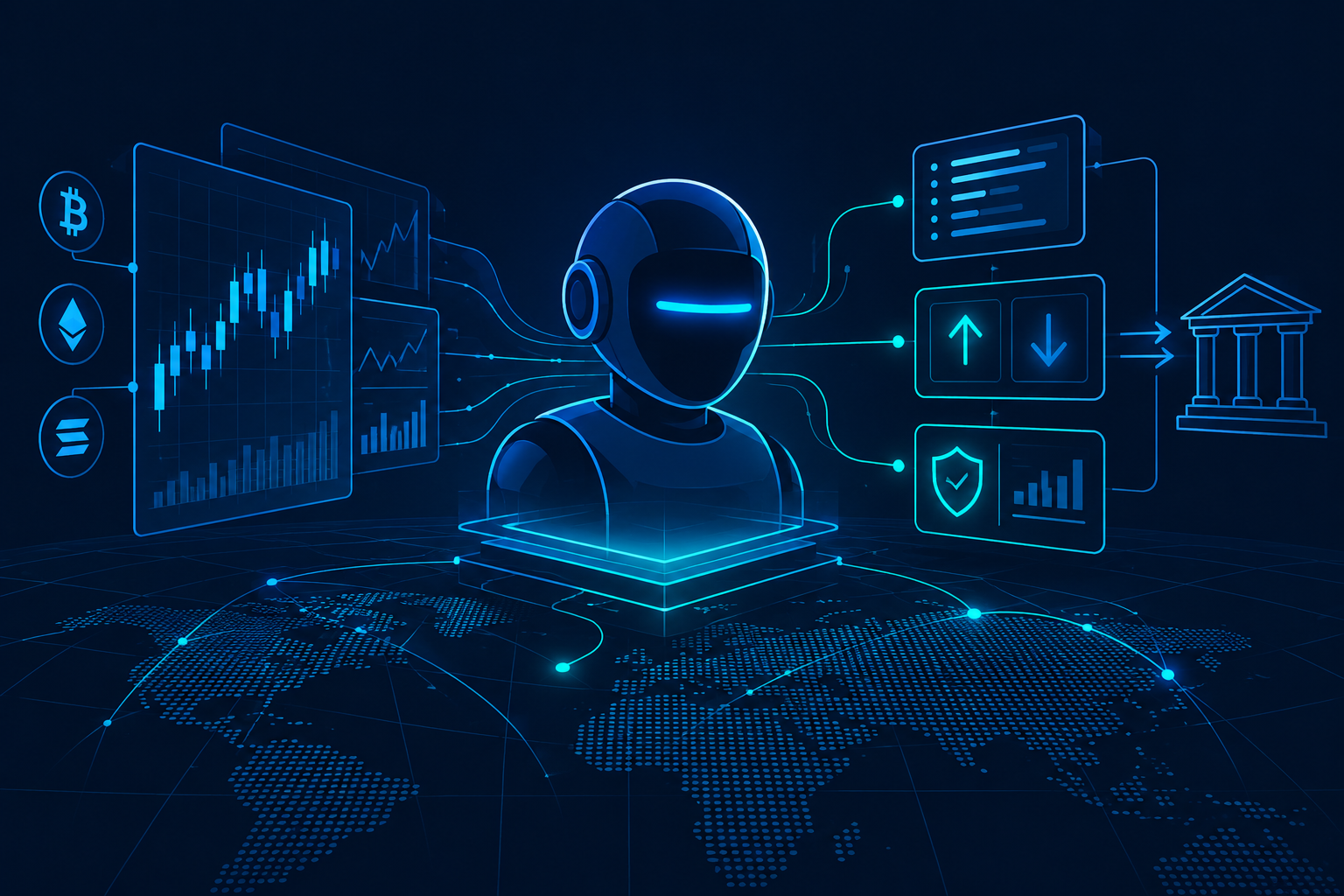
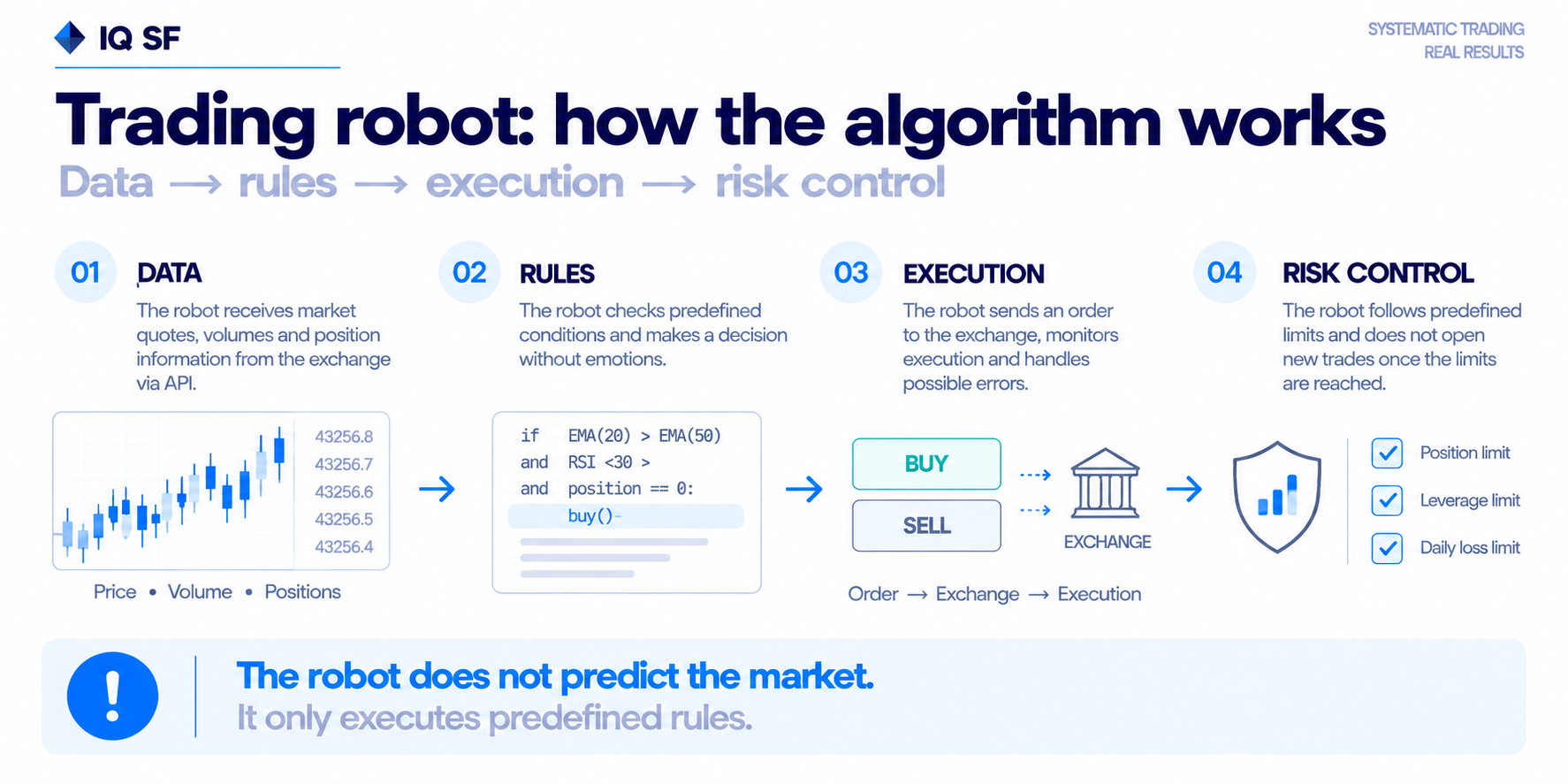
A trading robot works like an autopilot built from four blocks: data, rules, execution and risk limits. Without any one of them, the program stops trading or trades blind.
1. Data. Prices, volumes and position status come from an exchange or broker via an API (application programming interface) or a trading terminal.
2. Rules. Entry and exit conditions are unambiguous: "if A and B are true, buy this much". The program does no guessing.
3. Execution. The robot sends an order, checks the fill price and knows what to do if the exchange rejects it.
4. Risk limits. Caps on position size, leverage and daily loss that stop new trades.
Think of cruise control: it holds speed better than a driver but cannot see a closed bridge ahead. A robot is just as blind to news and outages missing from its rules. Why most trading bots fail to generate sustainable returns is covered separately.
Types of trading bots
By origin, trading robots fall into three groups: exchange bots, marketplace programs, and robots written to order or by yourself. The group decides what you can check before launch and who answers for a mistake.
• An exchange bot (grid, averaging) is set up in a crypto exchange's interface. Only its settings and your past trades can be checked; the main risk is leverage and averaging with no loss limit.
• A marketplace robot from MQL5 Market or similar shows behavior on history, sometimes live monitoring, but under someone else's conditions.
• A custom or self-built robot can be checked down to the source code, but coding and testing mistakes are yours.
By rule type, robots are trend-following, mean-reverting, grid or arbitrage, and the type decides where a robot earns and where it loses.
Trading robot development: steps, languages and paying for an order
Developing a trading robot takes longest at the testing stage: code takes days, proving the rules with real money takes months. A typical path:
1. The rule on paper. "Buy in a strong market" is not a rule; "buy if the price closed above the highest high of the last 20 days" is.
2. Code. MetaTrader 5 robots are written in MQL5; for brokers and exchanges with an open API, usually in Python. Russian brokers offer such APIs too: as of September 2026, the T-Invest API page describes building a fully automatic robot and testing it in a sandbox.
3. Backtest. The rules run through history with fees and slippage; why a beautiful curve rarely repeats is covered in our article on backtests.
4. Demo, then a small amount. A demo account reveals execution errors invisible in history; the first real money reveals actual slippage and rejections.
5. Maintenance. Exchanges change APIs and fees, and servers go down, so someone must read the logs and be able to stop the robot.
The price depends on the rules' complexity. On the MQL5 freelance service (rules as of September 2026), the money is blocked once the specification is agreed, the developer gets it minus a 10% service fee, and disputes are settled by the specification alone, so put loss limits and failure behavior into it.
How to check a trading bot before you buy
Judge a trading robot by its real trade history under your own conditions, not by a backtest from the sales page. Seven questions weed out most problems.
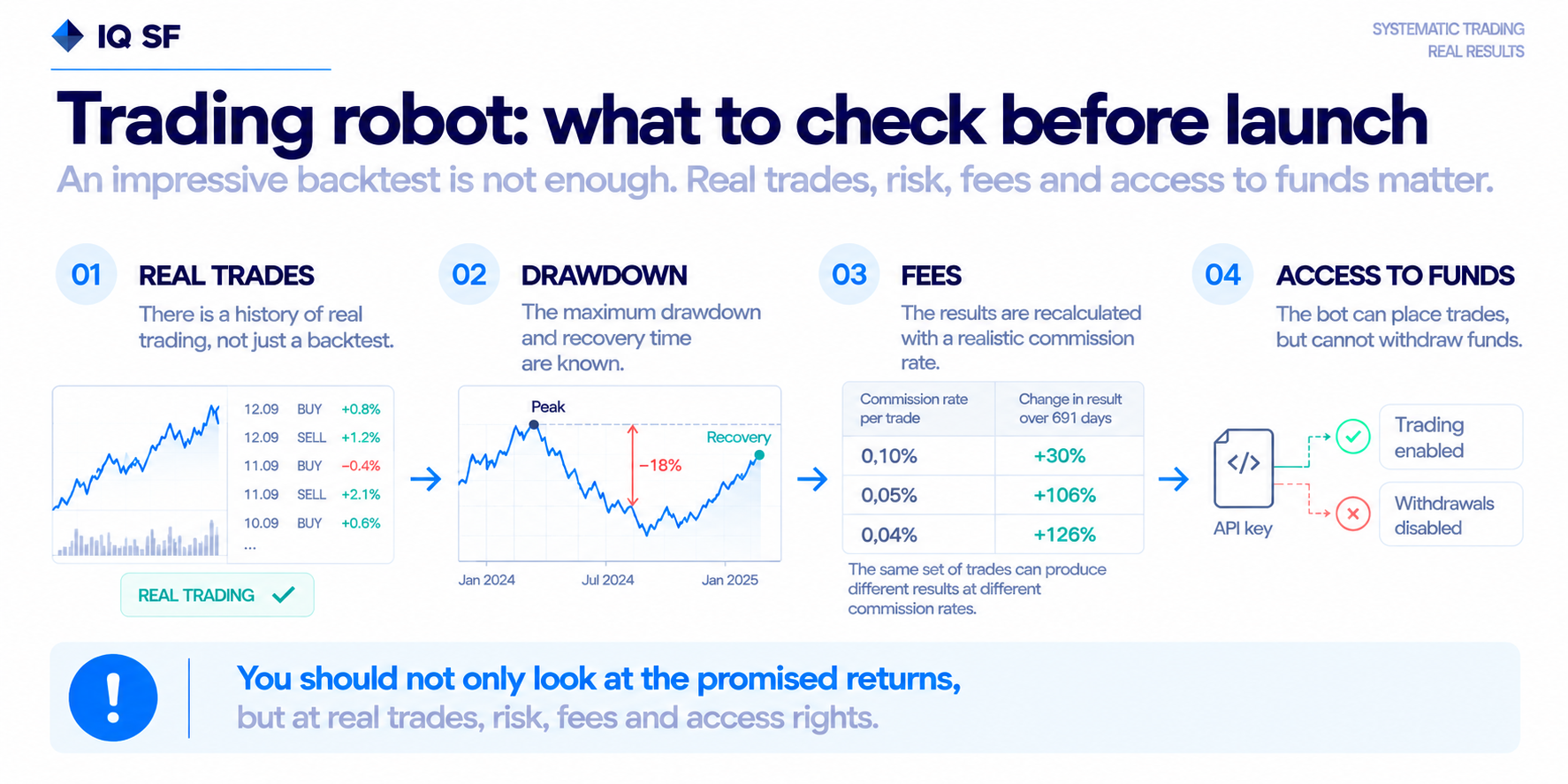
1. Is there live trading beyond the tester? A backtest or demo shows history the author chose; you need live trading through a rally, a decline and a sideways market.
2. Can the statistics be checked at the source? A screenshot proves nothing. Compare with broker or exchange data through a read-only key or a service such as IQ Metrics, which builds statistics directly from exchange data.
3. At what fee level was the result calculated? A few hundredths of a percent change the profit several times over.
4. What is the maximum drawdown and how long was the longest slump? Returns without drawdowns are half the picture.
5. What leverage, and does the robot average down? In our calculation on daily Binance bitcoin candles for 2017-2026, a 10x long opened on a random day without a stop would have been liquidated within a month almost half the time (47.3%). An averaging robot buys against the move, growing its position with each purchase; a smooth chart with rare but deep dips often means exactly that.
6. How many trades? Twenty trades can go well by chance; conclusions about rules need hundreds.
7. Where is the money and what can the key do? The money stays in your own broker or exchange account, and the robot's API key should allow trading but not withdrawals and be tied to the server's address.
Fees change the profit several times over: our test on 2,900 trades
The same trades of one algorithmic strategy produced from +30% to +126% over 691 days, and the only difference was the fee rate. We recalculated the trade log of the Basket 50 strategy at different rates: 2,900 executions in bitcoin and ether from September 5, 2024 to July 28, 2026.
Fee per execution | Change over 691 days | Fees over the period, % of average capital |
0.100% (a rate typical of intermediaries in the CIS) | +30% | 88% |
0.050% (Binance) | +106% | 44% |
0.040% (Binance VIP 2) | +126% | 35% |
The fee is charged on every execution, so the more a robot trades, the more its result depends on the rate. Redo a seller's VIP-fee result at your own rate.
Trading bots that work: can you trust one with your money?
You can trust a robot with money when you know in advance how much it can lose and how long a slump can last, and you are ready to sit through it. An algorithm takes emotions out of trading, but not drawdowns.
IQSF strategies are algorithmic: a program makes the trades by set rules. As of September 27-28, 2026, all three strategies Basket 50, Basket 70 and Quantum Alpha, are in the deepest and longest drawdown of their panel period, and none has ended. Even the calmest, Quantum Alpha, with a drawdown of only -3.94%, has been below its previous peak for 298 days. Past results do not guarantee future results.
If a robot seller shows nothing but growth, either the robot has not met its bad period yet or that period is missing from the report.
Who answers when something breaks? With a purchased robot, you answer for the server, keys and emergency stop. When a professional team runs a strategy, that is their job, and yours is to read the reporting and check it against exchange data.
This material is for information only and is not individual investment advice.
Frequently asked questions
Do trading bots actually work?
A bot works exactly as well as its rules and their testing. Trading bots that work have a verifiable live history, a known maximum drawdown and results calculated at the fees you will pay; a bot with only a backtest has proved nothing yet.
How much money can you make with a trading bot?
Nobody knows in advance, the seller included. It depends on the rules, the market, fees and leverage: in our recalculation, the same 2,900 trades cost 88% of average capital in fees at 0.1% and 35% at 0.04%. A promised fixed monthly percentage is advertising.
Are trading bots a scam?
The program itself is not a scam: brokers and exchanges provide APIs so that clients can run their own robots. The scam is what gets sold under the robot label: a fixed "monthly" return, transfers to a "project" wallet, rewards for bringing in friends. These are the marks of a Ponzi scheme, so check such a company against your regulator's warning list.