Stablecoins explained: USDT, USDC and their risks
In this article, we’ll explore how stablecoins work, what sets USDT and USDC apart, how their reserves and regulation differ, why even dollar-pegged tokens can lose value, and what risks investors should consider.
A stablecoin is a cryptocurrency whose price is pegged to another asset, usually the US dollar, so that one token should always be worth $1. The peg is held up by the issuer's reserves or by collateral, which is why the real risk of a stablecoin lies not in price swings but in who backs it and with what. Below: how USDT and USDC work as of October 2026, when stablecoins have lost their peg, and how the US and the EU regulate them.
What is a stablecoin in simple terms?
A stablecoin works like a digital IOU: the issuer takes in dollars, mints the same amount of tokens and promises to buy them back at $1.
The issuer invests the money it receives in reserves, mostly short-term US Treasury bills, and keeps the interest. Tokens move freely between wallets and trading platforms, but only the issuer turns them back into dollars, and only for verified customers. According to Tether's website as of October 2026, its minimum redemption is $100,000, the fee is 0.1% or at least $1,000, and identity verification costs $150 paid in tokens. Everyone else sells stablecoins on the market, where the price can drift away from a dollar.
In crypto markets stablecoins play the role of dollars: prices are quoted in them, and traders move between coins through them. A stablecoin itself is not meant to grow in value. Its whole job is to stay at exactly one dollar.
Types of stablecoins: fiat-backed, crypto-backed and algorithmic
Stablecoin types differ in what stands behind the peg: cash and government bonds, crypto collateral with a safety margin, or nothing but an algorithm.
• Fiat-backed (USDT, USDC): reserves held in dollars and government bonds. The risk sits with the issuer and with the banks that hold the reserves.
• Crypto-backed (DAI): tokens are minted against crypto collateral worth more than the tokens issued. If the collateral falls fast, it is sold off automatically, and in a crash the mechanism may not keep up.
• Algorithmic (UST): no backing at all, the peg is held by minting and burning a second token. The design works while people trust it and collapses when they stop.
USDT: reserves, audit and frozen addresses
USDT is the largest stablecoin: as of 30 June 2026 there were $183.6 billion of tokens in circulation, and the reserves of its issuer, Tether, exceeded its liabilities by $4.11 billion.
These figures come from the quarterly attestation by the accounting firm BDO. At the end of March the buffer was $8.23 billion, so it halved in a single quarter. The reserves included about $115 billion in US Treasuries, more than 146 tons of gold worth $18.8 billion, and 98,932 bitcoin.
An attestation confirms what the reserves look like on one date, while an audit checks a full year of financial statements, transactions and internal controls. In August 2026 Tether said KPMG had completed the first full audit of its 2025 financial statements and issued an unqualified opinion; according to the company, reserves exceeded liabilities by $6.814 billion at the end of 2025. How to check the reporting and audits of anyone who handles other people's money is covered in our guide on how to verify a fund or asset manager.
The issuer can also freeze tokens at any address. On 23 April 2026 Tether froze $344 million on two addresses at the request of OFAC, the US Treasury's sanctions office, and US law enforcement; by then, according to the company, it had frozen more than $4.4 billion in total. Frozen tokens stay visible on the blockchain, but nobody can move them.
USDC vs USDT: what is the difference?
USDC is issued by Circle, a US company: there are fewer tokens in circulation than USDT, but the reserves are simpler and get checked every month.
As of 30 June 2026 there were $73.3 billion of USDC in circulation. Most of the reserves sit in the Circle Reserve Fund, an SEC-registered money market fund managed by BlackRock, and the rest is cash at banks. A Big Four accounting firm confirms the reserves every month, and Circle itself, as a company listed on the New York Stock Exchange, files reports with the SEC. Circle can freeze tokens at an address too.
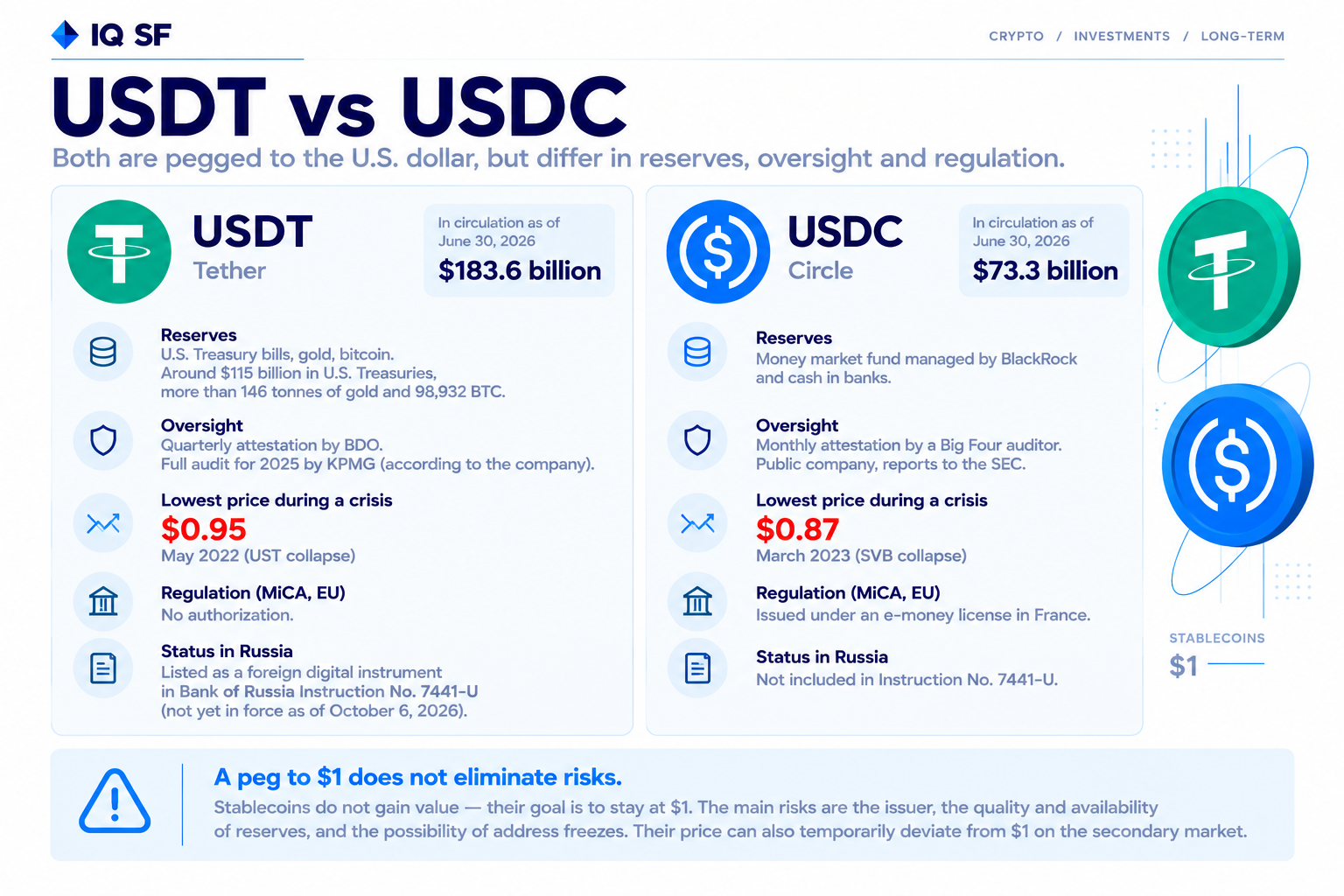
USDT | USDC | |
Issuer | Tether | Circle, US |
In circulation on 30 June 2026 | $183.6 billion | $73.3 billion |
Reserves | $115 billion in US Treasuries, $18.8 billion in gold, bitcoin | Money market fund managed by BlackRock, cash at banks |
Checks | Quarterly BDO attestation; KPMG audit of 2025, per the company | Monthly attestation by a Big Four firm, SEC filings |
Depeg in a crisis | $0.95 on 12 May 2022, UST crash | $0.87 on 11 March 2023, SVB failure |
EU status under MiCA | Not authorized | Issued under a French e-money licence |
Can freeze addresses | Yes | Yes |
When stablecoins lose their peg
A stablecoin loses its peg when holders stop believing they can swap the token for a dollar, and that has happened even to the largest ones.
USDC in March 2023
On 10 March 2023 Silicon Valley Bank failed while holding $3.3 billion of USDC's roughly $40 billion in reserves. On 11 March USDC traded at 87 cents, and it returned to a dollar on 13 March, after US authorities promised that all of the bank's depositors would be made whole. The reserves were never lost, but part of them was out of reach for a weekend, and that was enough for a panic.
The UST collapse in May 2022
UST held its peg through an algorithm tied to the LUNA token, and demand for it was fuelled by the Anchor protocol, which paid up to 19.5% a year. From 7 May 2022 holders rushed for the exit; on 11 May UST fell below 30 cents, and it never returned to a dollar. Together with LUNA, about $40 billion was wiped out, according to US prosecutors. In December 2025 Terra's founder Do Kwon was sentenced by a US court to 15 years in prison. A high rate on a "digital dollar" raises the first question from our seven signs of a Ponzi scheme: where does the return come from?
Beyond depegs, a fiat-backed stablecoin carries issuer risk, when reserves turn out smaller than claimed or out of reach, and the risk that an address gets frozen.
Stablecoin regulation in the US and the EU
The US and the EU now have dedicated stablecoin rules: reserves held one to one in safe assets, regular public disclosure and a licence for the issuer.
In the US, the GENIUS Act was signed on 18 July 2025. A payment stablecoin must be backed one to one by dollars, insured deposits, short-term Treasuries, Treasury repos and money market funds holding such assets. The issuer publishes its reserve composition every month, an independent accountant examines each report, and paying holders interest or yield is prohibited. The law takes effect 18 months after enactment, on 18 January 2027, or 120 days after final regulations are issued, whichever comes first.
In the EU, stablecoins have been regulated under MiCA since 30 June 2024. Circle received an e-money licence in France on 1 July 2024, so USDC is issued under MiCA. Tether did not seek authorization, and MiCA-licensed platforms no longer offer USDT to clients in the European Economic Area, although holding and transferring it is still allowed. On 30 September 2026 ESMA, the EU markets regulator, asked the European Commission to go further and ban custody and transfer services for non-compliant stablecoins as well; for now this is a proposal, not law.
This material is for information only and is not individual investment advice.
Frequently asked questions
What is a stablecoin in simple terms?
A stablecoin is a cryptocurrency pegged to the dollar or another asset, so one token should be worth, for example, exactly $1. The peg is held up by the issuer's reserves in cash and government bonds, by crypto collateral or by an algorithm. The two largest, USDT and USDC, are backed by reserves.
What is the difference between USDT and USDC?
The issuer, the size and how reserves are checked. As of 30 June 2026 there were $183.6 billion of USDT and $73.3 billion of USDC in circulation. USDT reserves include gold and bitcoin besides Treasuries and are attested quarterly; USDC reserves sit in a money market fund and bank cash and are attested monthly.
Can USDT lose its peg?
Any stablecoin can drift away from the dollar: USDT dipped to $0.95 on 12 May 2022, and USDC to $0.87 on 11 March 2023. Both returned to a dollar within days, while the algorithmic UST never did. A separate USDT risk is that the issuer can freeze tokens at a specific address.
Are stablecoins regulated?
Yes, in the largest markets. The US GENIUS Act, signed on 18 July 2025, requires one-to-one reserves and monthly disclosure and bans paying interest to holders; it takes effect no later than 18 January 2027. In the EU, stablecoins have been regulated under MiCA since 30 June 2024: USDC is authorized there, USDT is not.